
ISO 1513:2010 Explained: The International Standard for Paint & Varnish Sample Preparation
ISO 1513:2010 Explained: The International Standard for Paint & Varnish Sample Preparation
In the world of coatings, the final test result is only as reliable as the sample it was measured from. A state-of-the-art laboratory can produce highly precise data, but if the initial paint sample was not properly examined, homogenized, and prepared, those results are rendered meaningless. This critical, foundational step is governed by one of the most important standards in the industry: ISO 1513:2010 – Paints and varnishes — Examination and preparation of test samples.
This international standard is the universal rulebook for the very first stage of quality control. It dictates how to take a sample from its container, assess its initial condition, and homogenize it perfectly before any other physical or chemical tests are performed. It ensures that the small portion of paint being tested is a true and accurate representation of the entire batch.
Understanding and correctly implementing this standard is non-negotiable for achieving trustworthy quality assurance. As a leading accredited inspection body headquartered in Lucknow, we at TNV Inspection Body provide expert, impartial verification of these crucial procedures, ensuring that your quality control process is built on a foundation of integrity.
What Exactly is ISO 1513:2010?
ISO 1513:2010 is the international standard that specifies the procedures for the preliminary examination of a single paint or varnish sample, and the subsequent steps for preparing a test sample by blending and reducing the initial sample to a manageable, uniform quantity ready for testing.
The Critical Importance of Standardized Sample Preparation
Adherence to ISO 1513 is not merely a procedural formality; it is a strategic commitment to accuracy and quality that delivers tangible benefits.
- Ensures Test Reliability: It eliminates the single biggest variable in paint testing—an inconsistent sample. This ensures that test results are accurate and repeatable.
- Guarantees True Quality Control: By starting with a representative sample, manufacturers can be confident that their quality control tests reflect the true state of their production batch.
- Builds Unshakable Customer Trust: Verifying that your sample preparation follows this global standard provides profound confidence to your customers that your quality claims are backed by rigorous processes.
- Prevents Costly Errors and Disputes: It prevents false-passes of bad batches and false-fails of good ones, reducing waste, rework, and commercial disputes between suppliers and buyers.
A Detailed Breakdown of the ISO 1513:2010 Procedure: A Step-by-Step Guide
ISO 1513 breaks down the process into clear, methodical steps. Following these is essential for compliance.
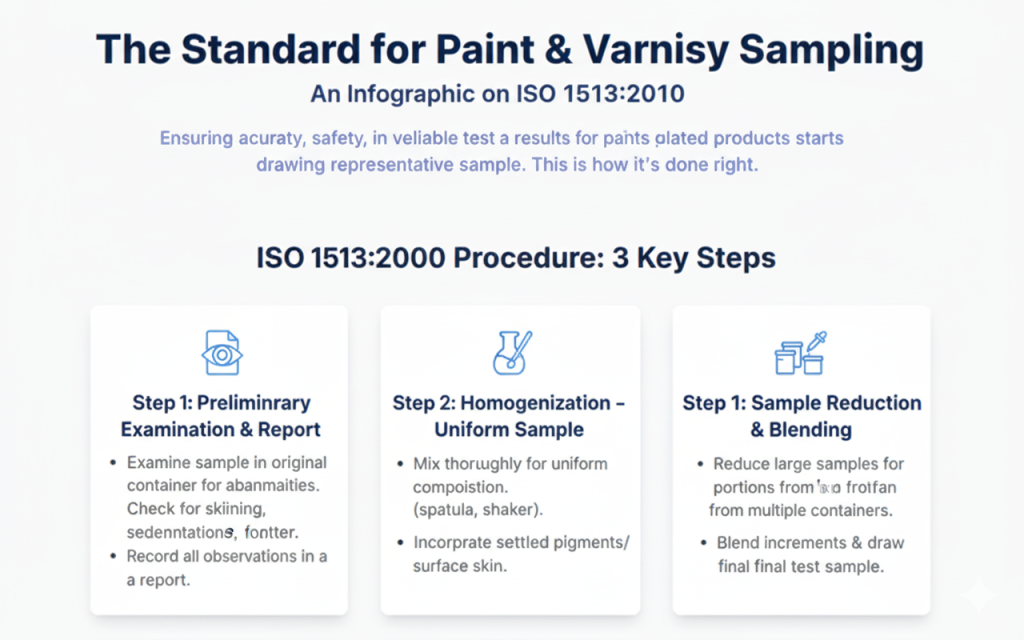
Step 1: The Preliminary Examination & Report
Before anything is mixed, the sample must be examined in its original container.
- What to Check: The inspector or technician looks for abnormalities like skinning (a solid layer on the surface), sedimentation (pigment settling at the bottom), the presence of foreign matter, and phase separation (gelling or liquid separation).
- How to Write the Report: All these observations must be recorded in a preliminary examination report. This report is a critical piece of documentation that provides context for the subsequent test results. For example, if heavy sedimentation was noted, it could explain certain performance issues later on.
Step 2: Homogenization – Achieving a Uniform Sample
This is the process of mixing the sample to ensure every part of it has the same composition.
- Required Equipment: This requires tools that will not contaminate the sample, such as a broad-bladed stainless steel spatula for manual mixing or a mechanical shaker for larger or more viscous samples. The key is to thoroughly incorporate any settled pigments or surface skin back into the liquid.
- Understanding Homogenization vs. Thixotropy:
- Homogenization is the goal: making the sample uniform throughout.
- Thixotropy is a property of some paints where they become thinner when stirred or agitated and thicken when left to rest. The homogenization process must account for this, ensuring the paint is mixed sufficiently to break down its thixotropic structure for accurate testing, especially for viscosity.
Step 3: Sample Reduction & Blending
If the original sample is too large for laboratory testing, it must be reduced to a smaller size without altering its composition.
- Procedure: After thorough homogenization, a representative portion is taken. For multi-container samples (e.g., a batch delivered in several drums), increments are taken from each and blended in a larger container before a final, smaller test sample is drawn.
How to Align with ISO 1513:2010 in Your Laboratory
Achieving alignment with this standard requires a systematic approach to your quality control.
- Adopt the Procedure: Make the steps of ISO 1513 the official, documented procedure for all incoming and in-process samples.
- Use the Right Equipment: Invest in non-reactive spatulas, calibrated mechanical shakers, and clean, airtight containers for sample storage.
- Train Your Personnel: Ensure every lab technician understands not just the steps, but the reasons behind them—especially the importance of avoiding contamination.
- Document Everything: Maintain meticulous records, including the preliminary examination report for every sample.
Navigating Common Challenges in Sample Preparation
- Hard Sedimentation: When pigment has settled into a hard cake, manual mixing is not enough. ISO 1513 requires noting this and using mechanical shakers to fully re-incorporate it.
- Surface Skinning: A dried film on top must be carefully removed before mixing to prevent dried flakes from contaminating the final liquid sample.
- Highly Viscous Materials: These can be difficult to homogenize. The standard allows for gentle heating or more powerful shakers, provided these methods are recorded and do not alter the sample’s properties.
Who Verifies Conformance? The Role of Independent Inspection
An organization cannot get “certified” to ISO 1513:2010. Instead, a laboratory’s procedure is audited for its alignment with the standard, and an inspection body can be accredited to verify these procedures.
This is where TNV plays a crucial role. As a UAF-accredited inspection body, our expert inspectors witness your sample preparation process, providing an independent, third-party verification that your methods conform to the ISO 1513 standard. This verification provides an unparalleled level of assurance to your customers that your quality control process is sound from the very first step.
Partner with TNV for Unquestionable Procedural Integrity
In the competitive coatings market, proving that your quality control is robust from start to finish is a powerful advantage. Independent verification of your sample preparation process provides the ultimate confidence that your test results are accurate and trustworthy.
Contact Us
For professional, accredited, and globally recognized inspection services, Contact TNV Inspection Division today.
- Email: info@tnvib.com
- Website: www.tnvib.com
- Address: B-1/19/69 Sector K, Aliganj, Lucknow, UP 226024, India
Ensure accuracy and integrity in your coatings quality control with TNV Inspection Division—your trusted ISO 17020-accredited inspection partner!