
ISO 4706:2018 – Refillable Welded Steel Gas Cylinders
The humble LPG cylinder is a mainstay of millions of homes and businesses across India and the world as a trusted source of energy. Yet, this unassuming item is an intricately designed pressure vessel capable of safely housing a flammable substance under a high-pressure environment. We trust it because of the intense design, manufacturing, and testing standards that go into it.
ISO 4706:2018 – Gas cylinders — Refillable welded steel cylinders — Test pressure 60 bar and below, is the international standard that regulates the entire process. It is the international reference document for the safety, soundness, and reliability of the steel gas cylinders used for LPG (Liquefied Petroleum Gas) around the world. Therefore, it is imperative for anyone in the LPG supply chain to understand this standard.
TNV inspection division, an internationally acclaimed accredited inspection body headquartered in Lucknow, India, offers independent verification of these essential manufacturing and testing processes. With an accredited scope in the “Stage-wise and Final Inspection of LPG Cylinder Manufacturing,” we are well-equipped to ensure the safety of the public.
Understanding the Standard: Key Objectives of ISO 4706
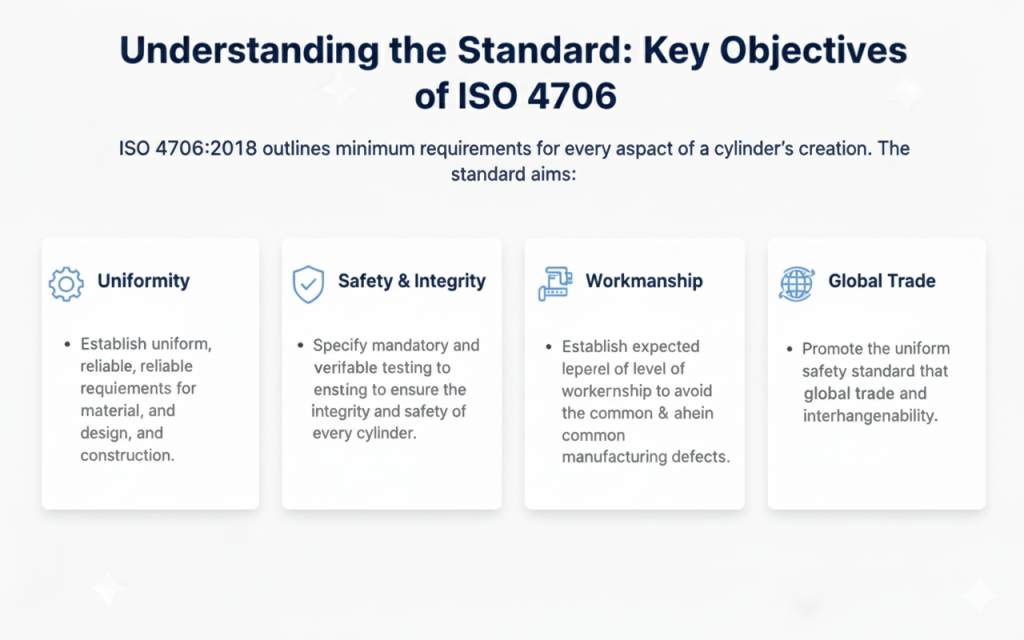
ISO 4706:2018 outlines minimum requirements for every aspect of a cylinder’s creation. The standard aims to:
- Establish uniform, reliable requirements for material, design, and construction.
- Specify mandatory and verifiable testing to ensure the integrity and safety of every cylinder.
- Establish the expected level of workmanship to avoid common manufacturing defects.
- Promote a uniform safety standard that enables global trade and interchangeability.
Why This Standard is the Foundation of Safety and Reliability
Adhering to ISO 4706 is a deep commitment to both public safety and the integrity of the product.
- Ensures Public Safety
This is the number one goal. The standard’s qualification requirements and test standards are strict and intended to eliminate catastrophic failures, such as leaks or ruptures during service. - Guarantees Product Stability
It ensures that the design remains consistent over time, and that cylinders can withstand stress and be refilled more than a hundred times, safely and soundly. - Creates Trust That Cannot Be Shaken
For cylinders that are manufactured and certified according to ISO 4706, consumers, gas companies, and safety authorities develop the highest level of confidence. - Provides Access to the Global Market
Compliance with this international standard is a prerequisite for manufacturers who wish to sell their cylinders on the global market.
Core Principles: An Engineering and Quality Foundation
The standard is built on core principles that aim to ensure a vessel can safely withstand repeated high-pressure exposures throughout its service life.
- Striking the Structural Integrity
The primary aim is to ensure that the cylinder can sustainably contain its contents. This involves managing the steel quality, wall thickness design calculations, and pipeline weld integrity. - Build it in, Not Inspect it out
The standard requires quality to be built-in at every stage, not simply inspected at the end. This includes:- Employing materials with known properties and certification.
- Using qualified welding procedures and certified welders.
- Performing critical post-weld heat treatment to ensure the steel is not brittle.
Mandatory Manufacturing and Testing Specifications
ISO 4706 outlines the key requirements to be satisfied in both manufacturing and testing.
Material and Design Requirements
The standard specifies the use of particular weldable steels with known strength and ductility properties. The wall thickness of the cylinder and the geometry of its domed ends must be designed to resist stresses far above its working pressure.
Key Manufacturing Requirements:
- Welding Integrity
The longitudinal and circumferential welds are the most critical parts. These welds must be executed under an approved Welding Procedure Specification (WPS) and performed by certified welders. Radiographic (X-ray) examination should be conducted to ensure weld quality. - Heat Treatment
Each cylinder must undergo a heat treatment procedure after welding (normalizing) to relieve stresses induced during manufacturing. This ensures the cylinder is consistent throughout and features a well-formed crystalline matrix.
Testing Regimen: Ensuring Safety
This is where the standard provides its safety assurance, including both batch and 100% testing.
- Hydrostatic Pressure Test
Every cylinder must undergo a hydrostatic (water pressure) test at a pressure well above its operating pressure. It needs to be leak-free and not deform after the test. - Burst Testing
A sample of cylinders from each batch is tested to destruction. The burst pressure must be several times higher than the established minimum, confirming the ultimate strength of the design. - Mechanical Tests
Test pieces are extracted from the welds of a test cylinder, and subjected to tensile and bend tests to confirm the strength and ductility of the weld.
Marking and Reporting
Every cylinder shall be permanently stamped with the following information for traceability:
- Manufacturer
- Serial Number
- Test Pressure
- Date of Manufacture
Key Stakeholders and Industry Applications
ISO 4706 is essential for a number of stakeholders in the gas and manufacturing industries:
- LPG Cylinder Manufacturers
- Gas Distribution Companies (Oil & Gas Sector)
- National Safety Regulators and Standards Bodies
- Industrial Users of LPG
- Third-party Inspection and Verification Bodies
Applications:
- Domestic LPG Supply:
This standard impacts the broad cylinders used for cooking and heating purposes globally. - Commercial and Industrial Use:
It affects cylinders used in restaurants, workshops, forklifts, and portable heating equipment. - Small Use:
This applies to the tiny portable cylinders used on camp stoves, barbecues, and in recreational vehicles. - Government Tenders & Procurement:
Conformance to ISO 4706 is often required to qualify for public sector contracts.
Why Engage an Accredited Independent Inspection Body?
For higher-risk products such as pressure vessels, an independent third-party inspection company provides the vital link between confidence and trust. An unbiased and objective evaluation by an accredited body adds tremendous value when showcasing safety compliance.
TNV inspection division, under the ISO/IEC 17020 UAF System, can perform this important verification activity. We offer the following services in line with our accredited scope for LPG cylinder manufacturing:
- Design and Material Verification
Verifies the design calculations and ensures the raw materials used comply with the stringent specifications outlined by the standard. - Inspection by Stage
Our inspectors are on-site to observe critical stages such as welding and heat treatment to ensure they follow qualified procedures. - Witness of Testing
We witness the mandatory hydrostatic tests, destructive burst tests, and mechanical tests, confirming that all equipment is calibrated and the results meet the standard’s limits. - Final Inspection and Stamping Confirmation
A final visual and dimensional inspection is performed, along with confirmation that each conforming cylinder is stamped with required traceability information. - Providing Comprehensive Reports
Our written reports document our findings and provide all the necessary information for interested parties.
Contact Us
Contact TNV Inspection Division today for professional, accredited inspection services recognized globally.
- Email: info@tnvib.com
- Website: www.tnvib.com
- Address: B-1/19/69 Sector K, Aliganj, Lucknow, UP 226024, India
Secure the safety and integrity of your pressure vessels in accordance with legal requirements with TNV Inspection Division, your trusted ISO 17020-accredited inspection partner!