
What is an Inspection Body? How It Differs from a Testing Lab and Certification Body
Introduction Why This Confusion Costs Indian Businesses
Every week, Indian manufacturers, exporters, and procurement teams make the same mistake. They need a pre-shipment inspection done and they call a testing laboratory. Or they need a quality certification for a government tender and they hire an inspection body. Or they need regulatory compliance verified for an oil pipeline project and they approach a certification body.
Each of these is the wrong tool for the job.
In India’s growing manufacturing and export economy where government tenders demand verified quality, international buyers insist on accredited inspection reports, and regulators like PNGRB, FSSAI, and RDSO specify exactly what kind of verification they require understanding the difference between an inspection body, a testing laboratory, and a certification body is not just useful. It is essential.
This guide explains clearly what each one is, what they do, how they differ, and when Indian businesses need which one.
What is an Inspection Body?
An inspection body is an independent organization that examines products, processes, services, or installations to determine whether they conform to specified requirements and then issues a formal inspection report or certificate as evidence of those findings.
The key word is independent. An inspection body has no financial or commercial relationship with either the manufacturer producing the goods or the buyer purchasing them. Its only job is to assess accurately and report honestly.
Under ISO/IEC 17020:2012 the international standard governing inspection bodies an inspection body must demonstrate technical competence, impartiality, and consistent operation. Accreditation against this standard by a recognized body such as UAF (United Accreditation Foundation) provides independent proof that these requirements are met.
Related Blog : What is an Inspection Body? A Comprehensive Guide for Manufacturers, Exporters, and Quality Professionals
What Does an Inspection Body Actually Do?
An accredited inspection body like TNV Inspection Division conducts physical on-site examinations. In practice, this means an inspector visits your factory, warehouse, project site, or supplier location and:
- Examines finished goods, raw materials, or components against your specifications
- Checks product dimensions, workmanship, functionality, and packaging
- Verifies quantities against shipping documents
- Reviews technical documentation where relevant
- Conducts or witnesses specialized tests such as NDT (Non-Destructive Testing)
- Takes photographic evidence of all findings
- Issues a detailed inspection report typically within 24 hours with a clear pass or fail result
The inspection report from an accredited body is recognized by buyers, banks, customs authorities, and regulators in India and internationally.
Types of Inspection Bodies Under ISO/IEC 17020
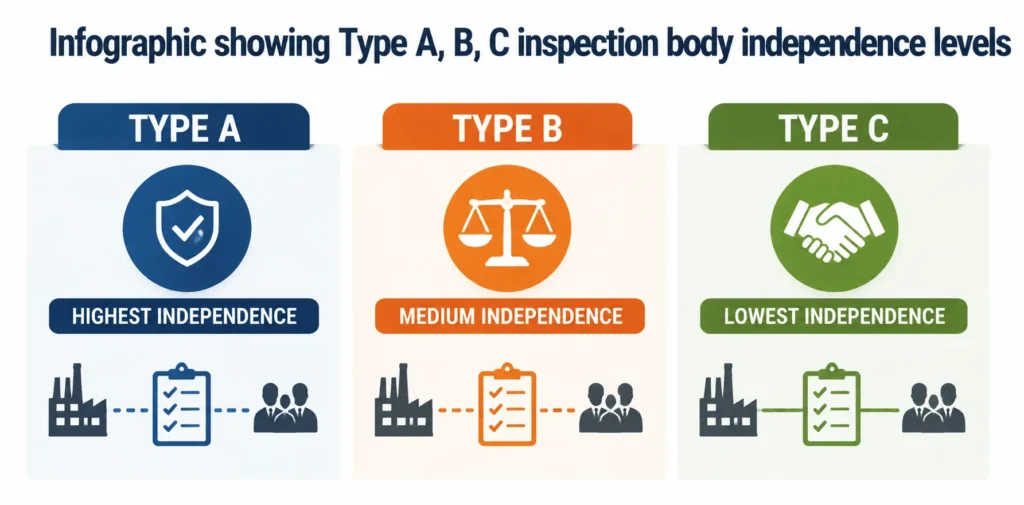
ISO/IEC 17020 classifies inspection bodies into three types based on their level of independence:
- Type A Inspection Body Fully independent. No commercial ties to any manufacturer, supplier, or buyer. This is the highest level of impartiality and the type most trusted by international buyers, banks, and regulatory authorities. TNV Inspection Division is a Type A inspection body.
- Type B Inspection Body Forms part of a larger organization that also designs, manufactures, or supplies products. Operates as a separated unit but within a connected structure.
- Type C Inspection Body Can be involved in design, manufacture, or supply of similar items to those it inspects. Least independent of the three types.
For any inspection involving government tenders, regulated industries like oil and gas, food exports, or railway supply chain, Type A is what Indian businesses need.
What is a Testing Laboratory?
A testing laboratory is a facility that performs specific scientific or technical tests on samples under controlled conditions to measure particular properties, characteristics, or compliance with standards.
A testing laboratory does not come to your factory. It receives samples and tests them in a controlled environment using specialized equipment. It then issues a test report showing the results of those specific tests.
What Does a Testing Laboratory Actually Do?
Testing laboratories in India work primarily in the following ways:
- You send product samples to the laboratory
- Technicians conduct specific tests chemical analysis, mechanical properties, electrical safety, flammability, tensile strength, food composition
- The laboratory issues a test report showing measured results against standard limits
- The report confirms whether the sample passed or failed those specific tests
Testing Laboratories in India Governing Standard
Testing laboratories in India are accredited under ISO/IEC 17025:2017 the international standard for the competence of testing and calibration laboratories. Accreditation is provided by NABL (National Accreditation Board for Testing and Calibration Laboratories) in India, or by international bodies like ILAC members for global recognition.
Important Limitation
A testing laboratory tests a sample you send. It does not visit your factory. It cannot verify that the rest of your production batch matches the tested sample. It cannot confirm quantity, packaging condition, labelling compliance, or workmanship of the actual shipment. That is the fundamental limitation and the reason why inspection and testing often work together rather than instead of each other.
What is a Certification Body?
A certification body is an organization that evaluates whether a company’s management system, product, or personnel meets the requirements of a specific standard and then issues a formal certificate as evidence of ongoing compliance.
Unlike inspection bodies that verify specific products or processes at a point in time, certification bodies assess organizational systems over time. They issue certificates with a defined validity period typically three years and conduct surveillance audits to ensure continued compliance.
What Does a Certification Body Actually Do?
A certification body in India conducts:
- Management system audits evaluating whether your quality, environmental, or safety management system meets standards like ISO 9001, ISO 14001, or ISO 45001
- Product certification confirming that a product type or product line consistently meets defined requirements under ISO/IEC 17065
- Personnel certification evaluating and certifying individual competence under ISO/IEC 17024
The output is a certificate not an inspection report. The certificate states that your organization or product has been evaluated and found to comply with the stated standard for the defined validity period.
Certification Bodies in India Governing Standards
Certification bodies operate under:
- ISO/IEC 17021-1 for management system certification (ISO 9001, ISO 14001, ISO 45001, etc.)
- ISO/IEC 17065 for product and process certification
- ISO/IEC 17024 for personnel certification
In India, accreditation for certification bodies is provided by QCI-NABCB (National Accreditation Board for Certification Bodies) or by internationally recognized bodies like UAF, UKAS, or DAkkS for global recognition.
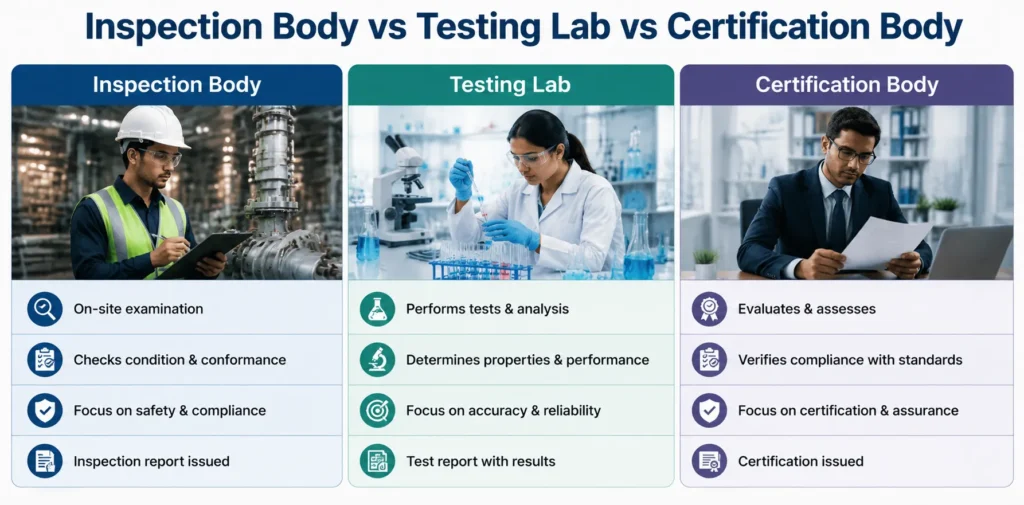
Inspection Body vs Testing Lab vs Certification Body Key Differences
This is where most Indian businesses need the clearest guidance. The three serve different purposes, produce different outputs, and operate under different standards.
|
Feature |
Inspection Body |
Testing Laboratory |
Certification Body |
|
What it evaluates |
Specific products, processes, or installations |
Physical or chemical properties of samples |
Management systems, product types, or personnel |
|
Where work happens |
On-site at your factory, warehouse, or project |
In a controlled laboratory environment |
At your office and facilities during audits |
|
Governing standard |
ISO/IEC 17020:2012 |
ISO/IEC 17025:2017 |
ISO/IEC 17021 / 17065 / 17024 |
|
Output issued |
Inspection report or certificate |
Test report |
Certificate (ISO 9001, ISO 14001, etc.) |
|
Validity of output |
Point-in-time reflects condition at inspection |
Point-in-time reflects tested sample |
Ongoing typically 3 years with surveillance |
|
Indian accreditation body |
UAF, IAS (international) |
NABL (national) |
QCI-NABCB, UAF, UKAS |
|
Independence level |
Type A = fully independent |
Independent of client |
Must be independent of client |
|
Scope |
Individual shipment, batch, site, or process |
Specific test parameters on a sample |
Entire organization or product category |
|
Who requests it |
Buyers, exporters, project owners, regulators |
Manufacturers, brands, R&D teams |
Companies seeking market access or credibility |
|
Example in India |
Pre-shipment inspection before export |
Lab test for BIS certification |
ISO 9001 certification for a factory |
Read Also : Inspection vs Testing vs Certification: Understanding the Differences
When Does Each Apply for Indian Businesses?
Understanding which service you need and when saves time, money, and prevents compliance failures.
Use an Inspection Body When:
You are an exporter whose buyer requires an independent inspection certificate before releasing payment under a Letter of Credit (LC). The buyer wants to know the actual shipment matches what was ordered quantity, quality, packaging, labelling. A testing lab report on a sample does not satisfy this requirement. An accredited inspection body does.
You are supplying to a government project under CPWD, NHAI, Jal Jeevan Mission, Indian Railways (RDSO), or any scheme that specifies third party inspection in the tender. These require on-site verification by an accredited inspection body not a lab test report.
You are in oil and gas and need PNGRB-compliant inspection for pipelines, city gas distribution infrastructure, or LPG storage. PNGRB’s technical codes mandate inspection by qualified third party inspection agencies this is an inspection body function.
You are a procurement team receiving materials at site steel pipes, electrical transformers, structural components, or construction materials and need to verify what arrived matches what was ordered and tested before acceptance.
You need NDT inspection of pipelines, pressure vessels, welds, or structural components during or after construction. NDT is a specialized inspection function carried out on-site by qualified inspection bodies.
Use a Testing Laboratory When:
You need to demonstrate compliance with product standards BIS certification, RoHS compliance, food composition analysis, material grade verification, or electrical safety testing where the standard specifies laboratory testing as the method of verification.
You are developing a new product and need to test its properties, durability, safety, or performance before market launch.
A regulator or buyer requires test certificates for specific parameters fire resistance rating, tensile strength, chemical composition that must be measured in a controlled environment with certified equipment.
You need calibration certificates for measuring instruments used in your production or inspection processes.
Use a Certification Body When:
A buyer, tender, or regulatory body requires your company to hold ISO 9001, ISO 14001, ISO 45001, or another management system certificate. Certification bodies audit your entire quality or environmental management system and issue the certificate.
You need product certification under an official scheme CE marking evaluation, BIS product certification, or an industry-specific product conformity program.
You need to certify personnel welding inspectors, NDT technicians, project managers under a formal personnel certification scheme.
How Inspection and Testing Work Together in India
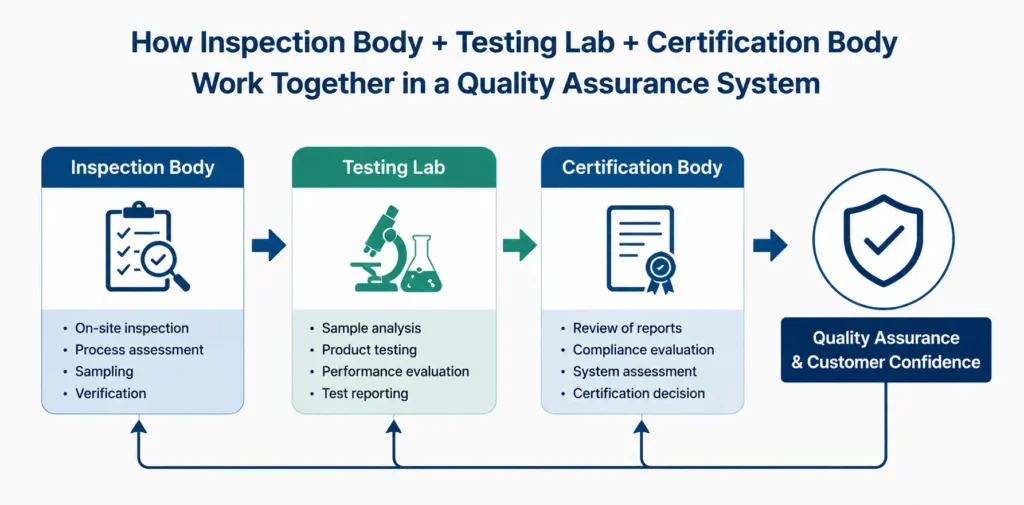
In practice, inspection and testing often complement each other. They are not alternatives they serve different functions in the quality assurance process.
A common example in India’s textile export sector: a garment factory in Tirupur produces an order for a European buyer. The inspection body conducts pre-shipment inspection at the factory checking workmanship, measurements, AQL sampling, packaging, and labelling. Separately, a testing laboratory tests fabric samples for azo dye content and tensile strength to meet EU REACH requirements. Both are needed. The inspection report confirms the shipment condition. The lab test report confirms the material properties.
In construction and infrastructure projects across India, inspection bodies conduct stage-wise and final inspections at the project site, while testing laboratories test concrete samples, steel specimens, and soil samples at accredited facilities. Both sets of results feed into project quality documentation.
In oil and gas, TNV provides on-site inspection of pipelines and pressure vessels including NDT testing conducted at the site while separate laboratories may analyze pipeline steel samples for chemical composition or mechanical properties.
What TNV Inspection Division Does and Does Not Do
Understanding TNV’s role helps Indian businesses engage the right partner for the right need.
TNV Inspection Division IS:
- A UAF-accredited Type A inspection body under ISO/IEC 17020:2012
- Accreditation No. 5241222IB04 valid until December 2028
- India’s first inspection body to receive UAF accreditation
- A division of TNV Global Limited, headquartered in Lucknow, operating across India and 95+ countries since 2011
- Accredited across 36+ industry sectors covering oil and gas, food and agriculture, railways, textiles, steel, chemicals, construction, electrical equipment, pharmaceuticals, and automotive
- Recognized by buyers, banks, Indian government agencies, and international regulatory bodies
TNV provides:
- Pre-Production Inspection (PPI) verifying raw materials and production readiness
- In-Process Inspection (IPI) monitoring quality during manufacturing
- Final Inspection (FI) and Pre-Shipment Inspection (PSI) certifying shipment quality before dispatch
- Container Loading Inspection (CLI) supervising loading and confirming quantities
- Vendor and Supplier Assessment evaluating manufacturing capability before order placement
- Factory Audits structured on-site evaluation of facilities and quality systems
- In-Service and Stage-wise Inspection for long-duration projects in infrastructure, pipelines, and construction
- NDT Inspection ultrasonic testing, radiographic testing, magnetic particle inspection, dye penetrant testing
- Documentation and regulatory review verifying completeness of technical files before dispatch
TNV does NOT:
- Issue ISO 9001, ISO 14001, or ISO 45001 management system certificates that is a certification body function
- Conduct laboratory testing on samples in a controlled facility that is a testing laboratory function
- Issue BIS, CE marking, or product conformity certificates those are product certification body functions
TNV’s clients include IRCTC (Indian Railways), Adani Wilmar, Patanjali Ayurved, and ICAR across railway supply chain, food and FMCG, and agricultural research sectors.
Verify TNV’s accreditation: uafaccreditation.org Verify any TNV certificate: certificate.tnvib.com
Choosing the Right Body for Your Indian Business Quick Decision Guide
Your Situation | What You Need |
Buyer requires inspection certificate before LC payment release | Inspection Body (Type A) |
Government tender requires third party inspection | Inspection Body (Type A) |
PNGRB requires pipeline inspection | Inspection Body (Type A) |
RDSO requires stage inspection for railway components | Inspection Body (Type A) |
Need BIS certification for a product | Testing Lab + Product Certification Body |
Need ISO 9001 certificate for management system | Certification Body |
Need chemical composition test on material sample | Testing Laboratory (NABL accredited) |
Need pre-shipment inspection AND material testing | Inspection Body + Testing Laboratory |
Need FSSAI compliance verification | Inspection Body (audit) + Testing Laboratory (food testing) |
Need NDT of pipelines or pressure vessels on-site | Inspection Body (with NDT capability) |
Need personnel certified as welding inspectors | Certification Body (ISO 17024) |
Conclusion
The difference between an inspection body, a testing laboratory, and a certification body is not a technicality it is the difference between getting the right quality verification for your specific need and wasting time and money on the wrong service.
For Indian manufacturers supplying to government projects, exporters satisfying international buyer requirements, and companies operating in regulated sectors like oil and gas, food, or railways an accredited inspection body is the specific, independent, on-site verification service that regulators and buyers require.
Testing laboratories confirm what is in a sample. Certification bodies confirm how your system operates. Inspection bodies confirm what is actually in your shipment, at your site, on the day it matters.
Need an accredited inspection body for your next shipment, project, or procurement requirement? Contact TNV Inspection Division.
📞 +91-9838070227 / +91-9838077603
✉ info@tnvib.com 🌐 tnvib.com
🔍 Verify our accreditation: uafaccreditation.org
📄 Verify your certificate: certificate.tnvib.com
📍 TNV House, B-1/19/69, Sector-K, Aliganj, Lucknow, UP 226024, India
Frequently Asked Questions(FAQ)
What is the difference between an inspection body and a certification body in India?
An inspection body verifies specific products, processes, or installations at a point in time and issues an inspection report. A certification body evaluates an organization's management system or product line over time and issues a certificate valid for a defined period. Inspection bodies operate under ISO/IEC 17020; certification bodies under ISO/IEC 17021, 17065, or 17024.
What is the difference between an inspection body and a testing laboratory?
An inspection body conducts physical on-site examination of products, processes, or installations and issues inspection reports. A testing laboratory receives samples and performs specific scientific tests in a controlled environment, issuing test reports. They serve different purposes and often complement each other in quality assurance programs.
What is a Type A inspection body and why does it matter in India?
A Type A inspection body under ISO/IEC 17020 has no commercial ties to any manufacturer, supplier, or buyer. It is fully independent. This matters because buyers, banks, government agencies, and regulators require the highest level of impartiality and Type A is that standard. TNV Inspection Division is a Type A body.
Which standard governs inspection bodies in India?
Inspection bodies are governed by ISO/IEC 17020:2012 the international standard for the competence of bodies performing inspection. TNV Inspection Division is accredited against this standard by UAF (United Accreditation Foundation), with accreditation number 5241222IB04.
Which standard governs testing laboratories in India?
Testing laboratories in India operate under ISO/IEC 17025:2017, with national accreditation provided by NABL (National Accreditation Board for Testing and Calibration Laboratories).
Do I need both an inspection body and a testing laboratory for export from India?
Often yes. For example, textile exporters to Europe need pre-shipment inspection (inspection body) confirming shipment quality and AQL compliance, plus lab test reports (testing laboratory) confirming fabric compliance with EU chemical restrictions like REACH. Both are required they are not interchangeable.
Can an inspection body also conduct laboratory tests?
Some inspection bodies have in-house laboratory capabilities or partnerships with accredited laboratories, but the two functions operate under different standards. TNV conducts on-site specialized tests including NDT as part of inspection scope. For standard laboratory testing, a NABL-accredited laboratory is appropriate.
Is TNV Inspection Division a certification body?
No. TNV Inspection Division is a UAF-accredited Type A inspection body under ISO/IEC 17020:2012. We do not issue ISO 9001, ISO 14001, or other management system certificates. For ISO certification, you need a certification body accredited under ISO/IEC 17021.
How do I verify if an inspection body is accredited in India?
Ask for the inspection body's ISO/IEC 17020 accreditation certificate, including the certificate number and accreditation body name. Then verify independently at the accreditation body's official website. For TNV, verify our accreditation at uafaccreditation.org and verify specific certificates at certificate.tnvib.com.
Which inspection body is accredited in India for oil and gas, railways, and food sectors?
TNV Inspection Division holds UAF accreditation across 36+ industry sectors including oil and gas (PNGRB-relevant), railways (RDSO-relevant), and food and agriculture (FSSAI-relevant). Our accreditation covers all these sectors under a single accreditation number: 5241222IB04. Verify at uafaccreditation.org.