
What is a Factory Audit? What Happens During an Audit at an Indian Factory
Introduction Why Factory Audits Matter in India's Manufacturing Landscape
India’s manufacturing sector contributes approximately 14% of the country’s GDP and employs millions across sectors ranging from textiles and automotive to pharmaceuticals and food processing. As India positions itself as a global manufacturing hub under initiatives like Make in India and Atmanirbhar Bharat, one reality is becoming unavoidable for Indian manufacturers: buyers, regulators, and project owners want proof not promises.
A factory audit in India provides that proof. It gives buyers independent, documented evidence of a supplier’s actual capabilities, quality systems, labor practices, and regulatory compliance before they commit to a purchase order, a long-term supply contract, or a government procurement.
For Indian manufacturers, understanding what a factory audit is, what happens during one, and how to prepare effectively is no longer optional. It is a baseline requirement for competing seriously in domestic and international markets.
What is a Factory Audit?
A factory audit is an on-site evaluation of a manufacturing facility conducted by an independent third party an accredited inspection body to assess its production capabilities, quality management systems, regulatory compliance, and working conditions against defined standards or buyer requirements.
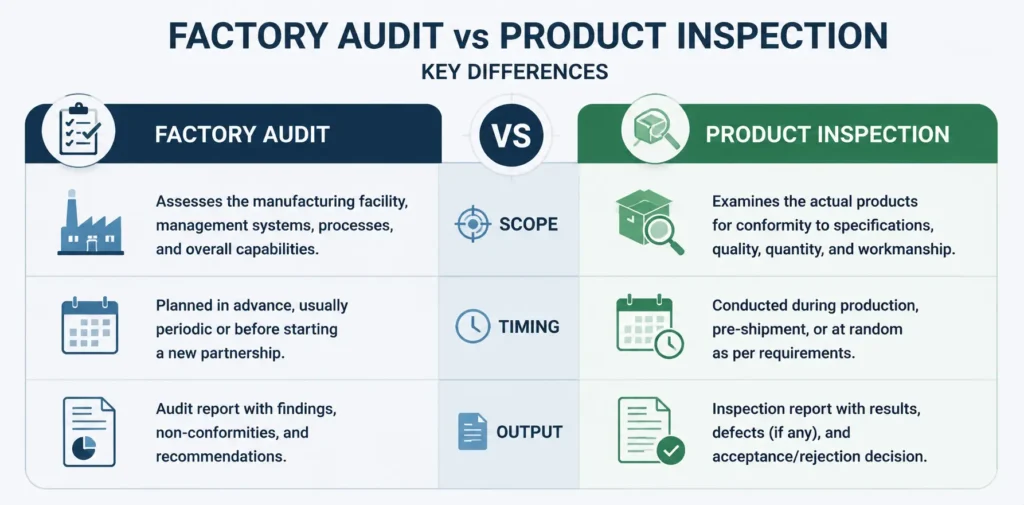
Unlike a product inspection that examines finished goods, a factory audit examines the facility and its systems the environment in which goods are produced. The fundamental question a factory audit answers is: Can this factory reliably produce what it claims to produce, to the standards required?
A factory audit in India is typically commissioned by:
- International buyers wanting to verify an Indian supplier before placing large orders
- Procurement teams qualifying new vendors for sensitive or high-value supply contracts
- Government project authorities ensuring contractor capability for infrastructure projects
- Regulatory bodies verifying compliance with sector-specific laws and standards
- Manufacturers themselves wanting independent validation of their own systems before a buyer visit
The output is a structured audit report with findings, photographs, non-conformities, and a supplier evaluation that gives the commissioning party objective evidence on which to base sourcing decisions.
Types of Factory Audits in India
Different situations call for different types of factory audits. The main types used in India include:
- Capability Audit (Supplier Assessment): Evaluates whether the factory has the production capacity, equipment, workforce, and technical systems to fulfill an order. Used before placing first orders with a new Indian supplier. Answers: Can they produce what we need, at the volume we require?
- Quality Management Audit: Examines the factory’s quality management system documentation, procedures, inspection processes, defect control, and corrective action systems. Often benchmarked against ISO 9001 or buyer-specific quality standards.
- Social Compliance Audit (Ethical Audit): Verifies labor practices, working conditions, worker welfare, and adherence to Indian labor laws including the Factories Act 1948 and Industrial Employment Act 1946. Internationally recognized frameworks like SEDEX/SMETA are commonly used by global buyers sourcing from India.
- Environmental Audit: Checks compliance with the Environment Protection Act 1986, pollution control measures, waste management practices, and National Green Tribunal (NGT) requirements. Increasingly required by European buyers with sustainability procurement policies.
- GMP Audit (Good Manufacturing Practices): Specific to pharmaceutical and food manufacturing. Verifies compliance with FSSAI requirements for food processors and Drugs and Cosmetics Act 1940 requirements for pharmaceutical manufacturers. Essential for Indian pharma and food exporters.
- Production/Process Audit: Evaluates specific manufacturing processes, equipment calibration, operator competence, and production controls particularly for technical products where process consistency directly determines product quality.
What Happens During a Factory Audit in India? (Step by Step)
Understanding the third party inspection process prepares Indian manufacturers for what to expect and helps them make a strong impression.
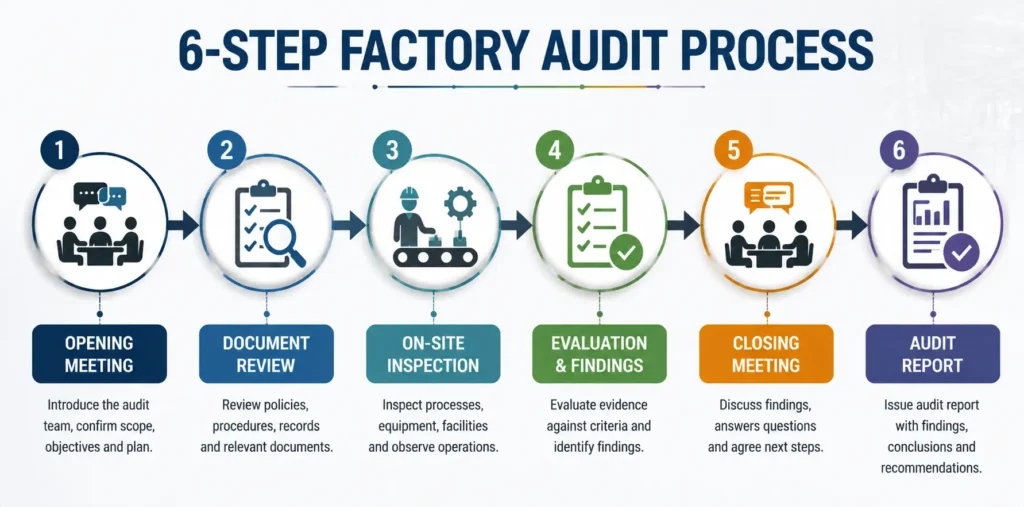
Step 1 Opening Meeting
The audit begins with an opening meeting between the auditor and the factory’s management team. The auditor explains the audit scope, objectives, and methodology. Factory representatives confirm the agenda, provide company background, and assign a guide for the facility walkthrough.
Step 2 Document Review
The auditor reviews key factory documentation including:
- Quality manuals and standard operating procedures
- Production records and batch documentation
- Equipment maintenance and calibration logs
- Worker training records and competency assessments
- Compliance certificates (ISO, FSSAI, Factories Act license, fire NOC, etc.)
- Previous audit reports and corrective action records
Document review reveals whether systems exist on paper. The facility walkthrough reveals whether they are actually followed.
Step 3 Facility Walkthrough and Physical Inspection
The auditor physically tours the factory, observing:
- Production Areas Equipment condition, production processes, cleanliness, housekeeping, material flow, and work-in-progress management.
- Quality Control Systems In-line inspection stations, measuring equipment and calibration status, sample retention, defect logging, and quality control records.
- Storage and Materials Management Raw material storage conditions, labelling, segregation of conforming and non-conforming materials, finished goods storage.
- Health, Safety, and Working Conditions Emergency exits, fire safety equipment, personal protective equipment provision and use, first aid facilities, ventilation, lighting, and overall worker environment all assessed against Factories Act 1948 requirements.
- Environmental Compliance Waste disposal systems, effluent management, chemical storage, and compliance with pollution control board requirements.
Step 4 Worker Interviews
For social compliance audits, the auditor conducts confidential interviews with factory workers selected randomly to verify their understanding of rights, working hours, wage payment, grievance mechanisms, and actual working conditions.
Step 5 Closing Meeting
The auditor presents preliminary findings to factory management highlighting key observations, non-conformities identified, and areas requiring corrective action. This gives the factory an opportunity to clarify factual points before the formal report is issued.
Step 6 Audit Report
Within the agreed timeframe typically 24 to 72 hours the auditor delivers a comprehensive written report covering:
- Overall factory assessment score or rating
- Findings across each audit category
- Photographs documenting observations
- Non-conformities classified by severity
- Recommended corrective actions with timelines
- Summary evaluation for buyer decision-making
Key Indian Regulations That Factory Audits Verify
Factory audits in India operate within a framework of domestic regulations that buyers and authorities expect suppliers to comply with:
- Factories Act, 1948 Governs worker safety, health, welfare, working hours, and hazardous machinery management. Social compliance audits verify compliance directly against this legislation.
- Environment Protection Act, 1986 Sets standards for pollution control, waste management, and emissions. Environmental audits verify compliance, particularly for factories in chemical, textile, and processing industries.
- FSSAI Regulations Food Safety and Standards Authority of India requirements for food processing units. GMP audits for food exporters verify facility hygiene, processing controls, and documentation against FSSAI standards.
- Drugs and Cosmetics Act, 1940 Pharmaceutical manufacturing audits verify compliance with this Act’s manufacturing standards, which are mandatory for Indian pharma exporters to regulated markets.
- PLI Scheme Compliance Factories receiving Production Linked Incentive scheme benefits are subject to compliance audits verifying product quality, worker welfare, and regulatory adherence.
- ISO 45001 Occupational health and safety management system standard increasingly referenced in factory audits for suppliers to European buyers and large Indian corporates.
Why Indian Manufacturers Need Third Party Factory Audit Services
- Win and Retain International Buyers: Major international buyers from Europe, the USA, the Middle East, and Japan require factory audit reports before approving Indian suppliers. Without an accredited factory audit service in India conducting an independent assessment, Indian manufacturers cannot qualify for these supply chains.
- Qualify for Government and Corporate Tenders: Large Indian corporates and government procurement under GFR rules increasingly require supplier capability assessments as part of vendor registration. An independent factory audit report from an accredited inspection body strengthens vendor qualification applications.
- Identify Internal Weaknesses Before Buyers Do: A factory audit conducted proactively before a buyer visit reveals compliance gaps, process weaknesses, and documentation deficiencies that the manufacturer can address on their own terms, rather than being flagged during a buyer-mandated audit.
- Build Long-Term Supplier Credibility: Manufacturers who voluntarily undergo independent factory audits and act on findings demonstrate quality commitment that buyers notice. This credibility differentiates Indian suppliers in competitive international tender processes.

Choosing the Right Factory Audit Service in India
With many companies offering factory audit services, selecting the right partner is critical. Use this checklist:
- ISO/IEC 17020:2012 Accreditation Verify independently. An accredited inspection body in India operates to internationally recognized standards.
- UAF or Recognized Accreditation Body UAF accreditation ensures your audit reports are accepted by international buyers and regulators in 95+ countries.
- Type A Classification Confirms the audit company has no commercial ties to the factory being audited essential for objective findings.
- Industry-Specific Experience Ensure the company has audited factories in your specific sector. Textile factory audits require different expertise than pharmaceutical facility audits.
- Regulatory Knowledge The auditor must understand Indian regulations Factories Act, FSSAI, Drugs and Cosmetics Act, Environment Protection Act as well as relevant international standards.
- Clear Reporting Audit reports should be detailed, photographic, and actionable not vague summaries.
- Pan-India Reach Confirm the company can serve your factory location and maintain consistent quality across all your sites.
TNV Inspection Division Factory Audit Services Across India
TNV Inspection Division is a UAF-accredited Type A inspection body under ISO/IEC 17020:2012, providing professional factory audit services in India since 2011. Our factory audits cover capability assessment, quality management evaluation, social compliance, environmental compliance, GMP audits, and process audits across 36+ industry sectors.
Why manufacturers and buyers choose TNV for factory audits:
- UAF Accreditation No. 5241222IB04 valid until December 2028
- Type A independent body no supplier ties, purely objective findings
- Auditors with industry-specific expertise across textiles, engineering, food, pharma, automotive, and more
- Detailed reports with photographs delivered within 48–72 hours
- Pan-India coverage from Lucknow headquarters
- Trusted by IRCTC, Adani Wilmar, Patanjali Ayurved, and ICAR
- Online certificate verification at certificate.tnvib.com
Conclusion
A factory audit in India is not a formality or a box to check. It is the most reliable way for buyers to verify supplier capability before committing to a supply relationship and the most effective way for Indian manufacturers to demonstrate that their facility, systems, and compliance are genuinely ready for serious business.
Whether you are an exporter in Tirupur preparing for a European buyer’s supplier approval process, a pharmaceutical manufacturer in Hyderabad meeting GMP requirements for regulated markets, or an auto component supplier in Pune qualifying for an international OEM’s vendor list a professional factory audit service from an accredited inspection body gives you the objective evidence that builds confidence and wins contracts.
Ready to schedule a factory audit at your facility? Contact TNV Inspection Division today.
📞 +91-9838070227 / +91-9838077603 ✉ tnvindia@gmail.com 🌐 tnvib.com 🔍 Verify accreditation: uafaccreditation.org 📄 Verify certificate: certificate.tnvib.com 📍 TNV House, B-1/19/69, Sector-K, Aliganj, Lucknow, UP 226024, India
Frequently Asked Questions (FAQ)
What is the difference between a factory audit and a product inspection in India?
A factory audit evaluates the manufacturing facility its systems, processes, capabilities, and compliance to determine whether it can reliably produce goods to required standards. A product inspection examines finished goods against specifications. Both serve different purposes: a factory audit is typically done before placing orders with a new supplier, while product inspection is conducted on specific shipments. Many Indian manufacturers use both together for comprehensive quality assurance.
How long does a factory audit take in India?
A standard factory capability or quality audit at an Indian factory typically takes one full working day for a medium-sized facility. Social compliance audits or GMP audits for food and pharmaceutical factories may take one to two days depending on facility size and complexity. The audit report is delivered within 48 to 72 hours after the on-site visit.
What documents should an Indian factory prepare for a factory audit?
Key documents include the factory license under the Factories Act, quality manual and standard operating procedures, equipment maintenance and calibration records, worker training records, production and quality control records, compliance certificates (ISO, FSSAI, pollution control board NOC, fire NOC), previous audit reports and corrective action records, and wage and attendance registers for social compliance audits.
How much does a factory audit service cost in India?
Factory audit costs in India typically range from ₹12,000 to ₹30,000 per man-day depending on audit type, factory size, location, and scope. Specialized audits GMP, social compliance with worker interviews, multi-day assessments may cost more. Contact TNV at tnvib.com for a customized quote based on your specific audit requirements.
Is a factory audit mandatory for Indian exporters?
A factory audit is not universally mandated by Indian law, but it is effectively mandatory in practice for several situations: international buyers from Europe, the USA, and Japan commonly require it before approving Indian suppliers; government tenders increasingly require supplier capability verification; regulated sectors like pharmaceuticals require GMP facility assessments; and sustainability-focused global buyers require SEDEX/SMETA social compliance audits. For any Indian manufacturer serious about international supply chains, a factory audit is an essential step.