
Type A vs Type B vs Type C Inspection Body — What Indian Clients Need to Know
Introduction — Why the Type Classification Is the Most Overlooked Credential in India
When Indian businesses select an inspection company, most focus on price, turnaround time, and whether the company claims ISO/IEC 17020 accreditation. Very few ask one of the most important questions of all: What type of inspection body are you?
Under ISO/IEC 17020:2012 the international standard governing inspection bodies every accredited inspection body is classified as Type A, Type B, or Type C based on how independent it is from commercial interests. This classification determines whether an inspection body can provide genuinely impartial assessments or whether its findings are, by design, influenced by relationships with manufacturers, suppliers, or buyers.
For Indian exporters needing LC-compliant inspection certificates, for procurement professionals qualifying suppliers for government tenders in India, and for international buyers requiring credible independent verification of Indian-manufactured goods the type classification is not a technical detail. It is the single most important indicator of whether an inspection report can be trusted.
What is ISO/IEC 17020:2012 and Why Does It Defines the Classification?
ISO/IEC 17020:2012 is the international standard published by the International Organization for Standardization that defines requirements for the competence, impartiality, and consistent operation of inspection bodies.
One of its core requirements is that inspection bodies must identify and manage risks to their impartiality particularly risks arising from commercial relationships. The standard recognizes that different types of inspection bodies have different structural relationships with the commercial parties involved in their work, and it classifies them accordingly.
This classification Type A, B, or C is not a quality ranking in the sense that one type is better at conducting inspections than another. It is a structural independence classification that tells you how much the inspection body’s findings can be influenced by commercial pressure from the parties whose goods or processes are being inspected.
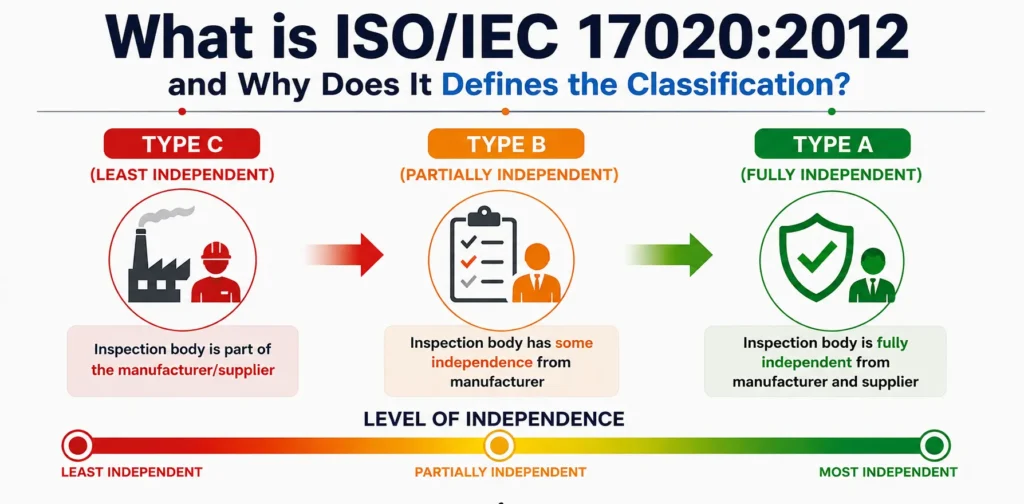
Type A Inspection Body Full Independence
A Type A inspection body is a fully independent third party organization that provides inspection services. It has no design, manufacture, supply, installation, maintenance, or use involvement in the items it inspects. Critically, it has no financial or commercial ties to any of the parties involved in the transaction or project being inspected.
Type A bodies operate solely as inspection organizations. Their income comes from inspection fees paid by clients who commission inspections but this commercial relationship does not compromise their independence because their reporting obligation is always to accurate findings, regardless of what those findings show.
What Type A Means in Practice
When a Type A inspection body visits an Indian factory to conduct a pre-shipment inspection, the inspector has absolutely no reason to overlook quality defects, approve a non-conforming shipment, or soften findings. The inspection body’s accreditation, reputation, and business depend entirely on accurate, honest reporting.
For Indian exporters shipping under Letters of Credit, a Type A inspection certificate tells the buyer’s bank: this report was issued by a body with no commercial interest in the outcome. That is why banks release payment against it.
For procurement teams qualifying suppliers for government infrastructure projects under GFR rules, a Type A inspection report tells the project authority: this verification was conducted by an independent body. That is why it satisfies tender requirements.
Who Needs Type A
- Indian exporters whose LC conditions specify “independent third party inspection”
- Government project buyers requiring inspection under CPWD, NHAI, Jal Jeevan Mission, RDSO specifications
- International buyers requiring inspection reports for regulatory compliance in their home markets
- Regulated sector companies in oil and gas (PNGRB), food (FSSAI), railways (RDSO), and pharmaceuticals
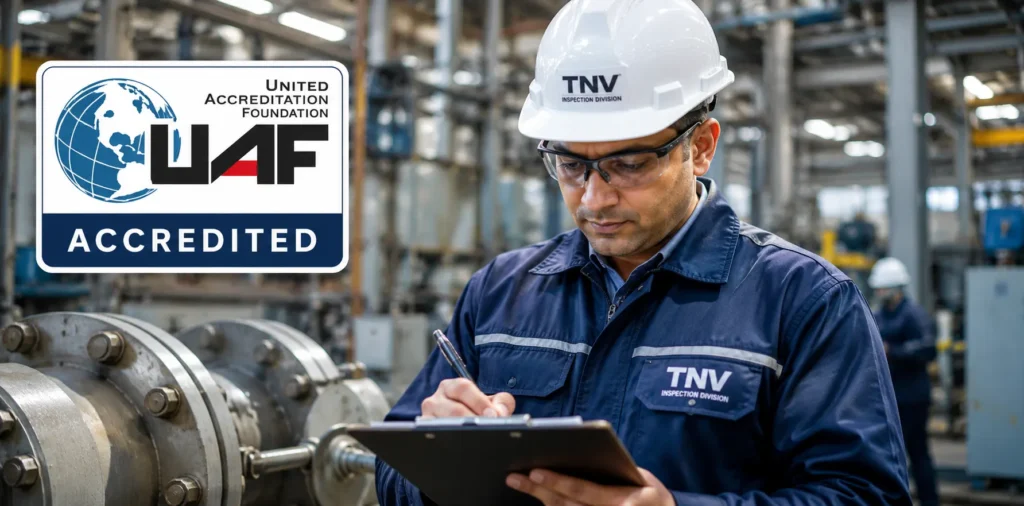
TNV Inspection Division is a Type A inspection body UAF accredited under ISO/IEC 17020:2012, Certificate No. 5241222IB04, valid until December 2028. Verify at uafaccreditation.org.
Type B Inspection Body Organisationally Separated
A Type B inspection body forms part of a larger organization that also designs, manufactures, supplies, installs, or maintains the products or services being inspected. The inspection function is structurally separated within the organization it has its own management, personnel, and reporting lines but it exists within and is funded by the parent organization.
What Type B Means in Practice
A manufacturing company that has an internal inspection department clearly structured and documented as separate from the production function can seek accreditation as a Type B inspection body. The inspectors are employees of the manufacturer, which creates an inherent structural tension between the inspection function’s obligation to report accurately and the parent organization’s commercial interest in the production outcome.
Type B bodies are used primarily for internal quality verification where the inspection results are used within the same organizational group for instance, a large industrial conglomerate verifying components produced by one group company before they are used by another.
Limitations for Indian Clients
Type B inspection reports are generally not accepted for:
- Letter of Credit payment release where genuine independence is specified
- Government tender compliance where independent third party inspection is required
- Regulatory submissions to PNGRB, FSSAI, or RDSO where independent verification is mandated
- International buyer qualification processes that specify third party independent inspection
The fundamental limitation is structural: even with the best intentions, a Type B inspector operates within an organization that has a commercial stake in the inspection outcome.
Type C Inspection Body Limited Independence
A Type C inspection body may be involved in the design, manufacture, supply, installation, or maintenance of products or services similar to or the same as those it inspects. This represents the lowest level of independence under ISO/IEC 17020:2012.
What Type C Means in Practice
A company that both manufactures products and operates an inspection service for products in the same category would be classified as Type C. The inspection function is not separated from the commercial activities that create direct conflicts of interest.
Type C accreditation exists in the standard to accommodate situations where some level of formal inspection structure is needed within commercially involved organizations but it is explicitly not intended for situations requiring independent third party assessment.
Limitations for Indian Clients
In the context of Indian export trade, government procurement, and regulated sector compliance, Type C inspection reports are the least likely to be accepted. Any situation requiring genuine third party independence which covers the vast majority of uses that Indian businesses need inspection reports for is inappropriate for Type C inspection bodies.
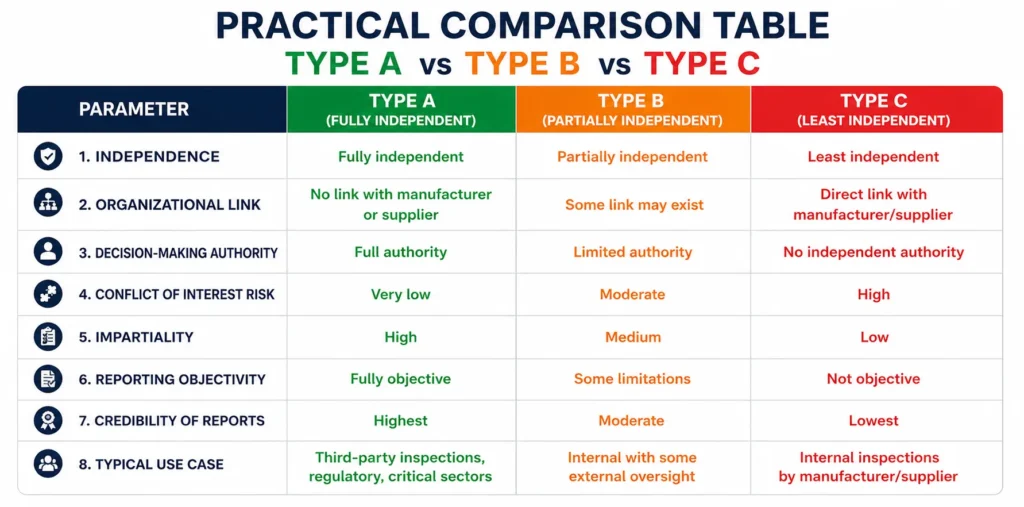
Direct Comparison Type A vs Type B vs Type C
|
Feature |
Type A |
Type B |
Type C |
|
Relationship to manufacturer |
None fully independent |
Part of same organization |
May design/make similar items |
|
Commercial ties to inspected items |
None |
Through parent company |
Direct involvement possible |
|
Level of independence |
Complete |
Partial |
Limited |
|
Accepted for LC payment |
✅ Yes |
❌ Typically not |
❌ No |
|
Accepted for government tenders |
✅ Yes |
❌ Typically not |
❌ No |
|
Accepted for PNGRB/FSSAI/RDSO |
✅ Yes |
❌ Typically not |
❌ No |
|
Accepted by international buyers |
✅ Yes |
⚠️ Limited cases |
❌ No |
|
Appropriate for third party inspection |
✅ Yes |
❌ No |
❌ No |
|
Credibility with banks |
✅ High |
❌ Low |
❌ None |
Real-World Consequences for Indian Businesses of Getting This Wrong
Scenario 1 Rejected LC Payment
An Indian garment exporter in Surat commissions a pre-shipment inspection from a company that claims ISO/IEC 17020 accreditation but is Type B its inspection division is part of a group that also operates textile sourcing businesses. The buyer’s bank reviews the inspection certificate and identifies the body is not Type A. Payment is withheld pending inspection by a genuinely independent Type A body. The shipment is delayed by three weeks.
Scenario 2 Disqualified Government Tender
A Pune-based engineering components manufacturer submits a vendor qualification application to a public sector buyer. The tender document specifies independent third party inspection reports. The manufacturer submits inspection reports from a company linked to their industry association a Type C situation. The reports are rejected. The vendor qualification fails.
Scenario 3 Regulatory Rejection
An oil and gas contractor in Gujarat submits pipeline inspection reports to comply with PNGRB technical standards. The inspection company used is Type B an internal inspection division of an equipment supplier involved in the project. PNGRB’s technical team identifies the structural conflict of interest and rejects the reports. Re-inspection by a Type A accredited body is mandated, delaying project commissioning.
These scenarios are preventable by one simple step: checking and verifying the type classification of the inspection body before engagement.
How to Verify Type Classification for Any Inspection Body in India
Verifying an inspection body’s type classification is straightforward:
Step 1 Ask directly Ask the inspection company: “What is your type classification under ISO/IEC 17020 Type A, B, or C?” A Type A body will answer immediately and confidently. Hesitation or vague answers are a warning sign.
Step 2 Request the accreditation certificate The certificate issued by the accreditation body (UAF, IAS, UKAS, etc.) should explicitly state the type classification along with the accreditation number, scope, and validity dates.
Step 3 Verify independently Confirm through the accreditation body’s official website:
- For UAF-accredited bodies: visit uafaccreditation.org
- For UKAS-accredited bodies: visit ukas.com
- For IAS-accredited bodies: visit iasonline.org
Step 4 Verify issued certificates For any inspection certificate already issued, verify it through the inspection body’s online portal. For TNV: verify at certificate.tnvib.com every certificate issued is verifiable in seconds.
TNV Inspection Division India's Type A Standard
TNV Inspection Division is India’s first UAF-accredited Type A inspection body under ISO/IEC 17020:2012. As a division of TNV Global Limited headquartered in Lucknow, TNV operates with zero commercial ties to any manufacturer, supplier, or buyer anywhere in India or across the 95+ countries where we operate.
Accreditation Details:
|
Detail |
Information |
|
Classification |
Type A Fully Independent |
|
Accreditation Body |
UAF United Accreditation Foundation, USA |
|
Standard |
ISO/IEC 17020:2012 |
|
Certificate No |
5241222IB04 |
|
Valid Until |
December 2028 |
|
IAF MLA |
Yes 95+ countries recognition |
|
Verify |
uafaccreditation.org |
|
Certificate Verify |
certificate.tnvib.com |
Industries covered: 36+ sectors including oil and gas, textiles, food and agriculture, engineering, railways, pharmaceuticals, construction, chemicals, electrical equipment, and consumer goods.
Trusted by: IRCTC, Adani Wilmar, Patanjali Ayurved, ICAR across government, FMCG, food, and research sectors.
Conclusion
The Type A, B, C classification under ISO/IEC 17020:2012 is not a bureaucratic formality. It is the most direct indicator of whether an inspection body’s reports can be trusted as genuinely independent or whether they are structurally compromised by commercial relationships.
For Indian clients exporters satisfying buyer requirements, manufacturers qualifying for government tenders, companies operating in regulated sectors, and procurement professionals building credible supply chains the question is simple: always use a Type A accredited inspection body.
Check the classification. Verify the accreditation. Accept nothing less than independence you can prove.
TNV Inspection Division. India’s first UAF-accredited Type A inspection body. Independent by accreditation. Trusted by evidence.
📞 +91-9838070227 / +91-9838077603 ✉ tnvindia@gmail.com 🌐 tnvib.com 🔍 Verify accreditation: uafaccreditation.org 📄 Verify certificate: certificate.tnvib.com 📍 TNV House, B-1/19/69, Sector-K, Aliganj, Lucknow, UP 226024, India
Frequently Asked Questions(FAQ)
What is the difference between Type A, Type B, and Type C inspection bodies under ISO 17020?
Under ISO/IEC 17020:2012, Type A bodies are fully independent with no commercial ties to manufacturers, suppliers, or buyers making them the most credible for genuine third party inspection. Type B bodies form part of a larger organization that also manufactures or supplies products creating structural conflicts of interest. Type C bodies may be involved in designing or making similar products to those they inspect representing the least independence. For any third party inspection need in India export trade, government tenders, or regulatory compliance only Type A is appropriate.
Why do Indian exporters specifically need Type A inspection bodies?
International buyers, banks processing Letters of Credit, and regulatory authorities require inspection reports from genuinely independent bodies meaning Type A. Reports from Type B or C bodies are typically rejected because the inspector has a structural commercial connection to the manufacturer or industry. For LC payment release, government tender qualification, and regulatory compliance with PNGRB, FSSAI, or RDSO, only Type A inspection reports are accepted.
How do I verify if an inspection company in India is genuinely Type A?
Ask the company directly and request their accreditation certificate showing type classification. Then verify independently through the accreditation body's official website for UAF-accredited bodies, check uafaccreditation.org. For TNV Inspection Division, our Type A status under UAF accreditation No. 5241222IB04 is publicly verifiable. Never rely solely on the inspection company's own claims.
Can a Type B inspection body become Type A?
Yes, but it requires fundamental organizational restructuring complete separation from any manufacturing, supply, or installation activities, with no commercial ties maintained. This is a significant structural change, not just a paperwork exercise. Accreditation bodies assess genuine structural independence rigorously before granting or upgrading Type A classification.
Is TNV Inspection Division a Type A inspection body in India?
Yes. TNV Inspection Division is India's first UAF-accredited Type A inspection body under ISO/IEC 17020:2012, Certificate No. 5241222IB04, valid until December 2028. As a Type A body, TNV has absolutely no commercial ties to any manufacturer, supplier, or buyer. Our independence is the foundation of everything we do. Verify our accreditation at uafaccreditation.org and verify any certificate we issue at certificate.tnvib.com.