
How to Prepare for a Pre-Shipment Inspection in India: Step-by-Step Checklist
Introduction
Many Indian exporters lose time and money at pre-shipment inspection not because their products are poor quality, but because they were not prepared. Wrong documents. Goods still being packed when the inspector arrives. Workers who don’t know what the inspection covers. These are avoidable mistakes that delay shipments, hold up LC payments, and damage buyer relationships. If you’re exporting from India and a pre-shipment inspection is coming up from your buyer, your bank, or your own quality process this checklist tells you exactly what to do before the inspector walks in.
What is Pre-Shipment Inspection in India?
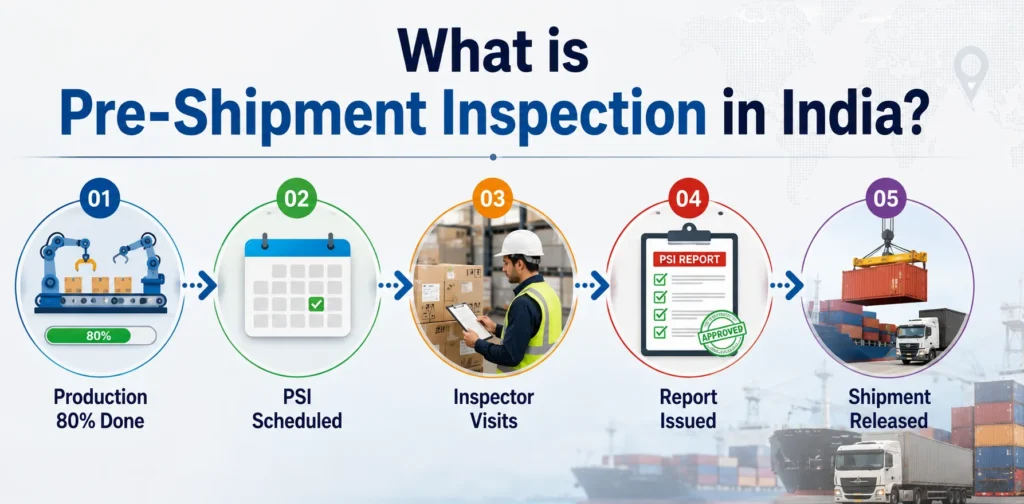
A pre-shipment inspection (PSI) is an independent quality check conducted after goods are manufactured and before they leave your factory. A qualified inspector from an accredited PSI company in India visits your facility, examines finished goods against your buyer’s specifications, and issues a formal inspection report or certificate.
The inspection covers product quality, workmanship, measurements, quantity, packaging, and labelling. It typically happens when 80–100% of goods are finished and packed.
The result a clean pre-shipment inspection certificate in India is what your buyer needs to release LC payment, accept the shipment, and clear customs in their country.
Being prepared is the difference between passing first time and facing delays, re-inspection costs, and frustrated buyers.
Step-by-Step Preparation Checklist
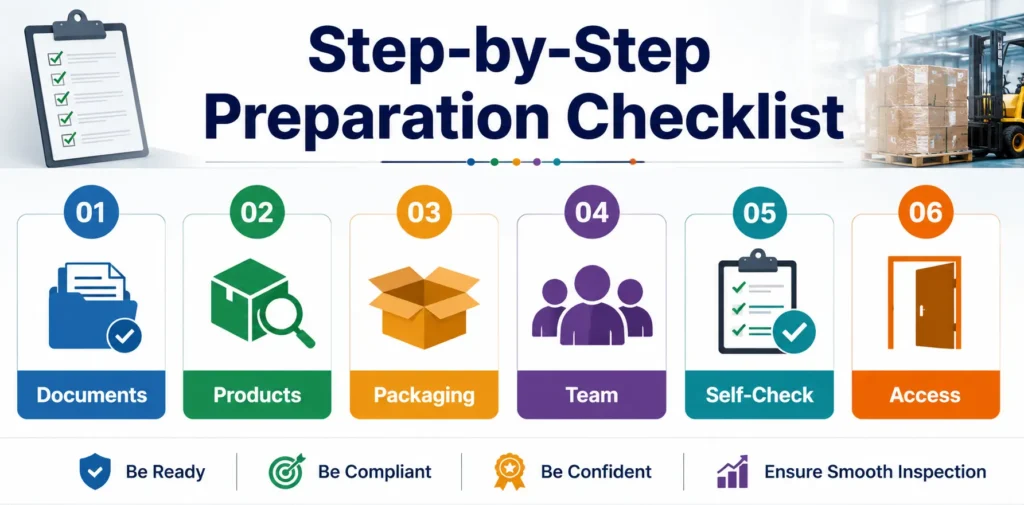
Step 1 Confirm Goods Are Ready Before Booking
Do not book PSI inspection in India until your goods are genuinely ready. This is the most common mistake.
Before scheduling, confirm:
- At least 80% of ordered quantity is manufactured and packed
- Goods are physically accessible for random sampling
- Products are not still on the production line during inspection
- Packing is complete on at least 80% of cartons
Calling an inspector to a factory where goods are half-packed wastes everyone’s time. Inspectors assess what is ready if your goods aren’t, the inspection fails by default.
Step 2 Gather All Required Documents
The inspector needs to compare your goods against the agreed order. Have these ready before the inspection date:
Commercial Documents:
- Purchase order (PO) from your buyer
- Proforma invoice or sales contract
- Packing list (must match actual cartons)
Technical Documents:
- Product specifications dimensions, materials, weight, colour codes
- Approved samples or reference photos
- AQL level specified by your buyer (if provided)
- Technical drawings (for engineering goods)
Compliance Documents (where applicable):
- CE declaration of conformity (for EU-bound goods)
- FSSAI certificate (for food products)
- BIS certificate (if required)
- Lab test reports previously approved by buyer
Keep these in one folder physical and digital. Do not make the inspector wait while you search for documents.
Step 3 Prepare Your Products and Packaging
Products should be in final, shippable condition exactly as they would leave your facility.
Product Preparation:
- Finished goods are complete no missing components, accessories, or parts
- Products match the approved sample in colour, material, and design
- Defective units are removed from the inspection batch
- Products are clearly identified and accessible for sampling
Packaging Preparation:
- Master cartons are sealed and labelled correctly
- Inner packaging matches buyer requirements
- Cartons are properly marked product name, quantity, country of origin
- Shipping marks match the purchase order
- Fragile goods have adequate protective packaging
Labelling Checklist:
- Product labels are in the correct language (English, plus destination country language if required)
- Barcode scans correctly
- Country of origin is clearly marked
- Care instructions, safety warnings, and regulatory marks are present
Missing or incorrect labelling is one of the most common causes of PSI failure in India. Check every label before the inspector arrives.
Step 4 Brief Your Factory Team
Your staff need to know what is happening on inspection day. An inspector who cannot access products, gets conflicting information from workers, or faces resistance from supervisors will note this in the report.
Brief your team on:
- Who the inspector is and why they are visiting
- Which products and cartons will be inspected
- That random sampling will happen they should not interfere or guide the inspector
- Who is the designated point of contact for the inspector on that day
- That everything must be available and accessible no locked areas, no hidden stock
Assign one senior person quality manager or production supervisor to accompany the inspector throughout the visit. They should be able to answer technical questions and provide documents on request.
Step 5 Do an Internal Pre-Inspection Check
Before the official pre-shipment inspection in India, do your own walk-through. Use your buyer’s specifications as the checklist.
Check 20–30 random units yourself:
- Do dimensions match specifications?
- Are there any visible defects scratches, stains, broken parts, uneven stitching?
- Does the product function correctly?
- Does packaging match the sample?
- Are all labels in place and accurate?
- Does the quantity in each carton match the packing list?
If you find issues at this stage, fix them before the inspector arrives. It costs almost nothing to correct defects now. It costs significantly more in time, money, and buyer trust to fail PSI and request re-inspection.
Step 6 Confirm Logistics and Access for the Inspector
On inspection day, the inspector needs to arrive, work efficiently, and leave with complete findings. Make it easy.
- Confirm factory address and provide clear directions or a location pin
- Ensure entry is arranged security clearance, visitor pass, gate access
- Provide a working area for document review a table and good lighting
- Ensure adequate lighting in the inspection area
- Have measuring tools available if the inspector needs them tape measures, weighing scales
- Confirm the inspection timing with your designated contact
What Happens After the Inspection?
Within 24–48 hours, the accredited PSI company in India delivers your inspection report. It will show:
- Pass or fail result
- Photographs of products, defects, and packaging
- Defect classification critical, major, minor
- Quantity verification results
- Measurement data
- Labelling compliance findings
If you pass: The inspection report or pre-shipment inspection certificate in India is issued. Share it with your buyer and bank to trigger LC payment and confirm shipment clearance.
If you fail: The report details exactly what failed. You can correct the issues, request a re-inspection, and get your certificate once the goods are compliant. Your accredited PSI company will advise on the re-inspection process.
Common Mistakes That Cause PSI Failure in India
Indian exporters fail pre-shipment inspections most often because of:
- Goods not ready when inspection was booked
- Documents missing or not matching the actual shipment
- Labels incorrect, missing, or in wrong language
- Defective units mixed into the inspection batch
- Carton quantities not matching the packing list
- Staff unaware of inspection requirements
- Factory team interfering with inspector’s random sampling
Every item on this list is preventable with the preparation steps above.
How to Choose an Accredited PSI Company in India
Not every company offering pre-shipment inspection services in India is equally qualified. When choosing your inspection partner:
Verify ISO/IEC 17020:2012 accreditation independently, through the accreditation body’s website Confirm Type A classification full independence from manufacturers and suppliers Check industry experience does the inspector know your product category? Confirm 24–48 hour report delivery critical for export timelines Check certificate verification can your buyer verify the certificate online?

TNV Inspection Division Your Accredited PSI Partner in India
TNV Inspection Division is India’s first UAF-accredited Type A inspection body under ISO/IEC 17020:2012 providing pre-shipment inspection services across India and 95+ countries since 2011.
- UAF Accreditation No. 5241222IB04 valid until December 2028
- Type A body zero commercial ties to suppliers or buyers
- 24-hour report delivery with photographic evidence
- Pan-India coverage across all major manufacturing clusters
- Online certificate verification at certificate.tnvib.com
- Trusted by IRCTC, Adani Wilmar, Patanjali Ayurved, ICAR
For pre-shipment inspection cost in India, contact TNV directly for a transparent quote based on your product, location, and order size.
Conclusion
Preparation is what separates exporters who pass PSI first time from those who don’t. The checklist in this guide covers everything from confirming goods readiness to briefing your team, from gathering documents to doing your own walk-through before the inspector arrives.
Follow these steps, work with an accredited PSI company in India you can trust, and the pre-shipment inspection process becomes a straightforward quality checkpoint not a source of stress.
Ready to schedule your next pre-shipment inspection? Contact TNV today.
📞 +91-9838070227 / +91-9838077603 ✉ tnvindia@gmail.com 🌐 tnvib.com 🔍 Verify accreditation: uafaccreditation.org 📄 Verify certificate: certificate.tnvib.com
Frequently Asked Questions (FAQ)
When should I book pre-shipment inspection in India?
Book PSI when at least 80% of your ordered goods are manufactured and packed. Booking too early when goods are still in production means the inspector cannot assess a representative sample. Booking too late risks missing your shipment deadline if issues are found. For most standard orders, schedule the inspection 3–5 days before your planned shipping date.
What documents do I need for PSI inspection in India?
At minimum: your purchase order, proforma invoice, packing list, product specifications, and approved samples or reference photos. For regulated products food, electronics, pharmaceuticals add relevant compliance certificates (FSSAI, BIS, CE declaration). Have all documents in one place before the inspector arrives.
How much does pre-shipment inspection cost in India?
Pre-shipment inspection cost in India typically ranges from ₹8,000 to ₹20,000 per man-day for standard orders, depending on product complexity, factory location, and inspection scope. Most standard PSIs take one day. This cost is a fraction of what a rejected shipment or held LC payment would cost your business.
What happens if my goods fail pre-shipment inspection?
You receive a detailed report showing exactly what failed with photographs and specific findings. You then work with your supplier or production team to fix the identified issues, and schedule a re-inspection. The re-inspection confirms the corrections before the pre-shipment inspection certificate in India is issued. Failing once is not the end addressing issues at the factory is always better than problems discovered at the destination.
How do I verify that a PSI company in India is genuinely accredited?
Ask for the inspection company's ISO/IEC 17020:2012 accreditation certificate with the certificate number and accreditation body name. Then verify independently on the accreditation body's official website for UAF, check uafaccreditation.org. For TNV Inspection Division, verify our accreditation at uafaccreditation.org and verify any specific certificate at certificate.tnvib.com.