
How to Prepare for a Factory Audit in India: What Auditors Look For
Most Indian factories that fail audits were not caught doing something wrong.
They were caught being unpreparedmissing documents, outdated records, workers who could not explain safety procedures, compliance certificates they held but could not locate. Problems that had nothing to do with actual production quality and everything to do with not knowing what an auditor was going to ask.
A factory audit in India is a structured, systematic evaluation of your facilityits systems, its processes, its compliance, and its people. Buyers use audit results to decide whether to place orders. Governments use them to qualify contractors. Regulatory bodies use them to verify compliance.
Knowing what auditors actually look forand preparing each area before they arriveis the difference between passing first time and facing corrective action requests that delay your business. This guide covers exactly that.
What is a Factory Audit in India?
A factory audit is an on-site evaluation conducted by an independent, accredited inspection body. The auditor visits your facility and assesses whether it meets specified standards, buyer requirements, or regulatory obligationsthen produces a formal audit report with findings and recommendations.
Factory audit services in India are typically commissioned before:
- A buyer places a large first order with a new Indian supplier
- A company qualifies for a government or corporate tender
- A factory prepares for ISO certification
- A regulatory body verifies sector-specific compliance (FSSAI, PNGRB, Drugs Act)
- An existing buyer renews their supplier approval
The auditor is not there to catch you out. They are there to assess whether your facility can reliably produce what you say it canat the quality and compliance levels required.
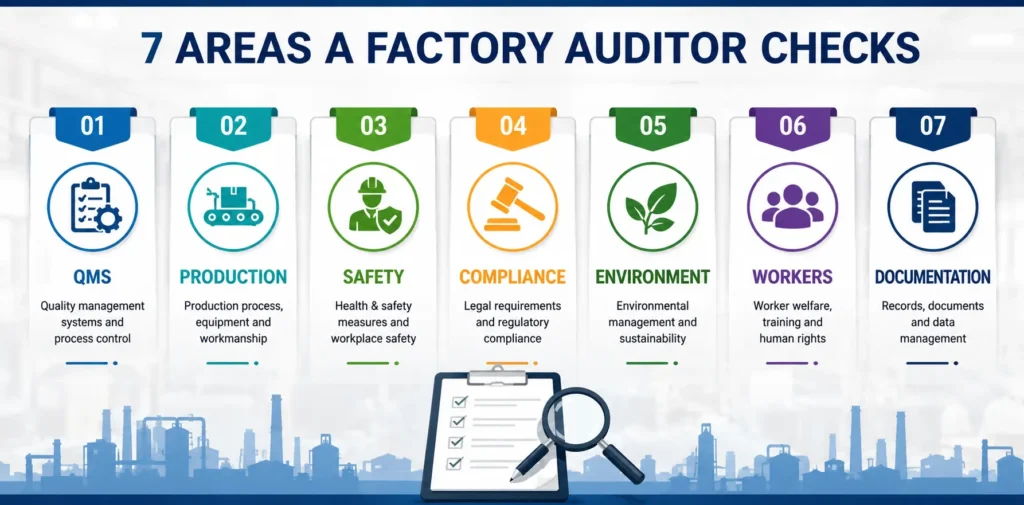
7 Areas Auditors Examine in a Factory Audit in India
1. Quality Management System (QMS)
This is usually the first thing auditors examineand the one most factories underestimate.
Auditors want to see that your quality management system exists not just in a manual, but in practice. They will ask to review:
- Your quality manual and standard operating procedures (SOPs)
- Internal audit records and outcomes
- Corrective action reportswhat went wrong and what was done about it
- Calibration records for measuring equipment
- Customer complaint logs and how they were resolved
The key question auditors are asking here: Does this factory have a system for maintaining qualityor does quality depend entirely on a few individuals?
A documented, functioning QMS tells a buyer your quality is repeatable. A factory that relies on one experienced worker to catch everything is a risk.
Prepare by: Reviewing and updating all QMS documentation at least two weeks before the audit. Ensure records are current, signed, and filed properlynot scattered across desks.
2. Production Process and Capabilities
Auditors assess whether your factory can actually produce what you claimat the volume, quality, and consistency required.
They will observe:
- Production flowfrom raw material receipt to finished goods dispatch
- Equipment condition and maintenance records
- Production capacity versus claimed output
- In-process quality checks at each stage
- How defects are identified, quarantined, and handled
Factories that show inspectors well-maintained equipment with calibration tags, clean production areas with clear material flow, and documented in-process checks look credible. Factories with crowded, disorganized production floors with no visible quality control systems do not.
Prepare by: Organizing the production floor before the auditclear walkways, labeled materials, accessible equipment records. Brief production supervisors on what the auditor will want to observe.
3. Legal and Regulatory Compliance
This area covers all the licenses, registrations, and certificates your factory is legally required to hold.
For a factory audit in India, auditors typically check:
- Factory license under the Factories Act 1948current and valid
- GST registration and basic business documentation
- FSSAI license (for food manufacturing)
- Drugs and Cosmetics Act registration (for pharma)
- Pollution Control Board consent to operate
- Fire safety NOC from local authority
- BIS registration (if applicable to your product)
- Any sector-specific licenses required by your buyer or regulator
Expired licenses are audit failures. Missing licenses are worse.
Prepare by: Making a complete list of all required licenses and certificates, checking their validity dates, and renewing any that are expired or close to expiry before the audit.
4. Health, Safety, and Working Environment
International buyersparticularly from Europe, the USA, and Japantake this area seriously. Regulatory bodies like PNGRB and the Factories Act mandate it.
Auditors check:
- Emergency exitsclearly marked, unobstructed, functional
- Fire extinguisherspresent, positioned correctly, within service date
- First aid kitsstocked and accessible
- Personal protective equipment (PPE)available and actually being used
- Hazardous material storagelabeled, segregated, properly stored
- Electrical safetyno exposed wiring, panels accessible and labeled
- Ventilation and lightingadequate for the work being done
- Accident records and near-miss reporting system
Auditors walk the floor. If workers are not wearing PPE they are supposed to wear, that is a finding. If fire exits are blocked by stacked cartons, that is a finding.
Prepare by: Doing a safety walkthrough yourself the week before the audit. Fix obvious issuesclear exits, check extinguisher dates, ensure PPE is available at every workstation and actually being worn.
5. Worker Welfare and Social Compliance
For buyers conducting social compliance auditscommon in textiles, garments, consumer goods, and retail supply chainsthis is a major focus.
Auditors assess:
- Working hoursare overtime records consistent with legal limits under the Factories Act?
- Wage paymentare workers paid on time, at least minimum wage, with proper payslips?
- Child laborage verification records for all workers
- Grievance mechanismsdo workers know how to raise concerns?
- Worker welfare facilitiesclean restrooms, drinking water, canteen or rest area where required
- Freedom of associationare workers aware of their rights?
Auditors may conduct confidential worker interviewsselecting employees randomly and speaking to them without management present. What workers say matters as much as what documents show.
Prepare by: Ensuring HR records are complete and current. Brief workers honestlynot with scripted answers, but with accurate information about their rights and the company’s practices. Workers who are confused or give contradictory answers raise red flags.
6. Environmental Compliance
This is growing in importanceespecially for buyers with sustainability commitments and for factories in sectors like textiles, chemicals, and food processing.
Auditors check:
- Pollution Control Board consent to operateis it current?
- Effluent treatment systemsoperational and documented
- Solid waste disposalsegregated, recorded, disposed through authorized channels
- Chemical storagelabeled, contained, with spill control measures
- Air emissionswithin permitted limits
- Energy and water usage records (for sustainability-focused buyers)
Prepare by: Ensuring PCB consent is current. Checking that effluent treatment records are available. Reviewing chemical storage areas for labelling and containment compliance.
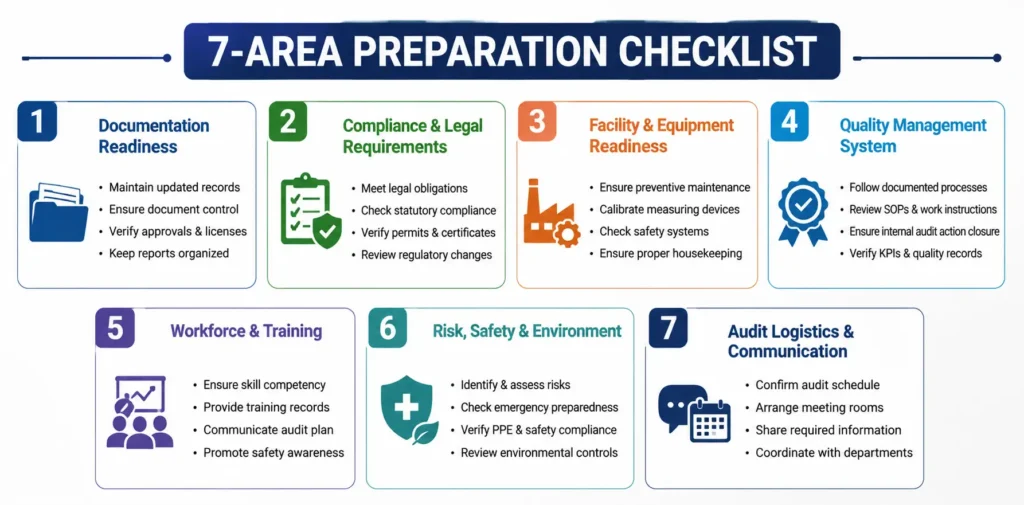
7. Documentation and Record-Keeping
This cuts across every other area. Auditors rely on documentation to verify that systems are not just described but actually operating.
Common documentation failures in factory audits in India:
- Records exist but are not currentcalibration logs, maintenance records, training registers
- Records exist but cannot be located quickly during the audit
- Records are filled in retroactivelyauditors recognize this
- Key documents are known only to one person who is absent on audit day
Prepare by: Creating a document folderphysical or digitalwith every key record organized by category. Test it: can any senior staff member find any required document within two minutes?
What Happens After the Audit?
Within 24–72 hours, your factory audit servicesprovider delivers a written report. It covers:
- Overall assessmentcapability rating or compliance score
- Findings by categoryconforming and non-conforming items
- Non-conformities classified by severitycritical, major, minor
- Photographs documenting observations
- Corrective action requests (CARs) with recommended timelines
If you pass: The audit report is shared with the buyer, project authority, or regulatory body. It confirms your facility meets the required standards and supports order placement, tender qualification, or regulatory approval.
If non-conformities are found: This is not the end. For minor and major findings, you respond with a corrective action plandescribing what you will fix and by when. The audit body may schedule a follow-up verification. Critical findings require immediate corrective action.
Most first-time audit failures in Indian factories involve documentation gaps and safety issuesboth of which are fixable before a re-audit.
How to Choose the Right Factory Audit Company in India
Not all factory audit service providers deliver equal value. When choosing:
- ISO/IEC 17020:2012 accreditation : verify independently, not just from the company’s own certificate
- Type A classification : full independence from manufacturers and suppliers
- UAF or recognized accreditation body : ensures results are accepted internationally
- Sector-specific expertise : auditors who know your industry and applicable regulations
- Structured, photographic reports : delivered within 48–72 hours
- Online certificate verification : transparency you can demonstrate to buyers
The United Accreditation Foundation (UAF) is one of the most widely recognized accreditation bodies internationally — UAF-accredited inspection bodies are accepted by buyers, banks, and regulators in 95+ countries. Verify UAF accreditation at uafaccreditation.org.
TNV Inspection DivisionFactory Audit Services Across India
TNV Inspection Division is India’s first UAF-accredited Type A inspection body under ISO/IEC 17020:2012providing factory audit services in India since 2011 across 36+ industry sectors.
Our factory audits cover:
- Supplier capability assessment
- Quality management system audit
- Social compliance audit
- Environmental compliance audit
- GMP audit for food and pharmaceutical manufacturers
- Production and process audit
- Health and safety assessment
Why Indian manufacturers choose TNV:
- UAF Accreditation No. 5241222IB04valid until December 2028
- Type A independence purely objective findings
- Auditors with sector-specific expertise
- Detailed photographic reports within 48–72 hours
- Pan-India coverage from Lucknow headquarters
- Online certificate verification at certificate.tnvib.com
- Trusted by IRCTC, Adani Wilmar, Patanjali Ayurved, ICAR
Conclusion
A factory audit in India is not something to approach last minute. The factories that pass first time are the ones that prepare systematicallyreviewing their QMS, organizing documentation, fixing safety gaps, briefing workers, and ensuring compliance certificates are current and accessible.
The preparation takes effort. But a clean audit report opens doorstop international buyers, government contracts, and regulated supply chainsthat an unprepared factory cannot access.
Ready to schedule a factory audit at your facility? Contact TNV Inspection Division.
📞 +91-9838070227 / +91-9838077603 ✉ tnvindia@gmail.com 🌐 tnvib.com 🔍 Verify accreditation: uafaccreditation.org 📄 Verify certificate: certificate.tnvib.com
Frequently Asked Questions (FAQ)
What is the most important thing to prepare for a factory audit in India?
Documentation. Most Indian factories fail audits not because of genuine compliance gaps, but because required recordslicenses, calibration logs, training registers, corrective action reportscannot be located during the audit. Organize all documentation at least two weeks before the audit date. Every required document should be findable within two minutes by any senior staff member.
How long does a factory audit in India take?
A standard supplier capability or quality management audit at a medium-sized Indian factory takes one full working day. Social compliance auditswhich include worker interviewsmay take one to two days depending on workforce size. GMP audits for food or pharmaceutical facilities can take one to two days. The audit report is typically delivered within 48 to 72 hours after the on-site assessment.
Can I fail a factory audit in India for safety violations?
Yes. Safety non-conformitiesblocked emergency exits, expired fire extinguishers, absence of PPE, inadequate hazardous material storageare among the most common causes of audit failure in Indian factories. Critical safety findings may result in audit failure regardless of performance in other areas. Conduct a safety walkthrough yourself before the audit and fix visible issues.
What is a corrective action request (CAR) in a factory audit?
A CAR is a formal finding in the audit report that identifies a non-conformitysomething that does not meet the required standardalong with a request for the factory to explain what corrective action will be taken and by when. Minor and major CARs are typically resolved through a documented corrective action plan submitted to the audit body or buyer. Critical CARs may require re-audit verification before approval is granted.
How do I find a UAF-accredited factory audit company in India?
Visit uafaccreditation.org and search the directory of accredited inspection bodies. TNV Inspection Division is listed under accreditation number 5241222IB04, valid until December 2028, as a Type A inspection body under ISO/IEC 17020:2012. You can also verify any specific audit certificate issued by TNV at certificate.tnvib.com.