
How to Read an Inspection Report: A Guide for Indian Buyers and Exporters
You receive the inspection report. You scroll to the result Pass and file it away.
That is the most common way Indian buyers and exporters handle inspection reports. And it means they are missing most of the value the report contains.
A professional inspection report from an accredited body is not just a pass or fail document. It is a detailed record of your product’s condition, your supplier’s quality systems, and potential risks in your next shipment. Understanding every section not just the headline result helps you make better sourcing decisions, catch early quality trends, and prevent future problems before they become expensive.
This guide walks through a standard inspection report section by section and explains exactly what each part means for Indian buyers and exporters.
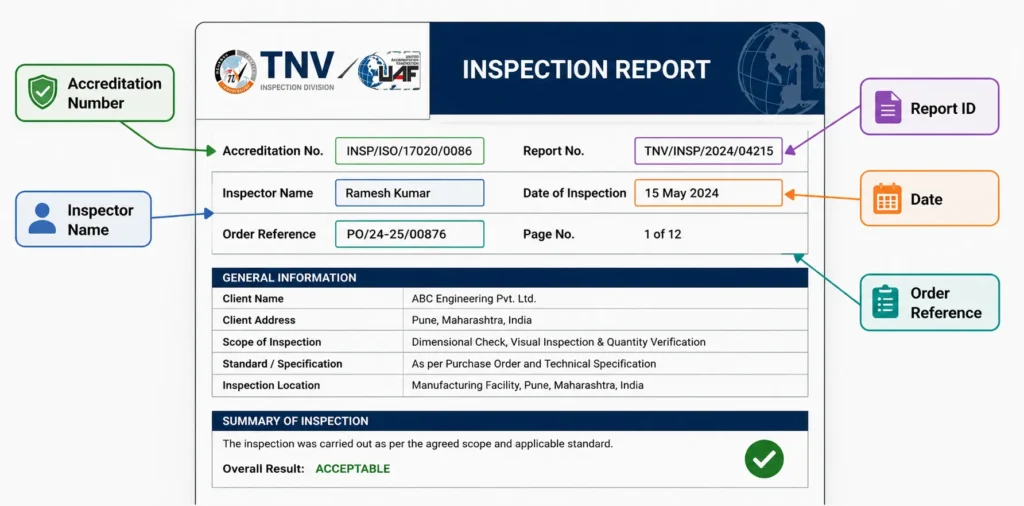
Section 1: Report Header Confirm the Basics First
Before reading any findings, verify the report header. This section confirms the inspection was what you commissioned.
Check these details:
- Inspection body name and accreditation Is it the company you hired? Do they show their ISO/IEC 17020:2012 accreditation number?
- Certificate/Report number Every professional report has a unique identifier. Use this to verify the certificate online.
- Inspector name and ID Who conducted the inspection? A credible accredited body includes inspector identification.
- Date and location of inspection Does this match when and where you scheduled the inspection?
- Order reference Your purchase order number should be referenced. Confirm it matches your records.
- Client name Your company name should appear as the commissioning party.
If any of these details are wrong or missing, contact the inspection body before proceeding. A report with incorrect order references or missing accreditation details is not a professional document.
For TNV reports: Verify the certificate authenticity at certificate.tnvib.com using the report number. Every TNV inspection certificate is verifiable online within seconds.
Section 2: Product and Order Details Verify What Was Inspected
This section describes the goods that were inspected. It tells you exactly what the inspector assessed and it is where discrepancies between the ordered goods and inspected goods are first visible.
Check:
- Product description Does it match what you ordered exactly? Wrong product descriptions are occasionally a sign of goods substitution.
- Order quantity vs inspected quantity How many units were available for inspection? If your order is 10,000 units but only 2,000 were ready, the inspection covers only what was available.
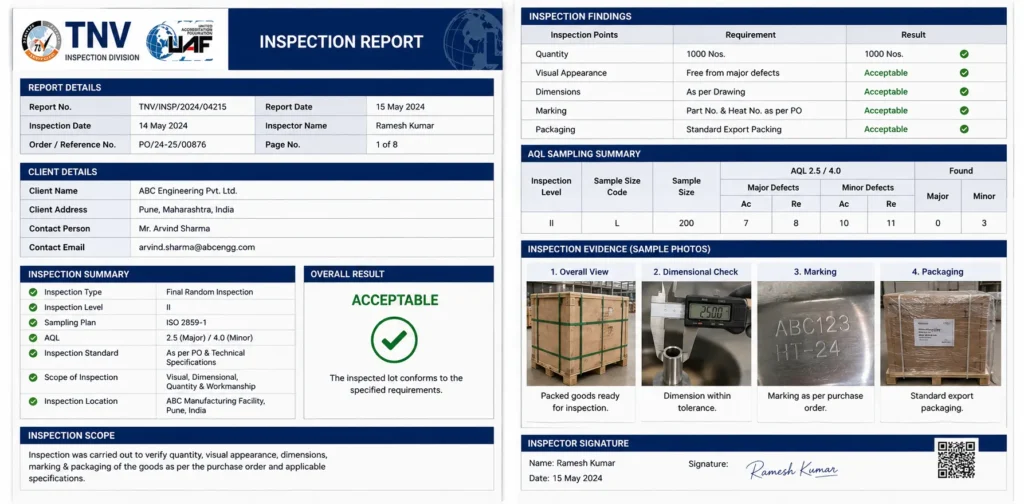
- Sample size How many units did the inspector examine? This is determined by AQL tables based on total lot size. You should see a sample size number for example, “315 units inspected from lot of 10,000.”
- Style/colour/size breakdown For orders with variants, confirm that the sample covered the right distribution across colours and sizes.
A report that inspected 50 units from a 50,000 unit order is not representative. Professional inspection bodies use statistically valid sample sizes under AQL standards the report should show the sampling methodology used.
Section 3: AQL Results This Is Where Most People Get It Wrong
AQL stands for Acceptable Quality Level. It is the statistical sampling method used in most pre-shipment inspections and is one of the most misunderstood sections in an inspection report.
How AQL works:
AQL sets thresholds for how many defects are acceptable in a sample before the entire lot is rejected. The most common standard is AQL 2.5 for major defects and AQL 4.0 for minor defects.
The report will show:
- Accept number the maximum number of defects allowed in the sample for a pass
- Reject number the number of defects that triggers a fail
- Defects found the actual number found during inspection
Example: Lot size: 10,000 units | Sample size: 315 units Major defects Accept: 14 | Reject: 15 | Found: 8 → PASS Minor defects Accept: 21 | Reject: 22 | Found: 19 → PASS (but close to the limit)
What this means for you:
A pass at 19/21 minor defects is not the same as a pass at 2/21. Both are technically passing but 19/21 tells you the supplier is right at the edge of acceptable quality. The next shipment may fail.
Indian buyers and exporters who only check whether the result says “Pass” miss this entirely. Always check how far the found defects are from the reject number not just whether the report passed.
Section 4: Defect Classification What Was Actually Wrong
Every inspection report lists defects found during the inspection. They are classified into three categories:
- Critical defects Safety hazards, regulatory violations, or product failures that make the goods completely unacceptable. Even one critical defect in the sample typically results in immediate rejection. Examples: sharp edges on children’s products, electrical faults, mislabelled allergens in food.
- Major defects Defects that would cause customer rejection or significant product dissatisfaction. Examples: wrong dimensions, broken components, significant colour variation, missing accessories, non-functional features.
- Minor defects Defects that are unlikely to cause customer returns but fall below ideal quality standards. Examples: very minor stitching irregularities, slight packaging scuffs, small cosmetic marks not visible in normal use.
How to use defect data:
Do not just count defects read the descriptions. The report should describe each defect with:
- What the defect is
- How many times it appeared in the sample
- Where on the product it was found
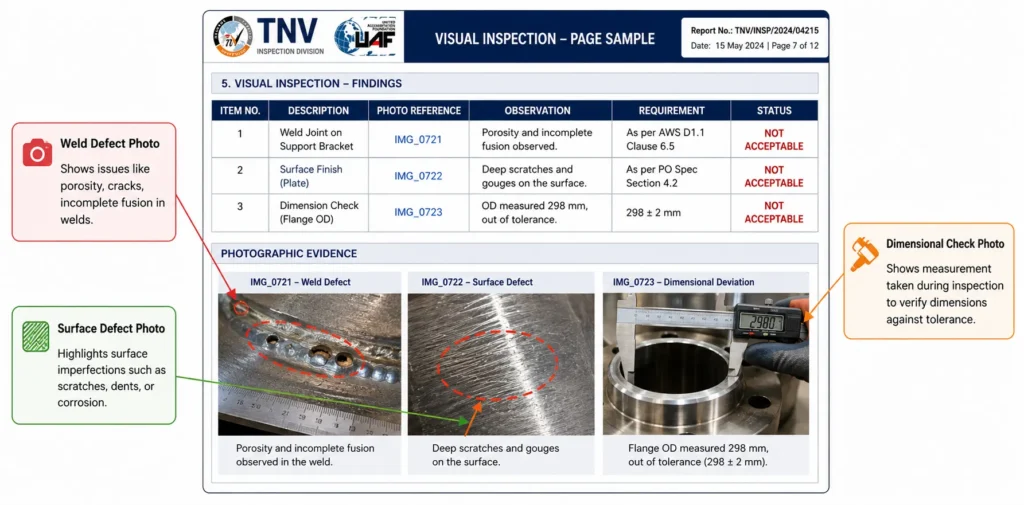
- Photographs showing the defect clearly
If 8 major defects are found, look at what they are. Eight variations of the same defect say, incorrect stitching at the collar tells you it is a systematic production problem, not random variation. That is a supplier conversation you need to have.
Section 5: Photographs Read These as Carefully as the Text
Professional inspection reports from accredited bodies include extensive, timestamped photographs. These are often the most useful part of the entire report and the most skipped.
What to look for in report photographs:
- Product condition photos show the general quality of the goods inspected
- Defect photos close-up images of each defect found, showing exactly what was wrong
- Packaging photos carton condition, labelling, inner packaging
- Measurement photos inspector measuring dimensions with tool visible in frame
- Quantity photos carton count and stacking arrangement
Red flags in photographs:
- Photos that look staged only showing perfect products
- No defect photos despite defects being listed in the text
- Photos without timestamps or date visible
- Photos that do not match the factory location described
A report from a professional accredited inspection body like TNV includes timestamped photographs of both conforming and non-conforming items giving you a complete, honest picture of the shipment’s condition.
Section 6: Packaging and Labelling Findings
Many Indian export shipments that pass product quality checks fail on packaging and labelling. This section of the report tells you whether your goods are ready for international retail.
What this section covers:
- Master carton condition strength, sealing, moisture resistance
- Carton markings product name, quantity, country of origin, shipping marks
- Inner packaging adequate protection, correct materials
- Product labels language, barcode, country of origin, care instructions, regulatory marks (CE, BIS, FSSAI, etc.)
- Barcode scans does it scan correctly to the right product?
Labelling failures are completely preventable and entirely the supplier’s responsibility. If your report flags labelling issues, these must be corrected before shipment they are not minor points. Incorrect country of origin labelling can trigger customs rejection in the destination country.
Section 7: Overall Result and Recommendations
The final section of the report gives the overall inspection verdict Pass, Fail, or Conditional Pass along with inspector observations and recommendations.
- Pass Goods meet the agreed standards. Proceed with shipment with confidence.
- Fail Defects exceed AQL limits or critical defects were found. Do not ship without addressing findings. Work with your supplier on corrective action and arrange re-inspection.
- Conditional Pass / Pending Some elements could not be inspected (e.g., goods not fully packed) or a minor re-check is needed. The report will specify the condition.
Read the recommendations section even on a passing report. Experienced inspectors note observations that do not trigger a fail but indicate risk. “Minor stitching variation within acceptable limits, recommend closer attention to hemming in next production” is useful intelligence about a supplier quality trend.
What to Do with a Failed Inspection Report
A failed report is not the end. It is information arriving at the right time.
- Step 1: Read the specific defects carefully understand exactly what failed and why
- Step 2: Share the relevant sections with your supplier the defect descriptions and photographs
- Step 3: Request corrective action what will they fix, how, and by when?
- Step 4: Document the supplier’s corrective action plan
- Step 5: Schedule re-inspection confirm the specific issues have been resolved before shipment
Do not accept verbal assurances from suppliers after a failed inspection. A re-inspection by the same accredited body provides documented proof that defects were addressed and protects you if disputes arise later.
TNV Inspection Division Reports You Can Actually Use
TNV Inspection Division is India’s first UAF-accredited Type A inspection body under ISO/IEC 17020:2012. Our inspection reports are designed to give Indian buyers and exporters information they can act on not just a pass/fail stamp.
Every TNV report includes:
- Complete AQL data with sample size and accept/reject thresholds
- Defect listings with descriptions, counts, and classifications
- Timestamped photographs of conforming and non-conforming items
- Packaging and labelling findings
- Inspector observations and recommendations
- Unique certificate number verifiable at certificate.tnvib.com
Accreditation: UAF, No. 5241222IB04 | Valid: December 2028 | Type: A
Conclusion
An inspection report is one of the most useful documents in an export or import transaction if you know how to read it.
The pass/fail result is the headline. Everything else the AQL margins, the defect descriptions, the photographs, the packaging findings, the inspector’s recommendations is the story behind it. That story tells you about your supplier’s quality systems, your shipment’s risks, and the decisions you should be making before the next order.
Take the time to read reports in full. Use them as quality intelligence, not just compliance paperwork.
Need inspection reports that give you the full picture? Contact TNV Inspection Division.
📞 +91-9838070227 / +91-9838077603 ✉ tnvindia@gmail.com 🌐 tnvib.com 🔍 Verify accreditation: uafaccreditation.org 📄 Verify certificate: certificate.tnvib.com
Frequently Asked Questions (FAQ)
What does "Pass" mean in a pre-shipment inspection report?
A pass means the defects found in the random sample were within the AQL (Acceptable Quality Level) limits agreed before the inspection. It does not mean zero defects it means the defect level is within commercially acceptable limits. Always check how close the found defects are to the reject threshold, not just whether the report says pass.
What is AQL and why does it matter in an inspection report?
AQL stands for Acceptable Quality Level the maximum number of defects per hundred units that is considered acceptable. The inspection report shows the sample size, the accept/reject thresholds at the agreed AQL level, and the actual defects found. Understanding AQL helps you see not just whether a shipment passed, but how comfortably it passed and whether the supplier's quality is trending toward risk.
What should I do if my inspection report shows a fail result?
Do not ship the goods. Read the specific defects listed not just the overall result. Share the defect descriptions and photographs with your supplier and request a specific corrective action plan with timelines. Once corrections are made, arrange re-inspection with the same accredited body to document that the issues were resolved. This protects you in any subsequent dispute with the buyer.
Why do some inspection reports have photographs and others do not?
Professional accredited inspection bodies always include timestamped photographic evidence in their reports it is part of the standard for quality inspection reporting. Reports without photographs or with only a few generic photos are a sign of inadequate inspection practice. Always request sample reports from a potential inspection company before engaging them. TNV reports include extensive timestamped photographs of products, defects, packaging, and measurements.
How do I verify that an inspection certificate issued in India is genuine?
Every certificate from a genuine accredited inspection body carries a unique report or certificate number. Verify it through the inspection body's official online portal. For TNV Inspection Division, verify any certificate at certificate.tnvib.com by entering the certificate number. This instant verification system confirms authenticity and protects buyers from fraudulent or altered certificates.