
Third Party Inspection Charges for MSMEs in India: Affordable Options
India has over 7.5 crore registered MSMEs. They contribute 45% of total exports and employ more than 33 crore people. But when it comes to quality inspection, most small business owners assume one thing: it is too expensive for them.
That assumption costs them more than the inspection ever would.
A missed LC payment because a buyer required an inspection certificate. A government tender disqualified because third party inspection documentation was missing. A first-time export shipment rejected at a European port.
These outcomes are not rare. They happen to MSMEs who skipped inspection to save ₹10,000 and end up losing ₹5,00,000 or more as a result.
This guide explains exactly what third party inspection charges look like for MSMEs in India, what affordable options exist in 2026, and how small businesses can access accredited inspection services without breaking their budget.
What Third Party Inspection Actually Costs MSMEs in India
The first concern most MSME owners have is straightforward: what does this cost?
Here is the honest answer for 2026:
Inspection Type | Cost Per Inspection | Duration |
Pre-Shipment Inspection (PSI) | ₹8,000 – ₹15,000 | 1 day |
Container Loading Supervision | ₹6,000 – ₹10,000 | 1 day |
During Production Inspection | ₹8,000 – ₹15,000 | 1 day |
Supplier/Vendor Audit | ₹12,000 – ₹25,000 | 1–2 days |
For most MSMEs, the most common requirement is pre-shipment inspection one man-day, typically ₹8,000–₹15,000 per inspection.
To put this in perspective for MSME scale:
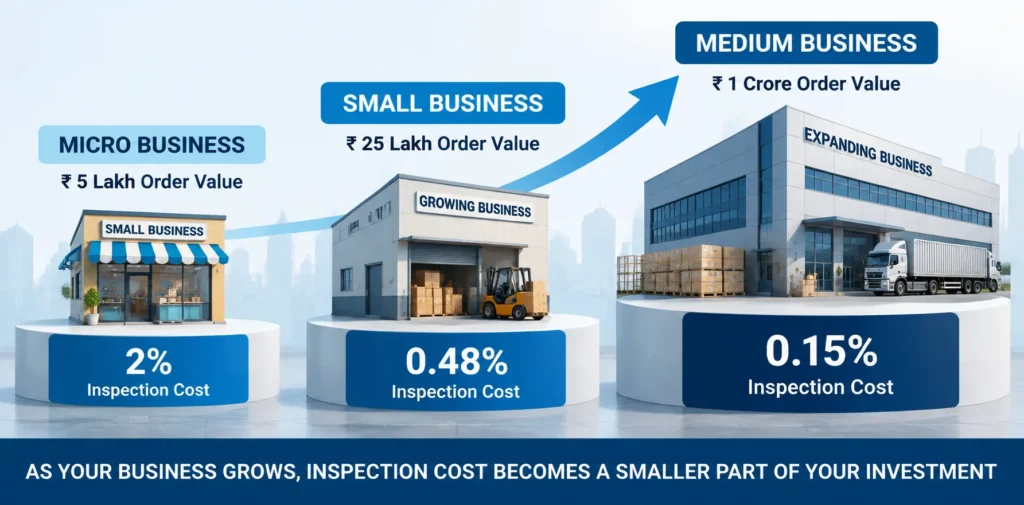
A Micro enterprise with an order value of ₹5 lakhs pays ₹10,000 for inspection 2% of order value. A Small enterprise with an order value of ₹25 lakhs pays ₹12,000 0.48% of order value. A Medium enterprise with an order value of ₹1 crore pays ₹15,000 0.15% of order value.
As a percentage of the order being protected, inspection charges for MSMEs are modest and decrease as your business grows.
Why MSMEs Need Accredited Inspection Not Just Any Inspection
This is where many MSMEs make a costly mistake. They find an unaccredited inspection company offering ₹2,000–₹4,000 per inspection and assume it is the affordable option.
It is not. It is a risk that carries a much higher cost.
Why unaccredited inspection certificates get rejected:
International buyers particularly from Europe, the USA, and the Middle East specify inspection by an ISO/IEC 17020:2012 accredited body in their LC conditions and purchase orders. Banks processing LC payments check accreditation before releasing funds.
Government tenders under GFR 2017 require inspection by recognized inspection bodies. A certificate from an unaccredited company is not a recognized document for these purposes.
An MSME that submits an unaccredited inspection certificate and has it rejected faces:
- LC payment withheld
- Supply rejected at government depot
- Re-inspection required paying for a second, proper inspection
The cost of one rejection erases every rupee saved on cheap inspection many times over.
The affordable option is not the cheapest option. It is the most cost-effective accredited option.
5 Ways MSMEs Can Reduce Third Party Inspection Charges in India
The good news: there are legitimate ways for MSMEs to reduce the cost of third party inspection without compromising on accreditation.
1. Consolidate Multiple Shipments Into Fewer Inspections
If you produce multiple products for the same buyer at the same factory, inspect them together rather than separately. One inspection day covering multiple SKUs or product lines costs the same as one inspection covering a single product. Coordinate production so goods are ready simultaneously and schedule a single inspection day rather than multiple visits.
Potential saving: ₹8,000–₹15,000 per consolidated inspection day.
2. Build Inspection Into Your Order Terms from Day One
Many MSMEs treat inspection as a last-minute addition booked at short notice, often incurring urgency premiums. Building inspection into your production and shipment timeline means booking at standard lead time (3–5 days in advance) and avoiding the 20–30% surcharge on urgent bookings.
Potential saving: ₹1,600–₹4,500 per inspection in avoided urgency premiums.
3. Choose an Inspection Company With Local Inspector Presence
Third party inspection charges increase when inspectors must travel significant distances. Choose an inspection company with genuine local inspector presence in or near your manufacturing location not one that sends inspectors from distant cities.
For MSMEs in major manufacturing clusters Tirupur, Surat, Ludhiana, Pune, Lucknow, Noida, Rajkot, Coimbatore, Kolkata inspection companies with local presence keep travel costs minimal, often included in the base day rate.
Potential saving: ₹3,000–₹10,000 in travel supplements for remote locations.
4. Use During Production Inspection Instead of Post-Production Rework
MSMEs that catch defects during production when only 20–30% is complete save on the cost of reworking or scrapping finished goods. A during production inspection costing ₹10,000 that catches a systematic defect early prevents the cost of reworking 70–80% of the order, which can run into lakhs.
This is not just a cost saving it is a quality investment that prevents the much larger cost of a full order rework or rejection.
Potential saving: ₹2,00,000–₹8,00,000 in prevented rework costs.
5. Include Inspection Cost in Your Product Pricing
This is the mindset shift most MSMEs need: inspection is not an overhead to absorb. It is a cost of doing business in international markets and should be included in your product pricing just like raw materials, labour, and freight.
An MSME exporting at ₹500 per unit needs to add ₹1–₹2 per unit to cover inspection costs on a standard order. International buyers who require inspection are already expecting it to be priced in. Including it explicitly positions your business as a quality-serious supplier which often justifies the price point rather than undermining it.
Government Support for MSME Quality Compliance in India
MSMEs in India have access to government schemes that support quality certification and compliance costs some of which are directly relevant to inspection.
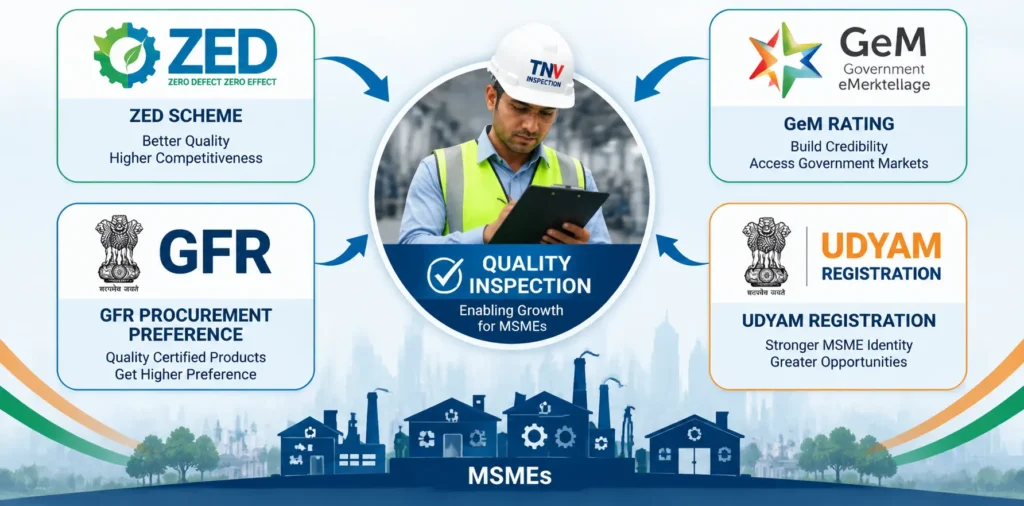
- ZED Certification Scheme (Zero Defect Zero Effect): The Ministry of MSME operates the ZED (Zero Defect, Zero Effect) scheme, which supports MSMEs in achieving quality and environmental standards. ZED-certified MSMEs receive government subsidy support toward quality compliance costs. MSMEs that build a quality assurance system including third party inspection can use ZED certification as an additional credential that strengthens buyer and government tender confidence.
- CLCSS (Credit Linked Capital Subsidy Scheme): For MSMEs investing in technology upgradation including quality testing and inspection equipment CLCSS provides capital subsidy. While this primarily covers equipment, MSMEs building in-house quality systems alongside third party inspection benefit from this support.
- GeM Supplier Quality Rating: MSMEs selling on GeM (Government e-Marketplace) build quality ratings through consistent delivery compliance. Third party inspection certificates for each supply strengthen GeM quality ratings which directly influence order allocation from government buyers. The inspection investment pays back through better GeM ranking and more government orders.
- MSME Procurement Policy: Under the public procurement policy for MSMEs, Udyam-registered businesses receive tender price preference and EMD exemption. To fully benefit, MSMEs must meet quality compliance requirements which in many tenders includes third party inspection. Inspection charges are the gateway cost to accessing procurement preferences worth far more.
What MSMEs Should Look for in an Affordable Inspection Provider
Affordable does not mean cheapest. For an MSME, the right inspection partner is one that:
- Holds ISO/IEC 17020:2012 accreditation verify independently at the accreditation body’s official website, not from the company’s own certificate
- Is classified as Type A fully independent from manufacturers and buyers; essential for LC payment and government tender acceptance
- Has local presence in your manufacturing zone minimizes travel supplements and reduces total cost
- Provides written, all-in quotes no surprise charges added after the day rate
- Delivers reports within 24 hours critical for MSME cash flow and shipment timelines
- Offers online certificate verification your buyer can verify the certificate instantly, building trust without additional paperwork
- Has experience with MSME-scale orders not just large corporate supply chains; inspectors who understand the context of small batch, multi-SKU, seasonal production
Building an MSME Inspection Budget A Simple Framework
Before requesting quotes, estimate your annual inspection budget:
Step 1: Count your expected annual shipments or supply events requiring inspection
Step 2: Multiply by ₹10,000–₹15,000 (standard PSI rate for accredited inspection)
Step 3: Add ₹1,600–₹4,500 per inspection if any are likely to be booked urgently
Step 4: Subtract potential savings from consolidated inspections
Step 5: Include in your product costing for each export order
Example Tirupur garment MSME, 12 shipments/year: 12 × ₹11,000 = ₹1,32,000 annual inspection budget Include as ₹11,000 per shipment in your order cost structure As % of typical order value (₹8 lakhs): 1.375% of revenue fully justified
TNV Inspection Division Accredited Inspection for MSMEs Across India
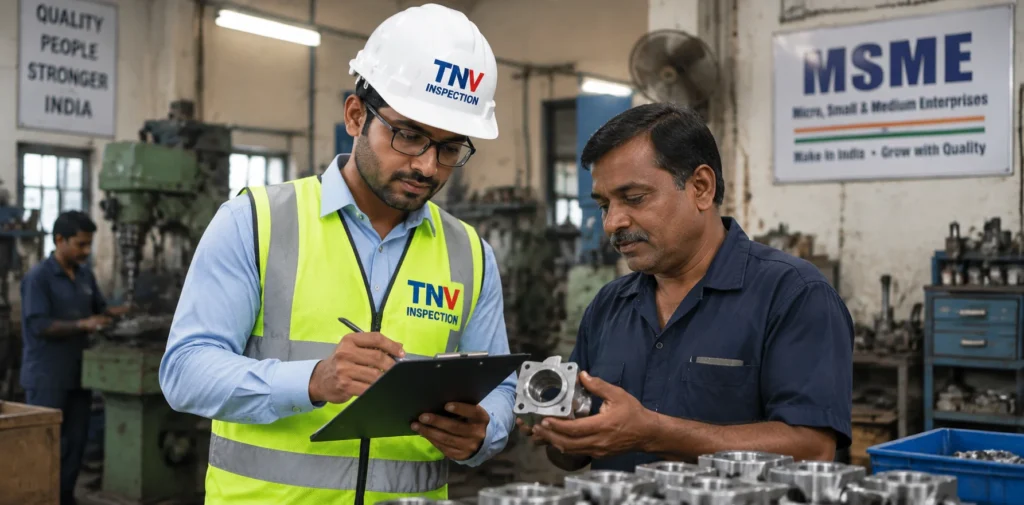
TNV Inspection Division is India’s first UAF-accredited Type A inspection body under ISO/IEC 17020:2012 serving MSMEs, small exporters, and first-time international suppliers since 2011.
Why MSMEs choose TNV:
- Transparent written quotes with no hidden charges
- Pan-India inspector coverage including major MSME clusters
- Reports delivered within 24 hours of inspection
- Online certificate verification at certificate.tnvib.com buyers verify instantly
- UAF Accreditation No. 5241222IB04 accepted in 95+ countries
- Type A independence certificates accepted for LC payment and government tenders
- Experience with MSME-scale orders small batch, seasonal, multi-SKU
UAF Accreditation No. 5241222IB04 | Valid: December 2028 | Type A | ISO/IEC 17020:2012
Verify at uafaccreditation.org | Certificates: certificate.tnvib.com
📞 +91-9838070227 / +91-9838077603 | 🌐 tnvib.com
Conclusion
Third party inspection charges for MSMEs in India are not a barrier to quality compliance they are an investment in it.
At ₹8,000–₹15,000 per inspection, accredited pre-shipment inspection represents less than 2% of most MSME order values. Against the cost of one rejected shipment (₹5,00,000–₹15,00,000+), one held LC payment, or one disqualified government tender, that investment is justified many times over.
The affordable option for Indian MSMEs is not the cheapest inspection on the market. It is the most cost-effective accredited inspection one that delivers a certificate your buyers and government departments will actually accept.
Contact TNV Inspection Division for a written, transparent quote for your MSME’s inspection needs across India.
📞 +91-9838070227 / +91-9838077603 ✉ tnvindia@gmail.com | 🌐 tnvib.com 🔍 Verify accreditation: uafaccreditation.org 📄 Verify certificate: certificate.tnvib.com
Frequently Asked Questions (FAQ)
What is the minimum inspection charge for MSMEs in India?
The minimum third party inspection charge from an accredited inspection body in India typically starts at ₹6,000–₹8,000 per inspection day for simple inspections like container loading supervision or pre-production material checks at factories near major cities. Standard pre-shipment inspection (the most common MSME need) runs ₹8,000–₹15,000 per day. Non-accredited providers quote lower, but their certificates are frequently rejected by buyers and banks which creates a far greater cost than the saving.
Can an MSME afford regular third party inspection in India?
Yes. For most MSMEs, inspection costs 0.5%–2% of order value a manageable overhead when included in product pricing from the start. An MSME doing 12 shipments per year at ₹11,000 per inspection spends ₹1,32,000 annually on quality assurance that protects far larger order values. The question is not whether an MSME can afford inspection it is whether they can afford a single rejection without it.
Are there government schemes that help MSMEs cover inspection costs in India?
Directly subsidized inspection costs are limited, but MSMEs benefit indirectly. The ZED (Zero Defect Zero Effect) certification scheme supports quality compliance investment. GeM platform ratings reward consistent quality delivery, increasing order volume. GFR 2017 procurement preferences give Udyam-registered MSMEs tender advantages but only when they meet quality compliance requirements, including third party inspection. The inspection investment is the gateway cost to accessing procurement preferences worth much more.
How can MSMEs reduce third party inspection charges without compromising quality?
Five practical ways: consolidate multiple shipments into one inspection day, book inspection at standard lead time (3–5 days) to avoid urgency premiums, choose inspection companies with local presence near your factory, use during production inspection to prevent costly rework, and include inspection cost in your product pricing rather than absorbing it. None of these reduce the accreditation standard they reduce unnecessary cost while maintaining the quality of the inspection certificate.
Does TNV provide affordable inspection services specifically for MSMEs?
Yes. TNV Inspection Division serves MSMEs, small exporters, and first-time international suppliers with the same accredited inspection quality provided to larger businesses at the same transparent day rates. TNV's pan-India inspector coverage minimizes travel costs, our 24-hour report delivery supports tight MSME timelines, and our online certificate verification at certificate.tnvib.com means your buyer can confirm authenticity instantl