
FSSAI Inspection Requirements for Food Businesses in India
Every food business operating in India from a small restaurant in Lucknow to a large food manufacturer in Pune exporting to international markets must meet FSSAI inspection requirements under the Food Safety and Standards Act 2006.
In 2026, FSSAI inspection requirements have changed significantly. From 1 April 2026, the regulatory framework was updated with new turnover thresholds for license categories, perpetual licenses replacing time-bound renewals, and a formal shift from calendar-based to risk-based inspections. Food businesses that understood the previous system need to update their compliance approach and those preparing for their first FSSAI inspection need accurate, current guidance.
This guide covers everything food business operators need to know about FSSAI inspection requirements in India in 2026 what types of inspections exist, how the process works, what inspectors check, how compliance is scored, and how to prepare effectively.
FSSAI License Categories Updated 2026 Thresholds
Before understanding inspection requirements, food businesses must understand which license tier applies to them. From 1 April 2026, FSSAI revised the turnover thresholds:
License Type | Annual Turnover | Fee |
Basic Registration | Up to ₹1.5 crore | ₹100/year |
State License | ₹1.5 crore to ₹50 crore | ₹2,000–₹5,000/year |
Central License | Above ₹50 crore | ₹7,500/year |
Important 2026 changes:
- FSSAI licenses and registrations are now perpetual they no longer expire on a fixed date
- Food businesses on ONDC (Open Network for Digital Commerce) now have defined compliance duties
- Street vendors registered under the Street Vendors Act 2014 are deemed registered under FSSAI
Inspection requirements and their frequency vary by license type and risk category. Central license holders large manufacturers, importers, exporters face more rigorous inspection standards than basic registrants.
Types of FSSAI Inspections in India
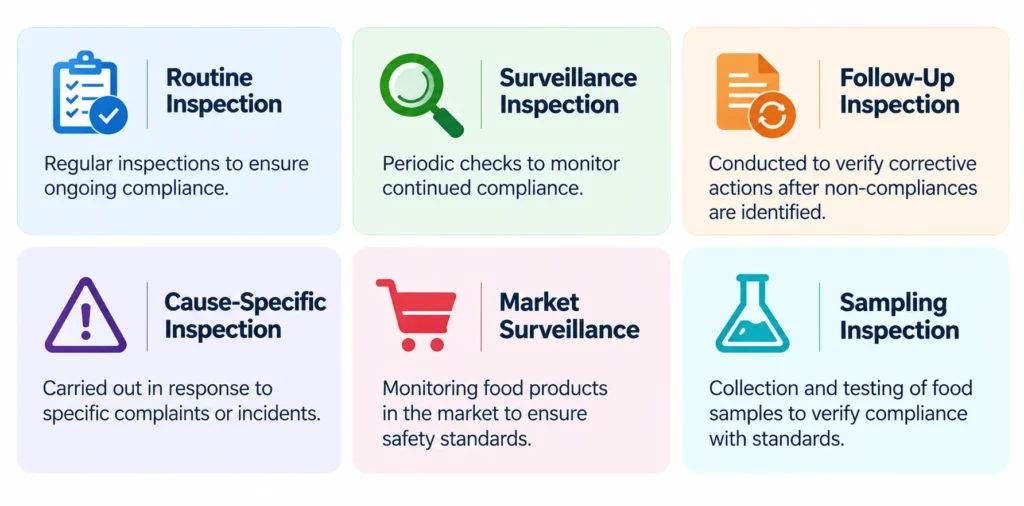
Under FSSAI regulations, Food Safety Officers (FSOs) are empowered to conduct six types of inspections:
- Routine Inspection Planned inspection conducted based on the risk classification of the food business. From 2026, FSSAI has moved from calendar-based (fixed annual or biannual inspections) to risk-based inspections meaning the frequency and intensity of inspection is determined by the risk level of the food business, its compliance history, and the nature of products handled.
- Surveillance Inspection Unannounced inspection to verify day-to-day compliance without prior notice. These “surprise visits” test whether standards maintained during formal inspections are upheld in normal operations.
- Follow-Up Inspection Conducted after a previous inspection identified non-conformities. Verifies that corrective actions have been implemented within the stipulated timeframe.
- Cause-Specific Inspection Triggered by a specific complaint, food safety incident, outbreak, or media report involving a food business. Can be conducted at any time without notice.
- Market Surveillance Inspections at retail level, markets, and points of sale checking labelling compliance, product storage conditions, and expiry dates.
- Sampling Inspection Collection of food samples from business premises for laboratory testing checking microbiological safety, chemical composition, adulteration, and compliance with FSSAI standards.
The FSSAI Inspection Process How It Works
Understanding the FSSAI inspection process helps food businesses prepare effectively and respond correctly when an inspector arrives.
Before the Inspection
For routine inspections, the food business may receive advance notice through the FoSCoS (Food Safety Compliance System) portal at foscos.fssai.gov.in. For surveillance and cause-specific inspections, there is typically no advance notice.
Inspection scheduling for risk-based inspections is determined by FSSAI’s risk classification system, which considers factors including:
- Type of food products handled (high risk vs low risk)
- Scale of operation
- Previous inspection compliance history
- Consumer complaint history
- Nature of processing activities
During the Inspection
The Food Safety Officer arrives and conducts a systematic assessment using FSSAI’s sector-specific inspection checklists which are standardized, downloadable from the FSSAI website, and categorized by food business type.
For each requirement on the checklist, the inspector marks:
- C (Compliant) requirement is met
- NC (Non-Compliant) requirement is not met
- PC (Partial Compliance) requirement is partially met
- NA/NO (Not Applicable/Not Observed) not relevant or not assessed
Each requirement carries 2 marks. Requirements marked with an asterisk (critical requirements) carry 4 marks and failing these automatically triggers overall failure regardless of scores elsewhere.
After the Inspection
The FSO prepares an inspection report documenting all findings. The food business receives:
- Overall compliance score
- Grading based on the FSSAI inspection matrix
- Specific non-conformities requiring corrective action
- Timelines for corrective action implementation
Non-compliance findings must be addressed within stipulated timelines. Follow-up inspection verifies corrective actions.
FSSAI Inspection Scoring and Grading System
FSSAI uses a standardized scoring and grading system for food safety inspections:
Grade | Score | What It Means |
A+ | 90+ | Excellent compliance |
A | 80–89 | Good compliance |
B | 70–79 | Satisfactory compliance |
C | 60–69 | Acceptable compliance |
D | 50–59 | Marginal compliance |
No Grade | Below 50 | Serious non-compliance |
Critical requirements (asterisked) count double 4 marks instead of 2. Failing any critical requirement results in automatic overall failure regardless of the total score. This scoring system creates a direct incentive for food businesses to prioritize critical compliance requirements particularly those related to food safety management systems, hygiene standards, and licencing.
FSSAI Inspection Checklist What Inspectors Actually Check
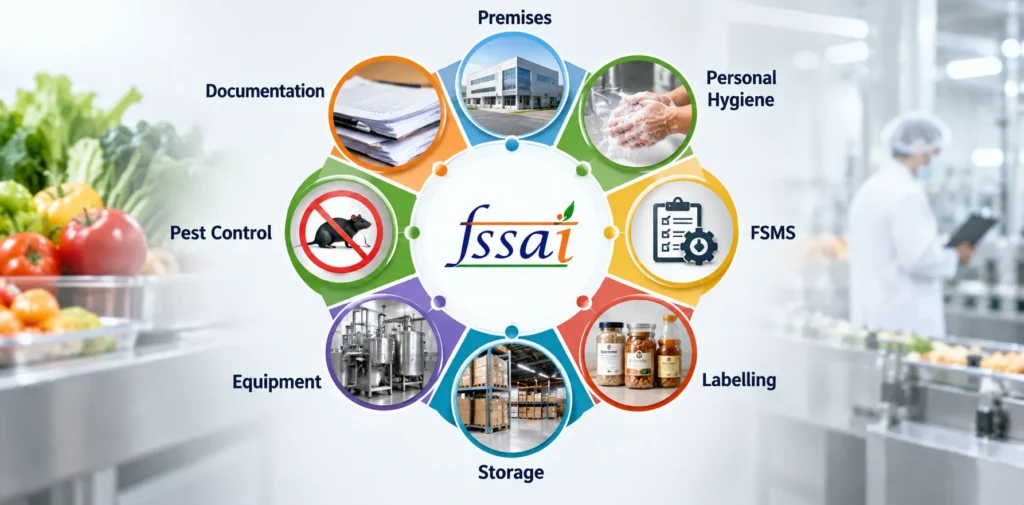
FSSAI inspection checklists are based on the revised Schedule 4 of the Food Safety and Standards (Licensing and Registration of Food Businesses) Regulation 2011. The checklist covers eight core compliance areas:
1. Premises and Infrastructure (Schedule 4, Part I)
- Premises cleanliness and maintenance floors, walls, ceilings, drainage
- Equipment condition, sanitization, and maintenance
- Water quality only potable, tested water for food preparation and cleaning
- Waste disposal systems proper segregation and disposal
- Ventilation and lighting standards for food preparation areas
- Pest control records and effectiveness
2. Personal Hygiene (Schedule 4, Part II)
- Handwashing protocols facilities available and used
- Protective clothing provision and use aprons, gloves, headgear
- Medical fitness certificates for food handlers
- FoSTaC (Food Safety Training and Certification) training compliance mandatory for State and Central license holders
3. Food Safety Management System (FSMS)
- Documented FSMS procedures
- Hazard analysis and critical control points (HACCP) where applicable
- Temperature monitoring logs refrigerators below 5°C
- FIFO (First In, First Out) stock rotation records
- Separation of raw and ready-to-eat foods
4. Food Labelling
- Mandatory label declarations on all packaged products
- FSSAI license number on label
- Nutritional information, ingredients, allergen declarations
- Manufacturing date, best before/expiry date
- Country of origin for imported food products
5. Food Storage and Handling
- Cold chain maintenance and temperature log records
- Dry storage conditions humidity, temperature
- Separation of food from non-food items and chemicals
- Condition and cleanliness of storage containers
6. Equipment and Utensils
- Food-grade materials for all contact surfaces
- Equipment sanitization records
- Calibration of weighing and measuring instruments
- No use of cracked or damaged equipment
7. Pest Control
- Pest control records professional treatment schedules
- No evidence of pest activity
- Physical barriers screens, door seals
- Chemical records only approved pesticides used
8. Documentation and Records
- FSSAI license/registration displayed prominently
- FoSTaC training certificates for required staff
- Supplier records traceability documentation
- Complaint handling records
- Internal audit records
Key 2026 Changes Affecting FSSAI Inspection Requirements
Shift to Risk-Based Inspections
The most significant operational change from 1 April 2026 is the formalization of risk-based inspections replacing fixed-calendar inspections. This means:
- High-risk food businesses dairy, meat, ready-to-eat, infant food face more frequent inspections
- Low-risk businesses with clean compliance histories may face less frequent routine inspections
- Poor compliance history will trigger increased surveillance frequency
- FSSAI’s data-driven approach means past inspection scores directly influence future inspection scheduling
Product Amendments (Effective February 1, 2026)
FSSAI product amendments notified on July 10, 2025 took effect from February 1, 2026 affecting food standards, labelling requirements, and permitted additives for several food categories. Food businesses must verify their products comply with post-amendment standards.
Perpetual Licenses
From 1 April 2026, FSSAI licenses no longer have fixed expiry dates. While this removes the renewal deadline pressure, it increases the importance of ongoing compliance since there is no mandatory renewal review to trigger compliance updates.
Standardised Risk Assessment Format
From 1 January 2026, all representations seeking risk assessment from FSSAI must follow a standardized scientific format submitted through FoSCoS.
Consequences of Non-Compliance with FSSAI Inspection Requirements
FSSAI has significant enforcement powers under the Food Safety and Standards Act 2006:
- Improvement Notices: For minor non-compliance, FSOs can issue improvement notices requiring corrective action within specified timelines.
- Prohibition Orders: For serious food safety risks, FSOs can prohibit a food business from operating or restrict specific activities immediately if risk is imminent.
- Product Recall: Non-compliant products can be recalled from the market through the FoSCoS portal now the mandatory channel for all food recalls from 2026.
- Financial Penalties: Fines ranging from ₹1 lakh for minor offences to ₹10 lakh for serious violations. Adulteration causing grievous hurt or death attracts criminal prosecution.
- License Cancellation: Repeated non-compliance or serious violations can result in FSSAI license cancellation effectively closing the business.
How Third-Party Inspection Supports FSSAI Compliance
Many food businesses particularly manufacturers, exporters, and larger operators use independent third-party inspection and audit services alongside mandatory FSSAI inspections for several reasons:
- Pre-Inspection Gap Assessment: A third-party audit before an FSSAI inspection identifies compliance gaps while corrections can still be made not during the official inspection when findings are formally recorded.
- Export Compliance: Indian food exporters need quality verification beyond FSSAI for international markets. Buyers in Europe, the USA, and the Middle East require independent inspection certificates alongside FSSAI documentation.
- APEDA Requirements: For agricultural and processed food exports through APEDA-registered exporters, independent third-party quality verification is commonly required.
- Continuous Compliance Monitoring: With risk-based inspections now formally in place, food businesses with strong compliance track records face less frequent official inspections. Third-party audits help maintain and document that compliance record.
TNV Inspection Division provides independent food safety and quality inspection services for food manufacturers, processors, and exporters in India supporting both domestic compliance and international export requirements.
UAF Accreditation No. 5241222IB04 | ISO/IEC 17020:2012 | Type A | Valid: December 2028
📞 +91-9838070227 | 🌐 tnvib.com | Verify: uafaccreditation.org
Conclusion
FSSAI inspection requirements in India in 2026 reflect a more sophisticated, risk-proportionate regulatory approach than the fixed-calendar system they replaced. Food businesses that understand what inspectors look for, maintain Schedule 4 compliance continuously, complete FoSTaC training requirements, and keep accurate operational records are well positioned under the new framework.
The shift to risk-based inspections creates both opportunity and risk: food businesses with strong compliance track records earn reduced inspection frequency, while those with poor histories face increased scrutiny. Investing in continuous compliance not just pre-inspection preparation is now the correct strategic response to FSSAI inspection requirements.
For food manufacturers and exporters who need to meet both FSSAI requirements and international buyer standards, independent third-party inspection services from accredited bodies provide the additional quality verification layer that domestic compliance alone does not cover.
Contact TNV Inspection Division for food quality inspection support across India.
📞 +91-9838070227 / +91-9838077603 ✉ tnvindia@gmail.com | 🌐 tnvib.com 🔍 Verify accreditation: uafaccreditation.org 📄 Verify certificate: certificate.tnvib.com
Frequently Asked Questions (FAQ)
What is the FSSAI inspection process for food businesses in India?
FSSAI inspections are conducted by Food Safety Officers (FSOs) using sector-specific checklists based on Schedule 4 of the Licensing and Registration Regulations 2011. FSOs assess each requirement as compliant, non-compliant, partially compliant, or not applicable. Standard requirements score 2 marks; critical requirements (marked with asterisks) score 4 marks. Failing any critical requirement results in automatic overall failure. The final score determines a grade from A+ (90+) to no grade (below 50). From 2026, inspections are risk-based frequency depends on business risk level and compliance history.
What is the FSSAI inspection checklist based on?
FSSAI inspection checklists are based on the revised Schedule 4 of the Food Safety and Standards (Licensing and Registration of Food Businesses) Regulation 2011. They cover eight areas: premises and infrastructure, personal hygiene, food safety management system, food labelling, storage and handling, equipment and utensils, pest control, and documentation. FSSAI publishes sector-specific inspection checklists on its official website at fssai.gov.in that food businesses can use to prepare for inspections.
What are the most common reasons food businesses fail FSSAI inspections?
The most frequently cited non-compliance findings in FSSAI inspections include: inadequate pest control records or evidence of pest activity; improper temperature maintenance and temperature log records; absence of medical fitness certificates for food handlers; FoSTaC training not completed by required staff; poor premises hygiene particularly drainage and waste disposal; labelling non-compliance including missing FSSAI license numbers; and inadequate traceability documentation. Critical requirements in any of these areas result in automatic inspection failure.
Is FoSTaC training mandatory for all food businesses in India?
FoSTaC (Food Safety Training and Certification) training is mandatory for State License and Central License holders in India specifically, at least one trained and certified food safety supervisor must be present at each food establishment. Basic registration holders are encouraged to undergo FoSTaC training but it is not currently mandatory for them. From 2026, with risk-based inspections formally in place, FoSTaC compliance is increasingly scrutinized during inspections of State and Central license holders.
What is the difference between FSSAI inspection and third-party food safety audit?
FSSAI inspection is a mandatory regulatory assessment conducted by Government Food Safety Officers using official checklists the outcome is a formal compliance record with legal consequences for non-compliance. A third-party food safety audit is conducted by an independent inspection body engaged by the food business for purposes such as pre-inspection gap identification, international buyer requirements, export certification, or internal quality assurance. Third-party audits do not replace FSSAI inspections but complement them particularly for exporters who must meet both domestic FSSAI requirements and international buyer standards simultaneously.