
How to Reduce Product Defects Before Shipment: A Guide for Indian Manufacturers
One rejected shipment can cost more than ten inspections.
Return freight, re-inspection fees, replacement production, delayed payment, and a buyer who now questions every future order these costs add up fast. For Indian manufacturers competing in international markets, defects are not just a quality problem. They are a business risk.
The good news: most product defects that cause shipment rejections are preventable. Not at the end but at every stage of the production process, starting with the raw materials that arrive at your gate.
This guide walks through a practical, stage-by-stage approach to reducing product defects before shipment for manufacturers across textiles, engineering, consumer goods, food, electronics, and beyond.
Why Defects Happen in Indian Manufacturing
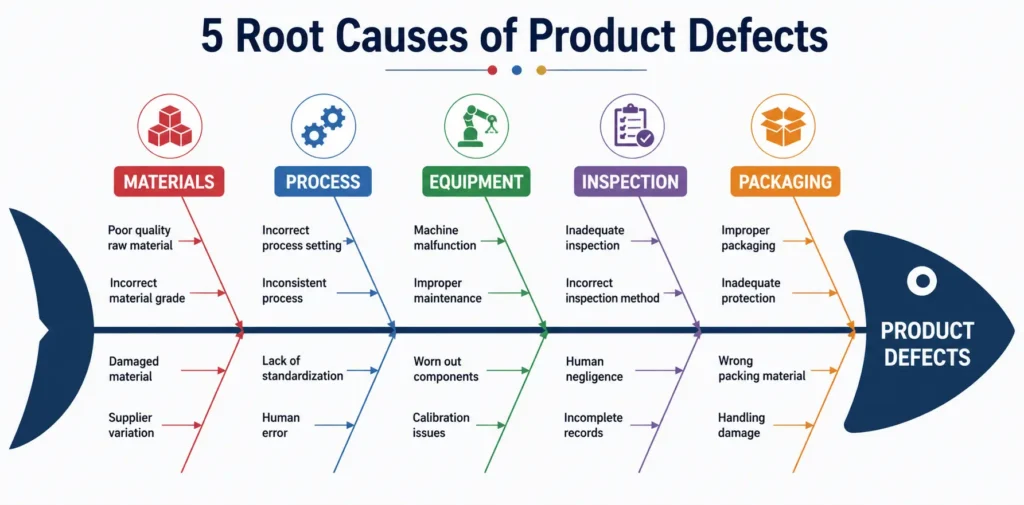
Before fixing a problem, understand where it comes from. Most product defects in Indian manufacturing trace back to one of five root causes:
- Substandard raw materials components or materials that do not meet specification, accepted without proper incoming inspection
- Process deviations workers skipping steps, using wrong settings, or rushing to meet production targets
- Equipment issues machines running out of calibration, worn tooling, inconsistent output across production runs
- Inadequate in-process checks defects building up through production without being caught and corrected
- Packaging failures goods that pass product inspection but fail on incorrect labels, damaged cartons, or wrong quantities
Identifying which of these is your primary defect source is the first step. Most Indian factories have more than one.
Stage 1: Start at Incoming Inspect Raw Materials Before They Enter Production
The most cost-effective point to catch a defect is before it enters your production process.
A substandard fabric lot that goes undetected at goods receipt will produce defective garments across an entire production run. A batch of components with incorrect dimensions will create assembly failures at every stage downstream. By the time the defect is visible in finished goods, you have wasted materials, labour, and time.
What to do:
- Establish written acceptance criteria for every raw material and component you use
- Conduct incoming material inspection against those criteria before accepting delivery not after
- Use AQL sampling for large consignments rather than checking every piece
- Reject or quarantine non-conforming materials immediately do not let them enter production
- Document what was received, what was checked, and what was accepted or rejected
For critical inputs specialty fabrics, precision components, food ingredients consider having a pre-production inspection conducted by a third-party inspection company at your supplier’s location before goods are even dispatched to you. Catching problems at source is cheaper than catching them at your factory.
Stage 2: Control the Process Do Not Wait Until the End to Check Quality
In-process quality control is where most Indian manufacturers have the biggest gap.
Many factories rely on a final check at the end of production to catch defects. By that point, the damage is done an entire batch may need rework or rejection. The principle of in-process control is simple: catch deviations early, while corrections are still cheap.
What to do:
- Define quality checkpoints at each stage of your production process not just at the end
- Train supervisors and line inspectors on what to check and how to classify defects
- Use control sheets at each workstation inspectors record findings in real time, not from memory at the end of the shift
- Set action thresholds: if the defect rate at any checkpoint exceeds a defined level, stop the line and investigate before continuing
- Photograph defects when found this creates a record and makes root cause analysis easier
For high-volume production runs garments in Tirupur, engineering components in Rajkot, consumer goods in UP during production inspection (DPI) by a third-party inspection body when 20–30% of production is complete gives you an independent view of quality before the entire batch is finished. Non-conformities identified at this stage are far cheaper to correct than after full production.
Stage 3: Use AQL Sampling Correctly Not Just as a Formality
AQL (Acceptable Quality Level) is the statistical sampling standard used in most professional product quality inspection. Many Indian manufacturers use AQL in name only they sample too few units, apply the wrong AQL level, or treat it as a formality rather than a real decision tool.
What AQL actually tells you:
AQL sampling defines how many units to inspect from a production lot and how many defects are acceptable before the lot is rejected. Common standards are AQL 2.5 for major defects and AQL 4.0 for minor defects.
If your lot size is 5,000 units, AQL 2.5 requires you to inspect around 200 units. If you find more than 14 major defects in that sample, the lot fails regardless of how good the rest looks.
What to do:
- Apply the correct sample size from AQL tables based on your actual lot size
- Use the AQL level your buyer specifies not a looser standard because it is more convenient
- Train your QC staff to classify defects correctly critical, major, minor not just pass everything that is not completely broken
- Record AQL results for every production run over time, this data shows you where defects concentrate and whether your quality is improving
Stage 4: Packaging and Labelling The Last-Mile Defect That Costs the Most
Many Indian manufacturers pass product quality inspection only to fail on packaging and labelling. These failures are entirely preventable and buyers treat them as seriously as product defects.
Common packaging failures in Indian export production:
- Cartons that crush in transit because they do not meet burst strength requirements
- Incorrect or missing country of origin marking
- Barcode that scans to the wrong product
- Labels in English only when the destination market requires French, German, or Arabic
- Missing care instructions, CE marking, BIS certification marks, or FSSAI numbers
- Quantities in cartons that do not match the packing list
What to do:
- Check every packaging element against your buyer’s requirements before the production run starts not after packaging is complete
- Test carton strength physically especially for goods that will travel by sea
- Scan every barcode before packing do not assume it is correct
- Conduct a labelling audit on a sample of packed cartons check every required element
- Keep buyer-approved packaging specifications on file and confirm they are current before each shipment
Stage 5: Pre-Shipment Inspection Your Last Line of Defence Before Goods Leave
Even with all the above controls in place, a professional product inspection before shipment by an independent, accredited third-party inspection body is the final and most important quality checkpoint.
Here is why this step matters even if your internal quality is strong:
- Your internal team has a production target. An independent inspector does not.
- Your workers know where the good goods are. A random sampling protocol prevents selective presentation.
- Your buyer trusts an independent accreditation body. They may not trust your self-declaration.
A pre-shipment inspection in India by a UAF-accredited Type A body checks everything product quality, AQL results, packaging condition, labelling compliance, quantity verification against your purchase order and buyer specifications. The report gives both you and your buyer documented, independent confirmation that the shipment is ready.
What happens during a professional pre-shipment inspection:
- Random AQL sampling of finished, packed goods
- Visual and functional examination against specifications
- Measurements and test results where applicable
- Packaging and labelling compliance check
- Quantity verification against packing list
- Detailed report with timestamped photographs delivered within 24 hours
If inspection finds issues at this stage, you fix them before the container is sealed not after the goods arrive at a port overseas.
Quick Reference: Defect Reduction Checklist for Indian Manufacturers
Stage | Action | When |
Incoming | Inspect raw materials on arrival | Before production starts |
In-Process | Check quality at each production stage | During production |
AQL Sampling | Apply correct sample size and thresholds | End of production run |
Packaging | Verify carton strength, labels, barcodes | Before packing is complete |
Pre-Shipment | Independent third-party product inspection | 80–100% goods packed |
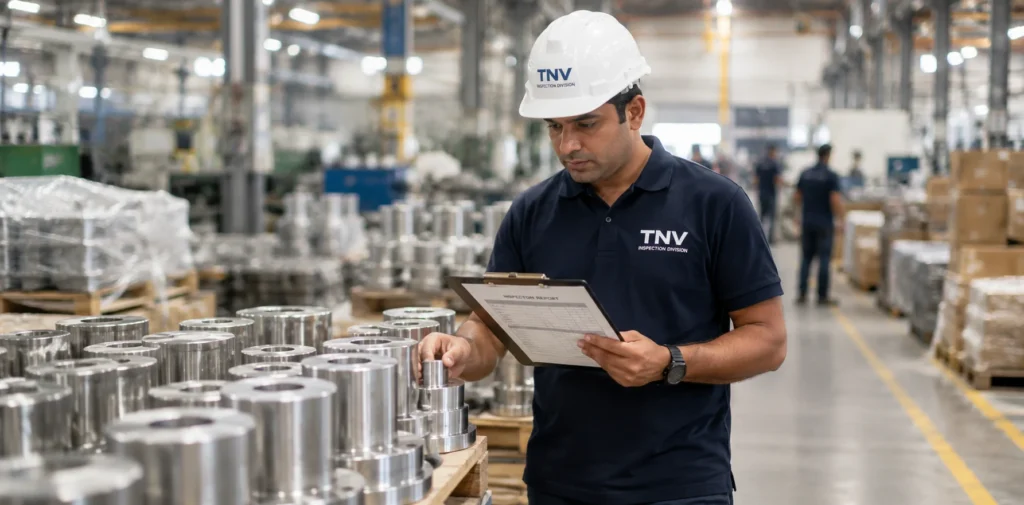
TNV Inspection Division Defect Prevention Through Independent Inspection
TNV Inspection Division is India’s first UAF-accredited Type A inspection body under ISO/IEC 17020:2012, providing independent product quality inspection and pre-shipment inspection services across India since 2011.
Our inspection services for Indian manufacturers include:
- Pre-production inspection of raw materials and supplier readiness
- During production inspection at critical milestones
- Final and pre-shipment inspection with AQL sampling
- Container loading supervision
- Detailed reports with timestamped photographs within 24 hours
UAF Accreditation No. 5241222IB04 | Valid: December 2028 | Type A fully independent
Verify our accreditation at uafaccreditation.org | Verify any certificate at certificate.tnvib.com
Conclusion
Reducing product defects before shipment is not about one check at the end. It is a stage-by-stage discipline starting with raw materials, continuing through production, and ending with independent pre-shipment inspection before goods leave your facility.
Indian manufacturers who build this framework into their production process do not just reduce defect rates. They reduce buyer complaints, improve repeat order rates, and compete more effectively in markets where quality is non-negotiable.
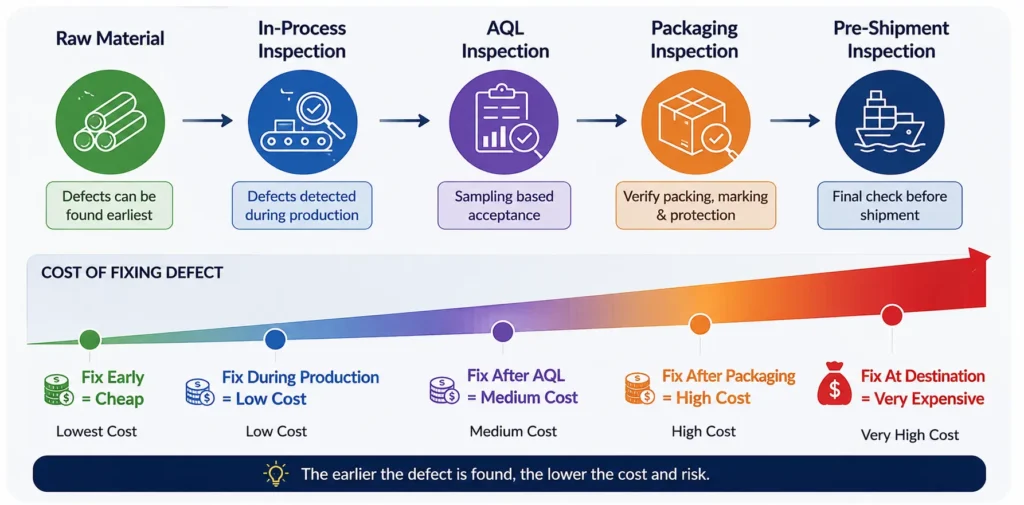
The most expensive defect is the one your buyer finds. Everything else catching it at raw material stage, at in-process inspection, or at pre-shipment is cheaper, faster, and better for your business.
Ready to add independent product inspection to your quality process? Contact TNV Inspection Division.
📞 +91-9838070227 / +91-9838077603 ✉ tnvindia@gmail.com 🌐 tnvib.com 🔍 Verify accreditation: uafaccreditation.org 📄 Verify certificate: certificate.tnvib.com
Frequently Asked Questions (FAQ)
At what stage of production should I catch defects to minimize cost?
The earlier the better always. Defects caught during incoming material inspection cost almost nothing to fix. Defects caught during in-process inspection require rework but avoid scrapping finished goods. Defects caught at pre-shipment inspection can still be corrected before shipment. Defects discovered after goods arrive at the buyer's warehouse are the most expensive involving return freight, replacement production, and potential loss of the buyer relationship.
How does pre-shipment inspection in India help reduce defects?
Pre-shipment inspection by an independent third-party inspection body provides an objective, AQL-based examination of finished goods before shipment. The inspector has no production pressure their only job is to report what they find. This catches defects, packaging failures, and labelling errors that internal quality teams miss due to familiarity, time pressure, or selective presentation of goods. Issues identified during pre-shipment inspection can still be corrected at the factory far cheaper than dealing with them at the destination.
My products pass internal quality checks but buyers still complain. Why?
The most common reasons are: internal QC teams inspect under time pressure and accept borderline items; internal inspection uses a smaller sample than AQL tables require; packaging and labelling failures are not caught because the focus is on product quality only; and buyers apply stricter acceptance criteria than the factory applies internally. An independent pre-shipment inspection using buyer-specified AQL levels and standards provides an objective view that internal inspection often misses.
How do I choose the right third-party inspection company for pre-shipment inspection in India?
Choose a company that holds ISO/IEC 17020:2012 accreditation from a recognized body (verify independently at the accreditation body's website), operates as a Type A inspection body (fully independent from manufacturers and buyers), has specific experience inspecting your product type, and delivers detailed photographic reports within 24 hours. For TNV Inspection Division, verify UAF accreditation at uafaccreditation.org and verify any issued certificate at certificate.tnvib.com.