
PNGRB Inspection Requirements for Pipelines and CGD Networks in India
India’s natural gas infrastructure is expanding rapidly. With over 22,000 km of natural gas pipelines and city gas distribution (CGD) networks authorized across more than 250 geographical areas, the Petroleum and Natural Gas Regulatory Board (PNGRB) maintains a comprehensive framework of mandatory inspection and audit requirements that every pipeline operator and CGD entity must comply with.
Understanding PNGRB inspection requirements is essential for project developers, pipeline operators, CGD companies, and contractors working in India’s regulated natural gas sector. Non-compliance carries serious consequences including project delays, financial penalties under Section 28 of the PNGRB Act 2006, suspension of authorization, and in severe cases, revocation of operating licenses.
This guide explains the PNGRB inspection framework in detail the technical regulations that apply, the three main audit types, the Third Party Inspection Agency (TPIA) empanelment system, and what the inspection process involves at each stage.
What Is PNGRB and Why Does It Mandate Inspection?
The Petroleum and Natural Gas Regulatory Board (PNGRB) was established under the PNGRB Act 2006 to regulate the refining, processing, storage, transportation, distribution, marketing, and sale of petroleum, petroleum products, and natural gas excluding production activities.
PNGRB’s mandate includes:
- Setting technical and safety standards for pipeline and CGD infrastructure
- Ensuring compliance with those standards through mandatory third-party inspection and audit
- Authorizing and monitoring Third Party Inspection Agencies (TPIAs) to conduct compliance audits
- Protecting consumer interests and safety across the gas supply chain
For pipeline and CGD operators, PNGRB inspection requirements are not optional compliance suggestions. They are legally mandated obligations backed by the PNGRB Act 2006, with penalties for non-compliance.
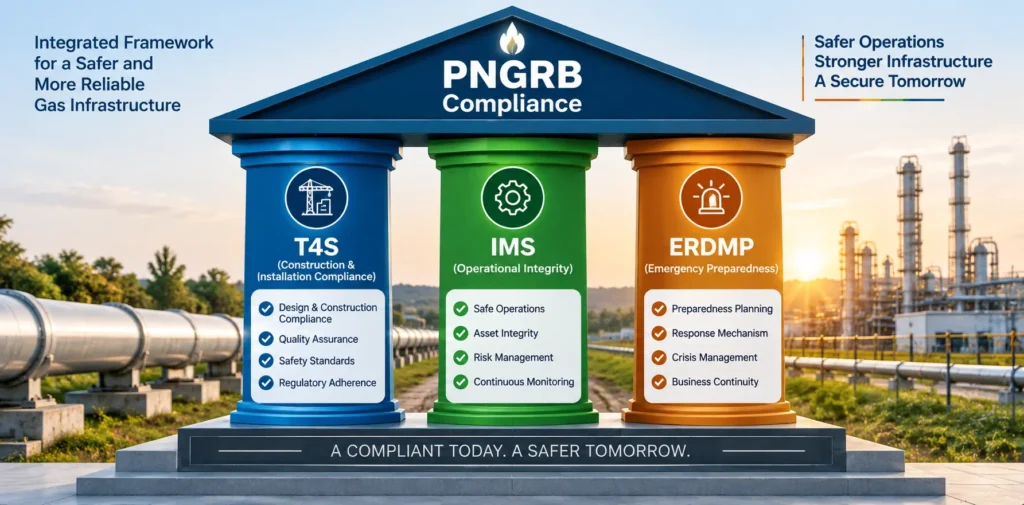
The Three Core PNGRB Regulatory Frameworks That Require Inspection
PNGRB has established three primary technical and safety regulations that trigger mandatory third-party inspection requirements:
1. T4S Technical Standards and Specifications (CGD Networks)
PNGRB Technical Standards and Specifications (T4S) cover the complete lifecycle of CGD infrastructure design, material selection, construction, installation, inspection, testing, commissioning, operation, and maintenance. T4S applies to:
- Steel and polyethylene (PE) pipelines in CGD networks
- City gas distribution pressure reduction stations (CDRS)
- District Regulation Stations (DRS)
- Metering and Regulation Stations (MRS)
- Service lines and internal piping (IP)
Under T4S regulations, third-party inspection is mandatory at specific construction and installation stages. PNGRB-empaneled TPIAs must conduct T4S audits to verify that infrastructure has been built, installed, and commissioned in accordance with technical standards.
Key T4S inspection requirement: For internal piping operating at pressure 4 bar(g) or above, Non-Destructive Examination (NDE) and soundness testing must be carried out per T4S standards. All defects identified during NDE must be repaired before gas-in approval.
2. IMS Integrity Management System
The PNGRB Integrity Management System (IMS) regulations require pipeline and CGD operators to establish, implement, and maintain a documented integrity management system covering the entire operational lifecycle of their infrastructure.
IMS audits verify that operators:
- Have documented and implemented integrity management procedures
- Conduct regular internal inspections and maintenance as per IMS requirements
- Maintain proper records of inspections, incidents, and corrective actions
- Operate effective emergency control systems
- Conduct HAZOP (Hazard and Operability Study) and risk assessments
IMS audits must be conducted by PNGRB-empaneled TPIAs at prescribed intervals.
3. ERDMP Emergency Response and Disaster Management Plan
Under the PNGRB (Codes of Practices for Emergency Response and Disaster Management Plan) Regulations 2010, all pipeline and CGD operators must have an approved Emergency Response and Disaster Management Plan. PNGRB maintains a separate list of TPIAs authorized to certify ERDMP compliance.
ERDMP certification requires independent assessment of the operator’s emergency preparedness, response procedures, communication systems, training programmes, and mock drill records.
PNGRB TPIA Empanelment What Qualifies a Third Party Inspection Agency
PNGRB maintains separate lists of empaneled Third Party Inspection Agencies (TPIAs) for different categories:
- CGD Networks
- Natural Gas Pipeline Networks
- Petroleum Product Pipeline Networks
- LNG Facilities
- LPG Storage, Handling, and Bottling Facilities
- ERDMP Certification
Not every inspection body can conduct PNGRB compliance audits. The Board specifies requirements for TPIA empanelment:
- Accreditation Requirement: The TPIA must hold accreditation under ISO/IEC 17020 or other applicable standards as specified by PNGRB. This independently verifies the inspection body’s technical competence and quality management system.
- Experience Requirement: The TPIA must have a minimum of 5 years of experience in the oil and gas sector for the category for which empanelment is sought. Auditors conducting IMS audits should have a minimum of 15 years overall technical experience and have conducted at least 3 prior audits of PNGRB technical regulations.
- Personnel Requirements: PNGRB specifies minimum ratios of Technical Managers to Supervisors/Inspectors within the TPIA organization.
- Management System: The TPIA must demonstrate a functioning quality management system aligned with ISO/IEC 17020.
- Renewal: Empanelment is subject to renewal TPIAs must maintain their accreditation, personnel requirements, and experience standards to remain on PNGRB’s approved list.
This structured empanelment system ensures that only technically qualified, independently accredited inspection bodies conduct mandatory compliance audits for India’s critical gas infrastructure.
Stage-Wise Inspection Requirements for Pipeline Construction and CGD Networks
PNGRB inspection requirements apply across the complete project lifecycle not just at commissioning:
Pre-Construction Stage
Before construction begins, PNGRB and applicable T4S standards require:
- Design review and technical document verification
- Material certification and inspection of pipes, fittings, valves, and equipment
- Welding procedure qualification all welding must be carried out by qualified welders per API 1104 standards
- Quality plan review and approval
Construction Stage
During construction, TPIAs verify:
- Pipe laying and alignment compliance with T4S specifications
- Welding quality and Non-Destructive Examination (NDE) for welds above specified pressure thresholds
- Joint inspection for IP pipework at pressure up to 4 bar, all welded and threaded joints must be inspected
- Cathodic protection installation for buried steel pipelines
- Valve and fitting installation compliance
Pre-Commissioning and Commissioning Stage
Before gas-in approval:
- Pressure testing complete pipeline tested at specified test pressure for defined duration
- Soundness testing and leak detection all joints checked using approved leak detection methods
- NDE for pipelines above 4 bar(g) operating pressure
- Gas-in approval from CGD entity or PNGRB empaneled TPIA required before introducing gas into the network
- Any alteration or addition to internal piping post gas-in requires TPIA approval
Operational Stage (Ongoing)
During operations, PNGRB inspection requirements include:
- Annual leak surveys for CGD networks
- Periodic IMS audits by empaneled TPIAs
- ERDMP certification renewal
- Cathodic protection monitoring and maintenance
- Regular integrity assessment of ageing infrastructure
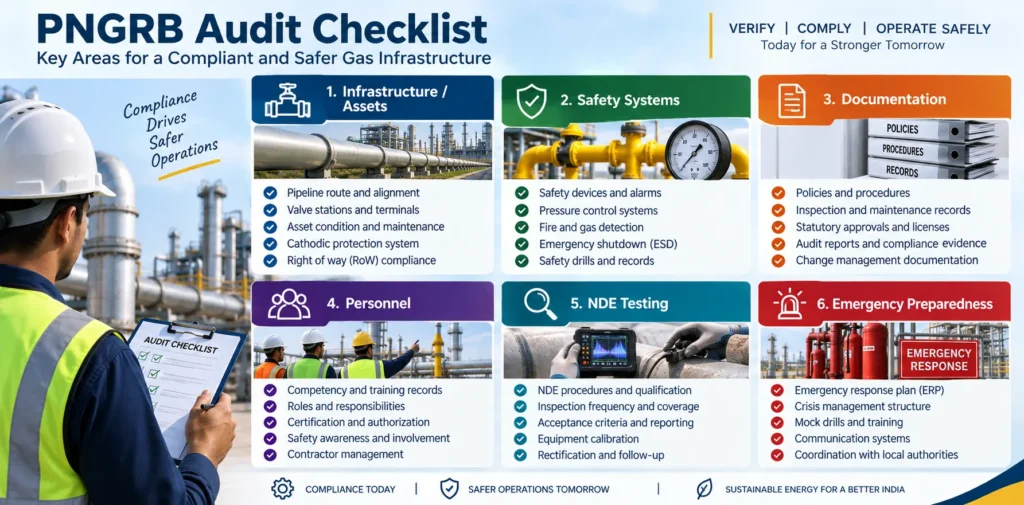
PNGRB Inspection Checklist Key Areas Verified During Compliance Audits
PNGRB compliance audits conducted by empaneled TPIAs typically verify the following areas:
Infrastructure and Asset Compliance:
- Pipeline materials, specifications, and installation conformance with T4S
- Valve maintenance API 6D/API 600 Gate/Ball/Plug valves
- Cathodic protection systems installation and functioning
- Control room and emergency control room designation and operation
Safety and Operational Systems:
- Work Permit System implementation
- Odorant dosing records and compliance
- Assembly points marking and emergency response readiness
- Warning signage at appropriate locations
- HAZOP and Quantitative Risk Assessment (QRA) documentation
Documentation and Records:
- Data management systems for asset design, manufacturing, and inspection records
- Maintenance records for all critical equipment
- Incident investigation records and corrective action implementation
- Communication plan effectiveness evidence
- ERDMP documentation and mock drill records
Personnel and Competency:
- Qualified welder certifications (API 1104)
- Operator and maintenance staff competency records
- HSE training records
Key Standards Referenced in PNGRB Inspection Requirements
PNGRB technical regulations reference several international and Indian standards:
Standard | Application |
PNGRB T4S for CGD Networks | Complete technical standard for CGD design, construction, operation |
API 1104 | Welding of Pipelines and Related Facilities |
API 6D | Pipeline and Piping Valves |
ISO/IEC 17020 | Inspection Body Competence (for TPIA accreditation) |
IS 16087:2025 | India’s national specification for biogas/biomethane (new 2026 CBG guidelines) |
HAZOP Methodology | Hazard and Operability Study for risk assessment |
BS EN 15001-1 | Gas infrastructure Gas installation pipework |
PNGRB's 2026 Transparency Initiative
In 2026, PNGRB launched an initiative to webhost Third Party Inspection Reports on its platform a significant step toward advancing transparency, accountability, and public confidence in India’s natural gas infrastructure compliance.
This development has important implications for pipeline operators and CGD entities:
- Inspection findings are now more visible to regulators, stakeholders, and the public
- Non-compliance issues identified in TPIA audits are documented in the public domain
- Operators face greater accountability for timely corrective action on audit findings
- The quality and credibility of the TPIA conducting compliance audits matters more than ever
Choosing a genuinely accredited, technically qualified TPIA one whose findings will withstand public scrutiny is now both a compliance obligation and a reputational imperative.
Consequences of Non-Compliance with PNGRB Inspection Requirements
Failing to meet PNGRB inspection requirements carries serious consequences:
- Financial Penalties: Under Section 28 of the PNGRB Act 2006, the Board can impose significant financial penalties for non-compliance with its regulations.
- Project Delays: Without mandatory TPIA clearances including gas-in approval from empaneled TPIAs projects cannot proceed to commissioning. Delayed inspections directly delay project timelines.
- Authorization Risk: Repeated or serious non-compliance can lead to suspension or revocation of PNGRB operating authorization.
- Legal Liability: Accidents or incidents on non-compliant infrastructure carry legal and financial liability for operators.
- Reputational Risk: With PNGRB’s 2026 transparency initiative, inspection findings are now increasingly visible making compliance failure a reputational as well as regulatory issue.
How TNV Inspection Division Supports PNGRB Compliance
TNV Inspection Division provides specialized third-party inspection services for companies operating in India’s oil and gas sector including support for PNGRB-regulated pipeline and CGD network projects.
Our oil and gas inspection services include:
- Stage-wise inspection for pipeline construction and CGD network installation
- Non-Destructive Testing (NDT) ultrasonic, radiographic, magnetic particle, dye penetrant testing
- Welder qualification verification (API 1104)
- Material inspection and certification review
- Pressure testing witness and documentation
- Pre-commissioning inspection support
Accreditation: UAF Accreditation No. 5241222IB04 | ISO/IEC 17020:2012 | Type A | Valid: December 2028
Verify our accreditation at uafaccreditation.org | Verify certificates at certificate.tnvib.com
📞 +91-9838070227 / +91-9838077603 | 🌐 tnvib.com
Conclusion
PNGRB inspection requirements represent a comprehensive, mandatory compliance framework for India’s natural gas pipeline and CGD infrastructure. The three-tier regulatory structure T4S technical standards compliance, IMS operational integrity, and ERDMP emergency preparedness creates inspection obligations at every stage of the infrastructure lifecycle, from construction through commissioning to ongoing operations.
With PNGRB’s 2026 initiative to publish third-party inspection reports publicly, compliance is now more transparent and more consequential than ever. Operators who engage genuinely qualified, properly empaneled TPIAs and act on audit findings promptly protect their project timelines, their operating authorizations, and their reputations.
For pipeline construction companies, CGD operators, and contractors needing specialized oil and gas inspection support in India, TNV Inspection Division provides UAF-accredited third-party inspection services with the technical expertise India’s expanding gas infrastructure demands.
Contact TNV Inspection Division for oil and gas inspection support.
📞 +91-9838070227 / +91-9838077603 ✉ tnvindia@gmail.com | 🌐 tnvib.com 🔍 Verify accreditation: uafaccreditation.org 📄 Verify certificate: certificate.tnvib.com 📍 TNV House, Sector-K, Aliganj, Lucknow, UP 226024
Frequently Asked Questions (FAQ)
What are the mandatory PNGRB inspection requirements for CGD networks in India?
PNGRB mandates three categories of third-party inspection for CGD networks: T4S compliance audits (verifying construction and installation against technical standards), IMS audits (verifying operational integrity management), and ERDMP certification (verifying emergency response preparedness). All three must be conducted by PNGRB-empaneled Third Party Inspection Agencies (TPIAs). Additionally, gas-in approval for CGD infrastructure requires clearance from a PNGRB-empaneled TPIA meaning no gas can be introduced into new infrastructure without this independent verification.
What is a PNGRB TPIA and how does a company become empaneled?
A TPIA (Third Party Inspection Agency) is an independent inspection body authorized by PNGRB to conduct compliance audits for regulated natural gas infrastructure. To become empaneled, a TPIA must hold accreditation under ISO/IEC 17020 or applicable standards, demonstrate minimum 5 years of oil and gas sector experience for the relevant category, meet PNGRB's personnel competency requirements, and submit to PNGRB's assessment process. Empaneled TPIAs are listed on the PNGRB website at pngrb.gov.in for different infrastructure categories
Is NDE (Non-Destructive Examination) mandatory for all CGD pipelines in India?
NDE is specifically mandated by PNGRB T4S regulations for internal pipework operating at pressure of 4 bar(g) or above. For such pipelines, NDE and soundness testing must be completed and all identified defects repaired before gas-in. For pipework at MOP up to 4 bar, all welded or threaded joints must be inspected but the full NDE requirement applies at the higher pressure threshold. All defects identified during NDE must be repaired PNGRB T4S does not permit gas-in with known defects.
What happens if a CGD operator or pipeline company fails a PNGRB audit?
Non-conformities found during PNGRB compliance audits must be addressed and corrective actions implemented. PNGRB audits have identified common recurring issues including improper maintenance of API 6D/API 600 valves, absence of cathodic protection systems, non-designated emergency control rooms, and inadequate Work Permit System implementation. Uncorrected major non-conformities can delay project authorization, attract financial penalties under Section 28 of the PNGRB Act 2006, and since 2026 may be visible in PNGRB's published inspection report database.
Can the same third-party inspection agency conduct all three types of PNGRB audits?
Not necessarily PNGRB maintains separate empanelment lists for different categories (CGD Networks, Natural Gas Pipeline Networks, LNG, ERDMP, etc.) and for different audit types. An agency empaneled for T4S audits of CGD networks is not automatically approved for ERDMP certification or IMS audits of natural gas pipeline networks. Companies must verify that the specific TPIA they engage is empaneled for the exact category and audit type required. The PNGRB website at pngrb.gov.in maintains the current list of empaneled TPIAs by category.