
RDSO Inspection Requirements for Railway Suppliers in India
Indian Railways is one of the largest rail networks in the world operating over 68,000 km of track, moving 22 million passengers daily, and representing one of India’s largest procurement organizations. For manufacturers seeking to supply components, equipment, or systems to Indian Railways, RDSO inspection requirements represent the mandatory quality gateway that determines eligibility to bid on railway tenders.
The Research, Designs and Standards Organisation (RDSO), headquartered in Lucknow, is the technical standards body for Indian Railways under the Ministry of Railways. RDSO develops specifications, standards, and designs for railway equipment and controls vendor approval for all safety-critical and controlled items supplied to the railway network.
Understanding RDSO inspection requirements is essential for any manufacturer seeking access to India’s railway supply chain. This guide explains what RDSO approval involves, which items require it, how the inspection process works, and what ongoing compliance obligations approved vendors must meet.
What Is RDSO and Why Does It Control Vendor Inspection?
RDSO functions as the research and standards authority for Indian Railways, responsible for ensuring that every component supplied to the network from wheels and axles to signalling relays and track fittings meets the technical specifications and safety standards required for safe railway operations.
RDSO vendor approval is not a commercial registration. It is a technical certification process that verifies a manufacturer’s capability, quality systems, and product compliance through physical factory inspection, prototype testing, and performance monitoring before any supplier is permitted to bid on Indian Railways tenders for controlled items.
Without RDSO approval for the relevant item category, a manufacturer cannot participate in tenders for that item regardless of their manufacturing capability, price, or business credentials.
Which Items Require RDSO Inspection and Approval?
RDSO controls specific items deemed critical to railway safety and performance. Mandatory RDSO inspection and vendor approval is required for:
- Rolling Stock Components: Wheels, axles, wheel sets, couplings, draw gear, brake components, bogie frames, suspension systems, locomotive parts
- Track Components: Rails, fish plates, sleepers, fastening systems, rail joints, track fittings
- Signalling and Telecommunications: Signalling relays, point machines, track circuits, interlocking equipment, level crossing gates, communication systems
- Electrical and Power Equipment: Traction motors, transformers, overhead equipment, insulators, cables for traction systems
- Structural and Civil Components: Girders, bridges and structural fabrications, concrete sleeper components
- Small Track Machines and Tools: Track maintenance equipment, tamping machines, ballast cleaning equipment
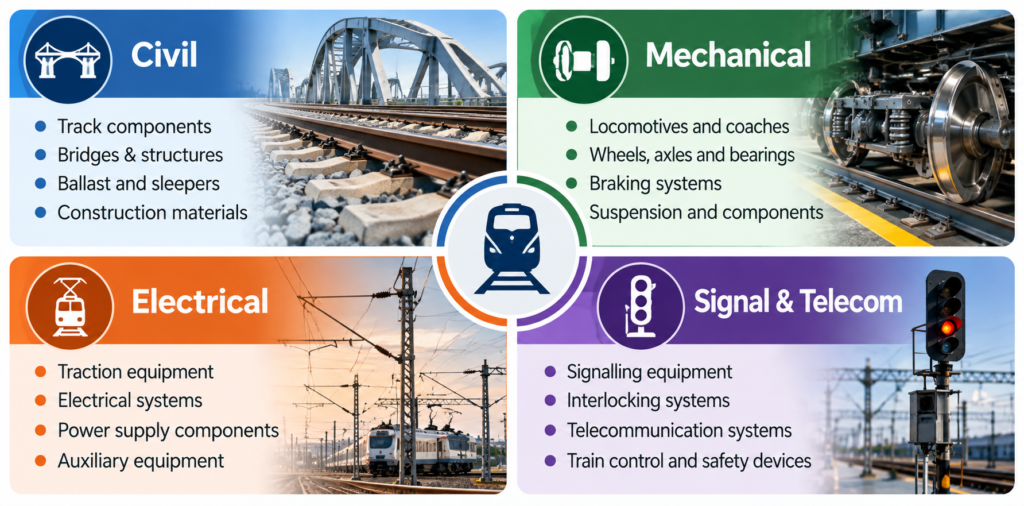
Items are classified into four major directorate categories at RDSO:
- Civil Track, bridges, construction
- Mechanical Rolling stock, workshops
- Electrical Traction, signalling
- Signal and Telecommunication Signalling systems, telecoms
Each directorate manages vendor approval for items under its technical domain.
RDSO Vendor Approval Process: Step by Step
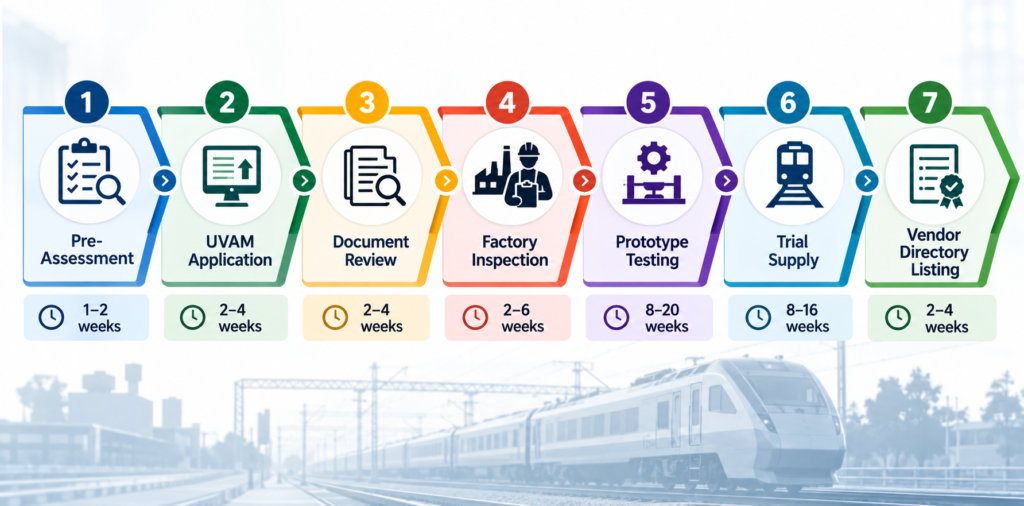
The RDSO vendor approval process is structured and systematic. The entire process typically takes 12 to 36 months depending on the item’s complexity, safety criticality, and trial requirements.
Stage 1: Pre-Application Assessment
Before applying, manufacturers should conduct a gap assessment against the RDSO vendor approval checklist for their specific item. This involves reviewing:
- RDSO specification for the target item
- Quality management system requirements (ISO 9001 minimum; ISO/TS 22163 for railway-specific requirements)
- Manufacturing capability and infrastructure requirements
- Testing equipment availability
- Raw material sourcing compliance
A realistic gap assessment prevents application at a stage before genuine readiness which wastes time and delays the process.
Stage 2: Online Application Through UVAM
All RDSO vendor approval applications are submitted through the Unified Vendor Approval Module (UVAM) on the IREPS (Indian Railways E-Procurement System) portal.
Documents submitted during application include:
- Company profile and legal documents
- Factory layout and manufacturing process flow charts
- List of manufacturing equipment and testing facilities
- Quality management system documents (ISO 9001 certificate or equivalent)
- Quality Assurance Plan (QAP) for the specific item aligned with RDSO specification
- Bill of materials showing raw material sources
- Test equipment list with calibration status
- Reference to relevant RDSO specification/drawing
Stage 3: Documentation Review
RDSO’s relevant directorate reviews the submitted documentation to assess:
- Whether the manufacturer’s stated processes align with RDSO specification requirements
- Whether the QAP adequately covers all inspection and testing stages
- Whether manufacturing and testing capabilities appear sufficient
- Whether quality management systems are appropriate
Deficiencies at this stage generate queries that manufacturers must resolve before proceeding. RDSO may also verify compliance with the latest version of RDSO’s ISO procedure documents (such as QM-RF-7.1-3).
Stage 4: Factory Inspection by RDSO Engineers
This is the central RDSO inspection stage. Engineers from the relevant RDSO directorate visit the manufacturer’s facility to physically verify:
Manufacturing Capability:
- Factory infrastructure and layout appropriate for the item
- Manufacturing equipment type, condition, and suitability
- Raw material storage and traceability systems
- Production process compliance with the submitted flow chart
Quality Systems:
- Quality Assurance Plan implementation not just documented, but actually followed
- Inspection and testing at each manufacturing stage
- Records and traceability can completed production be traced to raw material batches?
- Calibration status of testing and measurement equipment
- Non-conformance control and corrective action systems
- Document control systems
Testing Facilities:
- Test equipment availability types and specifications
- Test equipment calibration records
- Whether testing can be conducted per RDSO specification requirements
- Inventory management and spare parts systems
Personnel and Competency:
- Qualified technical staff for the item’s manufacturing requirements
- Quality personnel with relevant expertise
Stage 5: Prototype Inspection and Testing
Following satisfactory factory inspection, RDSO requires prototype inspection and testing to confirm that the manufacturer’s products comply with specification and performance requirements.
Prototype testing may be conducted:
- At RDSO’s own laboratories
- At RDSO-approved testing laboratories
- At the manufacturer’s facility under RDSO supervision
Prototype testing verifies dimensional accuracy, material properties, strength parameters, electrical characteristics, and performance under simulated service conditions all specified in the RDSO specification for the relevant item.
Any prototype failures require investigation, correction, and re-testing before progressing to trial supply.
Stage 6: Trial Supply and Performance Evaluation
Once prototype testing is satisfactory, RDSO may authorize limited trial supply to zonal railways or production units. The railway evaluates product performance under actual operating conditions over a defined period typically at least 12 months for most items.
Performance reports from zonal railways are submitted to RDSO and reviewed by the relevant Standing Committee or Directorate.
Stage 7: Final Approval and Vendor Directory Listing
Upon satisfactory performance evaluation, RDSO grants final vendor approval and lists the manufacturer in the Approved Vendor Directory for the specific item and category. The manufacturer is now eligible to bid on all IREPS tenders for that item across all 18 zonal railways, production units, and PSUs.
Quality Assurance Plan (QAP): The Core of RDSO Inspection Requirements
The Quality Assurance Plan (QAP) is the central document in RDSO inspection requirements. It defines how the manufacturer will control quality at every stage of production from raw material inspection through finished product testing.
A compliant QAP for RDSO items must cover:
- Raw material specifications and incoming inspection criteria
- Stage-wise inspection points throughout manufacturing
- Test parameters at each inspection stage what is tested, how, with which equipment
- Acceptance criteria for each test
- Hold points stages where inspection must be completed before proceeding
- Witness points stages where RDSO or railway quality personnel must be present
- Final product inspection requirements
- Records to be maintained for traceability
- Non-conformance control procedures
Hold Points vs Witness Points: A Hold Point requires the inspector to review and sign off before production proceeds the manufacturing line literally stops until inspection clearance is given. A Witness Point requires an inspector to be present when a specific test or operation is performed, but the line may proceed after completion without a formal sign-off.
Understanding these distinctions matters for manufacturers scheduling production around inspection requirements.
Ongoing RDSO Inspection Requirements After Approval
RDSO approval is not permanent. Ongoing inspection compliance obligations include:
- Approval Validity: RDSO approval is generally valid for two years. Manufacturers must apply for renewal at least three months before expiry.
- After Six Months Expiry: If approval lapses and is not renewed within six months of expiry, the vendor is permanently de-listed and must apply afresh restarting the full approval process.
- Active Participation in Tenders: Vendors must actively participate in tenders floated by zonal railways during the approval period. Approved vendors who do not participate in tenders face RDSO factory inspection during the renewal process to verify continued manufacturing capability.
- Specification Updates: When RDSO updates a specification or drawing for an approved item, vendors must comply with the revised requirements which may trigger additional prototype testing or QAP revision.
- Performance Reporting: Zonal railways submit performance reports on supplied materials. Poor performance reports can lead to suspension or de-listing.
- Stage Inspections During Supply: Even after vendor approval, stage-wise inspections at defined QAP hold points are conducted during ongoing supply either by railway quality personnel or by empaneled third-party inspection agencies.
Third-Party Inspection in the RDSO Supply Chain
For many RDSO-controlled items, railways and production units employ third-party inspection agencies (TPIAs) to conduct stage-wise inspection at the manufacturer’s premises during ongoing supply.
Third-party inspection in the RDSO supply chain serves two purposes:
- Pre-Dispatch Inspection: Independent verification that completed goods meet RDSO specification before dispatch to the railway confirming dimensional accuracy, material certification review, functional test witnessing, and documentation completeness.
- Stage-Wise Inspection: Verification at QAP-defined hold and witness points during production confirming that manufacturing is proceeding in compliance with approved processes and specifications.
For manufacturers, independent pre-dispatch inspection certificates from accredited inspection bodies provide documented compliance evidence that supports smooth payment processing and protects against consignment rejection at railway receiving depots.
For railway procurement teams and production units, third-party inspection reduces the administrative burden of in-house inspection while maintaining objective quality verification throughout the supply chain.
TNV Inspection Division provides pre-dispatch and stage-wise inspection services for RDSO-controlled railway components and equipment across major Indian manufacturing centres.
RDSO Inspection Checklist: What Inspectors Assess During Factory Visits
During factory inspection both initial approval and ongoing supply RDSO inspectors and empaneled TPIAs assess:
Infrastructure and Equipment:
- Factory layout and production flow
- Manufacturing equipment suitability and condition
- Maintenance records for production equipment
- Testing and measuring equipment type, calibration status, traceability
Quality Systems:
- ISO 9001 / ISO/TS 22163 implementation evidence
- QAP documentation and actual implementation
- Internal quality audit records
- Non-conformance and corrective action records
- Supplier qualification records for raw materials
Raw Material Controls:
- Raw material incoming inspection records
- Material test certificates for each batch
- Material traceability from raw material to finished product
- Storage and identification of materials
Production and Process Controls:
- Stage-wise inspection records at QAP hold points
- In-process test results
- Operator qualification records (for welding, special processes)
- Non-conforming product identification and segregation
Finished Product:
- Dimensional inspection against specification/drawing
- Material property verification
- Functional test results
- Marking and identification compliance
Documentation:
- Dispatch documents Test Certificate format per RDSO requirements
- Batch records and lot traceability
- Customer complaint and return records
Consequences of RDSO Non-Compliance for Railway Suppliers
Non-compliance with RDSO inspection requirements carries serious commercial and regulatory consequences:
- Consignment Rejection: Railway quality inspectors or TPIAs can reject consignments that fail inspection at the receiving end at the manufacturer’s cost for return and replacement.
- Complaint Action: Accumulated performance complaints from zonal railways trigger RDSO review and can lead to suspension of vendor approval.
- Suspension: RDSO can suspend vendor approval, removing the manufacturer from the approved vendor directory disqualifying them from all tenders for the item.
- De-listing: Permanent de-listing requires restarting the full approval process a 12–36 month commitment.
- Financial Penalties: Supply of sub-standard materials to Indian Railways can attract financial penalties and liability for consequential damages.
TNV Inspection Division Railway Supplier Inspection Services
TNV Inspection Division provides independent, UAF-accredited third-party inspection services for manufacturers in the Indian Railways supply chain supporting both RDSO vendor approval processes and ongoing supply inspection requirements.
Our railway sector inspection services include:
- Pre-dispatch inspection of RDSO-controlled items
- Stage-wise inspection at QAP hold and witness points
- Material certification review and verification
- Dimensional inspection using calibrated equipment
- Documentation review for RDSO compliance
- Supplier capability assessment for sub-vendors
Headquarters: Lucknow same city as RDSO’s own offices, giving TNV direct proximity to India’s premier railway standards organization.
UAF Accreditation No. 5241222IB04 | ISO/IEC 17020:2012 | Type A | Valid: December 2028
Verify at uafaccreditation.org | Certificates: certificate.tnvib.com
📞 +91-9838070227 / +91-9838077603 | 🌐 tnvib.com
Conclusion
RDSO inspection requirements represent one of the most rigorous quality frameworks in India’s manufacturing sector and with good reason. Railway safety depends on the consistent quality of thousands of components supplied by hundreds of manufacturers across the country.
For manufacturers, obtaining and maintaining RDSO approval requires a genuine commitment to quality systems, documented processes, and ongoing compliance not a one-time certification exercise. The 12–36 month approval timeline reflects the depth of verification required before a supplier is trusted with railway-critical components.
The commercial reward is substantial: access to one of the world’s largest railway procurement systems, with regular tender opportunities across 18 zonal railways, production units, and PSUs. RDSO approval, as noted, is the most valuable single compliance asset a railway component manufacturer can obtain.
For manufacturers navigating RDSO inspection requirements whether preparing for initial approval or managing stage-wise inspections during ongoing supply understanding what inspectors check at each stage is the foundation of effective preparation.
Contact TNV Inspection Division for railway sector inspection support across India.
📞 +91-9838070227 / +91-9838077603 ✉ tnvindia@gmail.com | 🌐 tnvib.com 🔍 Verify accreditation: uafaccreditation.org 📄 Verify certificate: certificate.tnvib.com 📍 TNV House, Sector-K, Aliganj, Lucknow, UP 226024 (Near RDSO Headquarters)
Frequently Asked Questions (FAQ)
What is RDSO vendor approval and why is it mandatory for railway suppliers in India?
RDSO (Research, Designs and Standards Organisation) vendor approval is a mandatory technical certification for manufacturers supplying safety-critical and controlled items to Indian Railways. It verifies that a manufacturer has the capability, quality systems, and product compliance required for railway supply. Without RDSO approval for the relevant item category, a manufacturer cannot bid on Indian Railways tenders for that item regardless of manufacturing capability or price. The approval process involves factory inspection, prototype testing, and performance evaluation, typically taking 12 to 36 months.
What is a Quality Assurance Plan (QAP) and why is it central to RDSO inspection requirements?
A Quality Assurance Plan (QAP) is a document that defines how a manufacturer will control and verify quality at every stage of production for a specific RDSO-controlled item. It specifies inspection points, test parameters, acceptance criteria, hold points (where production stops pending inspection), and witness points (where inspection must be present during a specific operation). The QAP is reviewed during the RDSO approval process and must be implemented in practice inspectors verify actual compliance with the approved QAP during factory visits.
How long is RDSO vendor approval valid and how is it renewed?
RDSO vendor approval is generally valid for two years. To renew, manufacturers must apply at least three months before expiry. Vendors who allow approval to lapse and do not renew within six months of expiry are permanently de-listed from the approved vendor directory and must restart the full approval process from the beginning. Active participation in tenders during the approval period is also required vendors who do not participate in tenders may face additional factory inspection during the renewal process.
What does a factory inspection by RDSO engineers involve?
RDSO engineers physically visit the manufacturer's facility to verify manufacturing capability, quality system implementation, testing facilities, and personnel competency. They examine factory layout, production equipment suitability and maintenance records, QAP implementation evidence, calibration records for test equipment, raw material traceability systems, non-conformance control, and document control. The factory inspection is not a paper review inspectors observe actual operations, check records, and form a direct assessment of whether the manufacturer can consistently produce to RDSO specification.
Can a third-party inspection agency conduct inspections for RDSO-approved suppliers?
Yes. For ongoing supply, many railways and production units use empaneled third-party inspection agencies (TPIAs) to conduct pre-dispatch inspections and stage-wise inspections at QAP hold and witness points. The TPIA provides independent verification that supplied goods meet RDSO specification before dispatch. For manufacturers, third-party inspection certificates from accredited bodies support smooth payment processing and protect against consignment rejection. TNV Inspection Division provides pre-dispatch and stage-wise inspection services for RDSO-controlled railway items across India.