
Introduction
You have manufactured your product. Your shipment is ready. But how does your buyer know the goods are actually what you promised?
This is exactly where Third Party Inspection Services come in.
Whether you are an exporter, importer, manufacturer, or project owner — third party inspection is the one thing that protects your business, builds buyer trust, and keeps you compliant. In this guide, we explain everything simply — what it is, how it works, and why your business needs it.
What is Third Party Inspection?
A third-party inspection involves an independent entity that evaluates product quality, safety, or processes. Unlike first-party inspections — where the manufacturer conducts the check — or second-party inspections — where the buyer oversees the check — third-party inspections remove any potential bias or conflicts of interest.
In simple terms:
Party | Who They Are |
First Party | Manufacturer — inspects their own product |
Second Party | Buyer — inspects the supplier’s product |
Third Party | Independent body — inspects with zero bias |
A third party inspection body has no commercial interest in the outcome — which is exactly why their reports are trusted globally.
Why Does Your Business Need It?
Here are the most common situations where businesses need third party inspection services:
You are an Exporter Your international buyer requires an inspection report before accepting the shipment. Without it — your goods get rejected at the port.
You are an Importer You need to verify that goods from your overseas supplier actually match what was ordered — before you make the payment.
You are a Manufacturer You want to catch defects early — before they reach the customer and cause costly recalls or complaints.
You are a Project Owner You need independent verification that construction materials, equipment, or installations meet the required quality and safety standards.
Types By Production Stages of Third Party Inspection Services
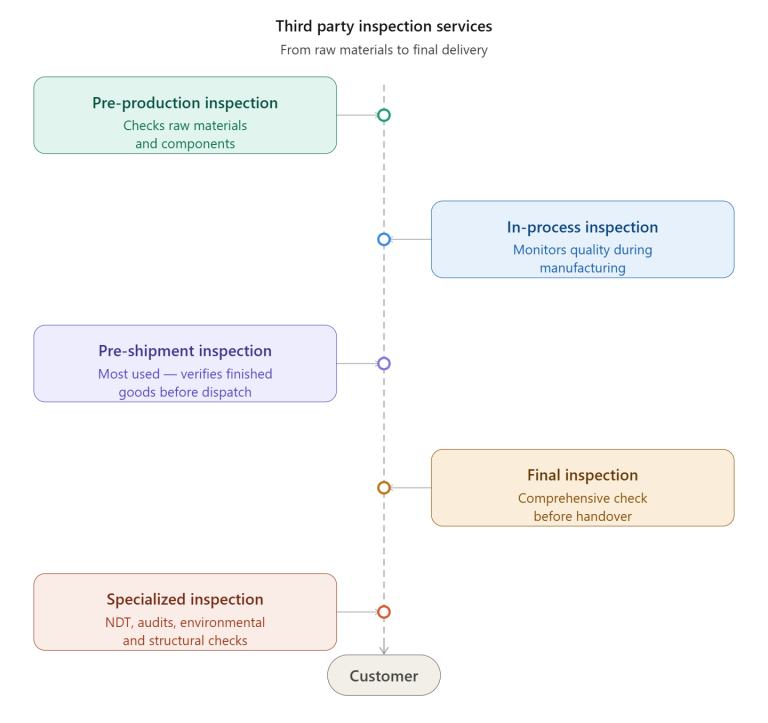
Third party inspection services help detect defects, non-compliance issues, or process inefficiencies early — allowing companies to take corrective action before products or services reach the customer.
Here are the main types:
Pre-Production Inspection (PPI) Checks raw materials and components before manufacturing begins. Prevents defective inputs from entering production.
In-Process Inspection (IPI) Monitors quality during manufacturing. Catches errors while they can still be corrected — before it is too late.
Pre-Shipment Inspection (PSI) The most widely used inspection type. Verifies finished goods before dispatch — checking quality, quantity, packaging, and labeling.
Final Inspection (FI) A comprehensive check of the completed product before handover or delivery to the buyer.
Specialized Inspection Covers advanced needs like Non-Destructive Testing (NDT), factory audits, environmental assessments, and structural inspections.
Key Benefits of Third Party Inspection Services
- Complete Impartiality Independent inspectors are not influenced by internal pressures or conflicts of interest — ensuring that their evaluations are solely based on factual data and regulatory standards.
- Early Detection Saves Money Identifying production flaws early reduces the risk of costly product recalls, minimizes risks related to non-compliance, and helps businesses avoid disruptions caused by defective products.
- Builds Buyer Confidence The use of third party inspection services significantly boosts stakeholder confidence. Clients, investors, and regulatory bodies can trust that evaluations are accurate and unbiased.
- Ensures Regulatory Compliance Third-party inspections ensure that products or services meet industry regulations and legal requirements — helping businesses avoid fines and penalties.
- Smoother International Trade TPI is often required for international trade — ensuring products meet importing country standards and avoiding customs rejections.
- Cost Effective Third-party inspection companies offer scalability — especially during peak seasons — without requiring a full-time inspector. A local third-party inspector is also more cost-effective than flying someone from abroad.
How the Third Party Inspection Process Works
At TNV Inspection Division, our process is simple, transparent, and built around your needs. Here is exactly what happens:
Step 1 — Planning and Engagement: We start with a conversation. Together we define the scope, review your technical documents, and build a customized inspection checklist — specific to your product and industry. A clear agreement is signed so you always know what to expect.
Step 2 — Pre-Inspection Preparation: Before our inspector arrives, we coordinate scheduling with your supplier, establish a sampling plan using AQL methodology, and ensure the facility is fully ready — so inspection day runs smoothly with zero surprises.
Step 3 — On-Site Execution: Our qualified inspectors arrive on-site and conduct a thorough evaluation — visual checks, functional testing, and specialized assessments like NDT where required. Every finding is recorded in real time with photographs and detailed notes — full transparency, always.
Step 4 — Reporting and Follow-Up: Within 24 to 48 hours, you receive a clear, detailed inspection report classifying all findings and providing a Pass or Fail summary. If issues are found, we guide you through corrective actions — and conduct re-inspection if needed.
Who Needs Third Party Inspection Services?
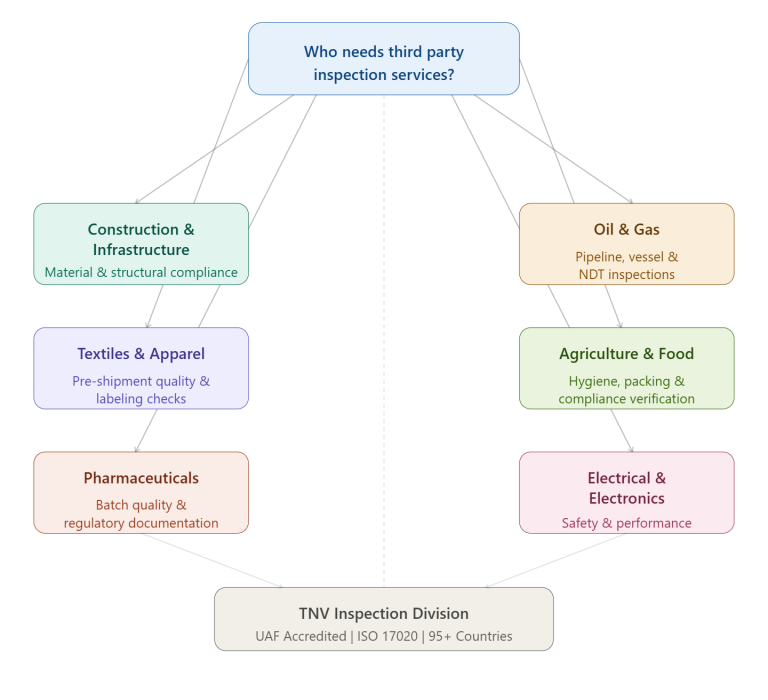
Engaging a third-party inspection service is a strategic decision that enhances quality assurance, regulatory compliance, and operational efficiency across industries such as manufacturing, construction, and product development.
Industries that benefit the most:
- Construction & Infrastructure — material and structural compliance
- Oil & Gas — pipeline, vessel, and NDT inspections
- Textiles & Apparel — pre-shipment quality and labeling checks
- Agriculture & Food — hygiene, packing, and compliance verification
- Pharmaceuticals — batch quality and regulatory documentation
- Electrical & Electronics — safety and performance compliance
Why TNV Inspection Division is the Right Choice for You
TNV Inspection Division is India’s first and most trusted UAF Accredited Inspection Body operating under ISO/IEC 17020:2012 — the international standard for independent inspection body competence.
Why businesses across 95+ countries choose TNV:
- UAF Accreditation — globally recognized inspection reports
- Type A Inspection Body — fully independent, zero conflict of interest
- 35+ Industry Sectors — from agriculture to oil & gas to pharmaceuticals
- 105+ Qualified Inspectors worldwide
- Operating Since 2011 — 14+ years of trusted inspection experience
- Verifiable Certificates — verify any TNV certificate at certificate.tnvib.com
Observation
Third party inspection services are not just a compliance requirement — they are a smart business decision. They protect your products, build buyer trust, ensure regulatory compliance, and save you from costly mistakes down the line.
When choosing an inspection partner, always look for an accredited inspection body under ISO/IEC 17020:2012 — one with proven technical expertise, genuine impartiality, and globally recognized reports.
TNV Inspection Division — UAF Accredited, ISO/IEC 17020:2012 compliant, trusted across 95+ countries since 2011.
📧 tnvindia@gmail.com | 🌐 tnvib.com | 📞 +91 9838077603