
What is ISO/IEC 17020:2012 and Why Does It Matter for Indian Buyers
Introduction Why ISO/IEC 17020:2012 Matters for Indian Buyers
Every day in India, thousands of inspection reports are issued by hundreds of companies claiming to provide “third party inspection services.” Some of those companies are properly accredited, internationally recognized, and technically competent. Others are not but their reports look identical on paper.
For an Indian manufacturer supplying to a government infrastructure project, an exporter shipping to a European buyer under Letter of Credit, or a procurement team accepting materials for a pipeline construction in Gujarat, choosing the wrong inspection provider is not just an inconvenience. It can mean rejected reports, failed tenders, refused payments, and regulatory violations.
ISO/IEC 17020:2012 is the international standard that separates credible inspection bodies from the rest. Understanding what it requires, what accreditation against it proves, and how to verify it is one of the most practical things any Indian business involved in quality-sensitive procurement or export can do.
This guide explains it fully in plain language, with specific application to Indian business contexts.
What is ISO/IEC 17020:2012?
ISO/IEC 17020:2012 is an international standard published by the International Organization for Standardization (ISO) and the International Electrotechnical Commission (IEC). Its full title is: “Conformity assessment Requirements for the operation of various types of bodies performing inspection.”
In plain terms, it defines the minimum requirements that any organization must meet to be considered a competent, impartial, and reliable inspection body.
The standard was developed because inspection is fundamentally different from testing or certification. Testing measures specific properties in a laboratory. Certification audits management systems over time. Inspection involves qualified professionals going to a site a factory, warehouse, pipeline, construction project, or vessel and making professional judgments about whether what is there meets defined requirements. ISO/IEC 17020:2012 sets the framework for how that process must be conducted to be credible.
What ISO/IEC 17020:2012 Is Not
It is important to understand what this standard does not cover:
- It is not ISO 9001 which covers quality management systems for organizations
- It is not ISO/IEC 17021 which covers certification bodies that issue management system certificates
- It is not ISO/IEC 17025 which covers testing and calibration laboratories
- It does not apply to companies simply claiming to “do inspections” it applies specifically to organizations formally accredited by a recognized accreditation body
The distinction matters. Many companies in India advertise inspection services but operate without accreditation. ISO/IEC 17020:2012 accreditation means an independent body has verified the inspection organization actually meets the standard’s requirements not just that they claim to follow it.
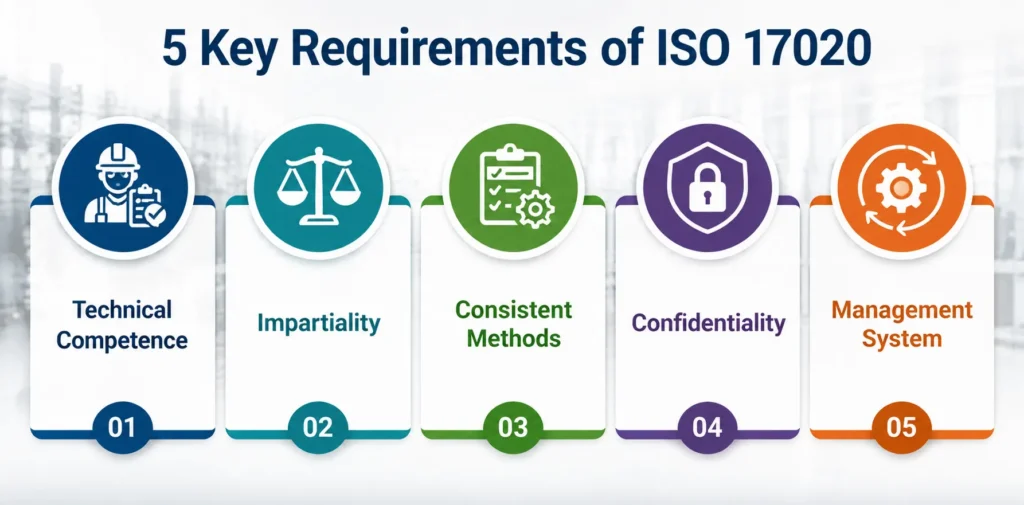
Key Requirements of ISO/IEC 17020:2012
The standard defines requirements across several critical areas. Understanding these helps Indian buyers know exactly what an accredited inspection body has proven it can do.
3.1 Technical Competence
An ISO/IEC 17020 accredited inspection body must demonstrate that its inspectors possess the technical knowledge, skills, and experience required for the inspections they perform. This means:
- Inspectors hold relevant educational qualifications
- They have documented, verifiable experience in the industries they inspect
- They undergo ongoing training and competency assessment
- Their technical capability is independently verified not self-declared
For Indian businesses, this requirement means that when you engage a truly accredited inspection body, the inspector who visits your factory or project site is a qualified professional not a generalist with a checklist.
3.2 Impartiality and Independence
This is one of the most critical requirements of ISO/IEC 17020:2012 and the one that most directly protects Indian buyers.
The standard requires that inspection bodies identify risks to their impartiality and have documented systems to manage them. Specifically, it prohibits inspection bodies from having financial interests that could influence their inspection outcomes.
For Type A inspection bodies the most independent classification under the standard this requirement is absolute. A Type A body cannot have any commercial relationship with manufacturers, suppliers, or buyers whose products or processes it inspects. The only acceptable business relationship is between the inspection body and the party commissioning the inspection.
For Indian buyers, this means: if you hire a Type A accredited inspection body to inspect your supplier’s factory in Pune, the inspection body has no reason to protect the supplier’s interests. Its report will reflect what is actually there.
3.3 Consistent Methods and Procedures
ISO/IEC 17020:2012 requires accredited inspection bodies to use documented, standardized inspection methods and procedures. This ensures:
- The same inspection is conducted the same way each time
- Results are reproducible and comparable across different inspectors and locations
- Sampling methods are appropriate and statistically valid (such as AQL-based sampling for pre-shipment inspections)
- Equipment used for measurements is calibrated and traceable to national or international standards
For Indian manufacturers and exporters, this consistency means you can rely on the same inspection standard being applied whether your shipment is being inspected in Tirupur, Ahmedabad, or Kanpur.
3.4 Confidentiality and Information Security
The standard requires inspection bodies to protect confidential information obtained during inspections. For Indian businesses, this means product specifications, production volumes, quality data, and commercial terms shared with an accredited inspection body remain protected.
3.5 Management System Requirements
Accredited inspection bodies must operate a quality management system that ensures ongoing compliance with the standard’s requirements. This includes documented procedures, internal audits, corrective actions, and management reviews not as one-time exercises but as continuous operational requirements.
Type A, B, and C The Classification System Under ISO/IEC 17020
ISO/IEC 17020:2012 classifies inspection bodies into three types based on their independence from commercial interests. This classification is one of the most important things Indian buyers need to understand when selecting an inspection provider.
Type A Fully Independent
A Type A inspection body is completely separate from the design, manufacture, supply, installation, maintenance, or use of the items it inspects. It has no ownership links, operational ties, or financial relationships with manufacturers, suppliers, or buyers.
This is the classification that carries the highest credibility and is the one most trusted by:
- International buyers in Europe, the USA, and the Middle East
- Indian government agencies for regulated procurement
- Banks processing Letters of Credit that require inspection certificates
- Regulatory bodies like PNGRB, FSSAI, and RDSO
TNV Inspection Division is a Type A inspection body accredited as such under UAF accreditation number 5241222IB04.
Type B Organisationally Separated
A Type B inspection body forms part of a larger organization that also manufactures, supplies, or installs the products being inspected. It operates as a separated unit within that organization but remains connected to it.
Type B bodies are used primarily for internal quality verification within larger industrial groups. They are not appropriate for situations requiring genuinely independent third party inspection.
Type C Limited Independence
A Type C inspection body may be involved in the design, manufacture, supply, or maintenance of products similar to those it inspects. This represents the lowest level of independence under the standard.
Practical guidance for Indian buyers: For pre-shipment inspection, government tender compliance, regulatory requirements, and any situation where the inspection result will be used as evidence by a third party always require a Type A accredited inspection body.
What is ISO/IEC 17020:2012 Accreditation and Who Provides It in India?
Complying with ISO/IEC 17020:2012 and being accredited against it are two different things.
Any inspection company can claim to follow ISO/IEC 17020. Accreditation means an independent, internationally recognized accreditation body has assessed the inspection organization, found it to genuinely meet the standard’s requirements, and issued a formal accreditation certificate as proof.
Accreditation Bodies Recognized in India
UAF United Accreditation Foundation (USA) UAF is an internationally recognized accreditation body that evaluates inspection organizations globally against ISO/IEC 17020:2012. UAF is a signatory to the IAF Multilateral Recognition Arrangement (MLA) and the APAC Mutual Recognition Arrangement (MRA). This means inspection reports from UAF-accredited bodies are recognized by buyers, banks, customs authorities, and regulators across 95+ countries including India, the European Union, the United States, and the Middle East.
- IAS International Accreditation Service US-based accreditation body with international recognition through IAF MLA membership.
- UKAS United Kingdom Accreditation Service UK’s national accreditation body, widely recognized across Europe and internationally.
- DAkkS Deutsche Akkreditierungsstelle Germany’s national accreditation body, recognized across the EU.
- QCI-NABCB National Accreditation Board for Certification Bodies India’s domestic accreditation body relevant for certification bodies rather than inspection bodies in most cases.
For Indian businesses working in international trade or seeking globally recognized inspection certificates, UAF accreditation is one of the strongest credentials an inspection body can hold.
Why ISO/IEC 17020:2012 Accreditation Specifically Matters for Indian Buyers
For Indian Exporters LC Payment and Buyer Requirements
International buyers particularly from Europe, the USA, the Middle East, and East Asia increasingly specify ISO/IEC 17020 accredited inspection bodies in their Letter of Credit (LC) conditions and purchase order terms. This means only a certificate from an accredited inspection body will trigger payment release.
An inspection report from a non-accredited company, no matter how thorough it appears, will not satisfy this requirement. Indian exporters in textiles (Tirupur, Surat, Ludhiana), engineering goods (Pune, Rajkot, Coimbatore), food products (UP, Punjab, Maharashtra), and chemicals (Gujarat) routinely face this requirement.
For Government Tenders and Infrastructure Projects
India’s government procurement under GFR 2017 rules, CPWD contracts, NHAI projects, Jal Jeevan Mission infrastructure, and Indian Railways supply chain all increasingly specify third party inspection requirements. Many specifically require accredited inspection bodies and in regulated sectors like oil and gas and food, accreditation is a legal requirement, not a commercial preference.
- Oil and Gas (PNGRB): The Petroleum and Natural Gas Regulatory Board’s technical codes for pipelines and city gas distribution networks require inspection by qualified inspection agencies. Working with an ISO/IEC 17020 accredited Type A body ensures compliance with these requirements.
- Railways (RDSO): Indian Railways’ Research, Designs and Standards Organisation requires stage-wise inspection of components from approved vendors. Inspection by an accredited body supports vendor qualification and inspection report acceptance.
- Food (FSSAI): The Food Safety and Standards Authority of India requires third party audits and inspections for food business operators, especially for export-eligible facilities.
For Risk Management and Dispute Resolution
When quality disputes arise between Indian manufacturers and their buyers, between contractors and project owners, or between suppliers and procurement teams inspection reports from ISO/IEC 17020 accredited bodies carry legal and commercial weight that non-accredited reports do not.
An accredited report demonstrates that the inspection was conducted by a competent, independent professional following documented, internationally recognized procedures. This makes it defensible in commercial disputes, legal proceedings, and regulatory inquiries in a way that an unaccredited report cannot be.
For Building Credibility in International Markets
For Indian manufacturers competing for supply contracts in Europe, the USA, the Middle East, and Southeast Asia, having products inspected by an ISO/IEC 17020 accredited body signals quality commitment that buyers recognize. It differentiates Indian suppliers who take quality verification seriously from those who do not.

How to Verify ISO/IEC 17020 Accreditation A Practical Guide for Indian Buyers
Verification is simple and takes less than five minutes. It protects you from working with companies that claim accreditation without holding it.
Step 1 Request the Accreditation Certificate
Ask the inspection company to share their ISO/IEC 17020:2012 accreditation certificate. The certificate should clearly show:
- The name of the inspection body
- The accreditation body that issued it (UAF, IAS, UKAS, etc.)
- The certificate number
- The issue date and expiry date
- The scope of accreditation (industries and inspection types covered)
- The type classification (Type A, B, or C)
Step 2 Verify Through the Accreditation Body’s Official Website
Do not rely solely on the certificate provided by the inspection company. Verify independently:
- For UAF-accredited bodies: visit uafaccreditation.org and search the directory of accredited organizations
- For UKAS: visit ukas.com and search their accredited organizations database
- For IAS: visit iasonline.org and check their directory
Confirm the inspection body appears in the directory with current accreditation status, and that the scope covers your specific industry and inspection type.
Step 3 Verify Issued Certificates
For inspection certificates already issued by an inspection body, verify their authenticity through the inspection body’s certificate verification portal.
For TNV certificates: verify at certificate.tnvib.com every certificate TNV issues can be authenticated online within seconds.
Step 4 Check Scope Coverage
Accreditation scope is specific. Confirm that the inspection body’s scope explicitly covers:
- Your product category or industry
- The type of inspection you need (pre-shipment, in-process, factory audit, NDT, etc.)
- The geographic locations where your inspections will be conducted
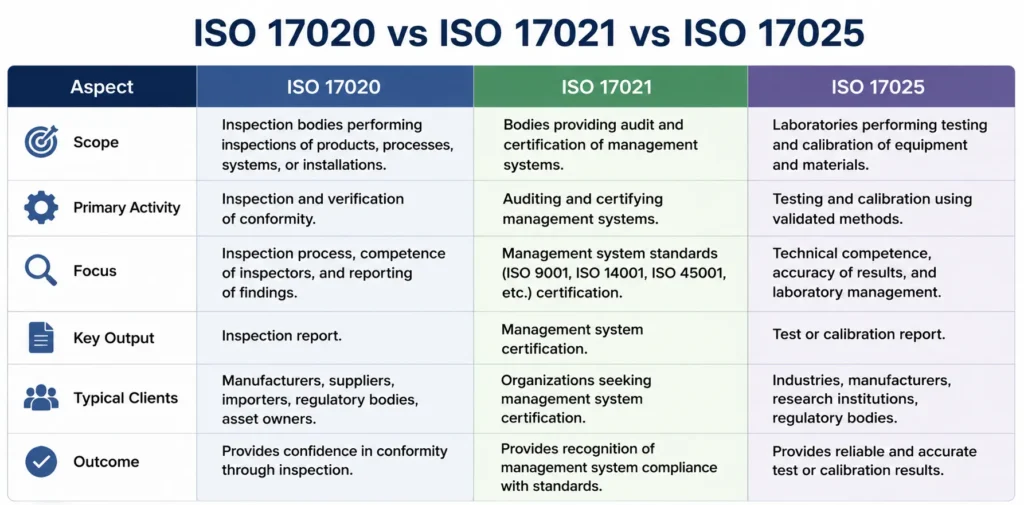
ISO/IEC 17020:2012 vs ISO 17021 vs ISO 17025 Quick Reference
Indian buyers frequently encounter these three standards and need to understand the difference:
Standard | Applies To | Output | Key Accreditation Bodies in India |
ISO/IEC 17020:2012 | Inspection Bodies | Inspection Report or Certificate | UAF, IAS, UKAS |
ISO/IEC 17021-1 | Certification Bodies | Management System Certificate (ISO 9001, 14001, etc.) | UAF, UKAS, QCI-NABCB |
ISO/IEC 17025:2017 | Testing & Calibration Labs | Test Report / Calibration Certificate | NABL, ILAC members |
These three serve entirely different functions. Knowing which one applies to your need prevents the costly mistake of engaging the wrong type of body.
TNV Inspection Division and ISO/IEC 17020:2012 Accreditation
TNV Inspection Division holds UAF accreditation under ISO/IEC 17020:2012 as a Type A inspection body the most independent classification under the standard.
TNV Accreditation Details:
|
Detail |
Information |
|
Accreditation Body |
UAF United Accreditation Foundation, USA |
|
Standard |
ISO/IEC 17020:2012 |
|
Certificate Number |
5241222IB04 |
|
Valid Until |
December 2028 |
|
Type |
Type A (fully independent) |
|
IAF MLA Signatory |
Yes reports recognized in 95+ countries |
|
APAC MRA |
Yes recognized across Asia-Pacific |
|
Verify Accreditation |
uafaccreditation.org |
|
Verify Certificates |
certificate.tnvib.com |
TNV is India’s first inspection body to receive UAF accreditation a distinction that reflects both the quality of our systems and our commitment to international standards since our founding in 2011.
- Industry Scope: TNV’s accreditation covers 36+ industry sectors across 10 IAF technical groups, including oil and gas, food and agriculture, textiles and garments, railways, steel and metals, construction and infrastructure, chemicals, electrical equipment, pharmaceuticals, and automotive.
- Trusted by: IRCTC (Indian Railways), Adani Wilmar, Patanjali Ayurved, ICAR across railway supply chain, food and FMCG, and agricultural research sectors.
- Coverage: Pan-India, from Lucknow (headquarters) to all major manufacturing states, and internationally across 95+ countries.
Conclusion
ISO/IEC 17020:2012 is not just a technical document or regulatory formality. For Indian buyers, exporters, manufacturers, and procurement professionals, it is the most reliable indicator that the inspection body they are working with is genuinely competent, truly independent, and operating to internationally accepted standards.
In a market where many companies claim inspection capabilities without formal accreditation, understanding what ISO/IEC 17020 requires and verifying that an inspection body is genuinely accredited against it protects your quality investments, your commercial relationships, and your regulatory compliance.
Whether you are an exporter in Tirupur needing a pre-shipment certificate accepted by your European buyer, a project manager in Gujarat managing PNGRB-compliant pipeline inspection, or a procurement team in Delhi qualifying vendors for a government tender ISO/IEC 17020:2012 accreditation from a recognized body like UAF is what you should be looking for.
TNV Inspection Division. India’s first UAF-accredited Type A inspection body under ISO/IEC 17020:2012. Verify us. Then trust us.
📞 +91-9838070227 / +91-9838077603 ✉ info@tnvib.com 🌐 tnvib.com 🔍 Verify accreditation: uafaccreditation.org 📄 Verify certificate: certificate.tnvib.com 📍 TNV House, B-1/19/69, Sector-K, Aliganj, Lucknow, UP 226024, India
Frequently Asked Questions(FAQ)
What is ISO/IEC 17020:2012 in simple terms?
Far far away, behind the word Mountains far from the countries Vokalia and Consonantia, there live the blind texts. Separated they live in Bookmark
Why does ISO/IEC 17020:2012 matter for Indian exporters?
International buyers especially from Europe, the USA, and the Middle East frequently require inspection certificates from ISO/IEC 17020 accredited bodies as a condition of LC payment release. Without accreditation, your inspection report may not be accepted, holding up payment and shipment.
What is the difference between ISO 17020 and ISO 9001?
ISO 9001 is a quality management system standard for organizations of any type it covers how your company manages quality internally. ISO/IEC 17020 is specifically for inspection bodies it defines how organizations that inspect products, processes, or installations must operate. An ISO 9001 certificate does not make a company an inspection body; ISO/IEC 17020 accreditation does.
What is the difference between ISO 17020 and ISO 17021?
ISO/IEC 17020 applies to inspection bodies that visit sites and issue inspection reports. ISO/IEC 17021 applies to certification bodies that audit management systems and issue management system certificates (ISO 9001, ISO 14001, etc.). They are different standards for different types of conformity assessment.
How do I check if an inspection body is ISO 17020 accredited in India?
Request their accreditation certificate, note the certificate number and accreditation body name, then verify independently on the accreditation body's official website. For UAF-accredited bodies like TNV, verify at uafaccreditation.org. For TNV inspection certificates, verify at certificate.tnvib.com.
Is ISO 17020 accreditation mandatory in India?
It depends on the context. For regulated sectors like oil and gas (PNGRB), food exports (FSSAI), and railway supply (RDSO), accreditation is effectively required. For government procurement under GFR rules, accredited inspection is increasingly mandated. For international export trade, buyers commonly specify it. In all cases, it is best practice.
What does "Type A" mean under ISO/IEC 17020?
Type A under ISO/IEC 17020 is the classification for fully independent inspection bodies those with no commercial ties to manufacturers, suppliers, or buyers. It is the most credible classification for third party inspection. TNV Inspection Division is a Type A body.
Can a company be accredited under both ISO 17020 and ISO 9001?
Yes. ISO 9001 and ISO/IEC 17020 address different things. An inspection body can hold ISO 9001 certification for its own quality management system while also being accredited under ISO/IEC 17020 as an inspection body. However, ISO 9001 alone does not make an organization an accredited inspection body.
How long is ISO/IEC 17020 accreditation valid?
Accreditation periods vary by accreditation body but typically run for three to five years, with mandatory surveillance assessments at regular intervals. TNV's current UAF accreditation (No. 5241222IB04) is valid until December 2028, with ongoing surveillance.
Which is better NABL accreditation or ISO 17020 accreditation for inspection?
They cover different activities. NABL accreditation (under ISO/IEC 17025) applies to testing and calibration laboratories. ISO/IEC 17020 accreditation applies to inspection bodies conducting on-site examinations. For physical inspection of products, processes, or installations, ISO/IEC 17020 is the relevant accreditation. For laboratory testing, NABL is the relevant accreditation. They are not alternatives they serve different functions.