
Is Third Party Inspection Worth the Cost? ROI for Indian Manufacturers
Every Indian manufacturer who has paid for a third party inspection has asked the same question at some point: is this really worth it?
It is a fair question. Third party inspection charges are real, recurring, and visible in your cost sheet. The cost of not inspecting the rejected shipment sitting at a port, the buyer who does not place the next order, the LC payment held for three months is less visible. Until it happens.
This guide does the math that most manufacturers never do. It calculates the actual ROI of third party inspection charges in India in real rupees so you can make a properly informed decision rather than one based on avoiding an upfront cost.
What Third Party Inspection Actually Costs in India
Before calculating return, establish the investment.
Third party inspection charges in India for accredited services run:
Inspection Type | Cost Per Inspection |
Pre-Shipment Inspection (1 day) | ₹8,000 – ₹15,000 |
During Production Inspection (1 day) | ₹8,000 – ₹15,000 |
Factory Audit (1–2 days) | ₹12,000 – ₹30,000 |
Container Loading Supervision (1 day) | ₹6,000 – ₹10,000 |
For most Indian exporters doing standard pre-shipment inspection one factory, one product type, one man-day the cost of third party inspection is ₹8,000–₹15,000 per shipment.
That is the number we will measure against.
What a Rejected Shipment Actually Costs
This is the calculation most Indian manufacturers never make before a rejection happens.
Take a real scenario: an Indian garment exporter shipping 10,000 units to a European buyer. Order value: ₹25 lakhs. The shipment fails quality inspection at the destination workmanship below standard, labels non-compliant.
Cost breakdown of one rejected shipment:
Cost Item | Approximate INR |
Return sea freight (India-Europe return) | ₹1,50,000 – ₹3,00,000 |
Port storage charges (destination) | ₹25,000 – ₹75,000 |
Customs clearance costs (return) | ₹15,000 – ₹30,000 |
Rework or replacement production | ₹2,00,000 – ₹8,00,000 |
Re-shipment freight | ₹1,00,000 – ₹2,50,000 |
Penalties for delayed delivery | Contractual often 1–2% of order value |
LC payment held (opportunity cost) | ₹25,00,000 tied up for 60–90 days |
Total direct cost of one rejection | ₹5,00,000 – ₹15,00,000+ |
This does not include:
- The buyer who reduces future orders or removes you from their vendor list
- The reputation damage in a market where buyers share supplier experiences
- The internal management time spent handling the dispute
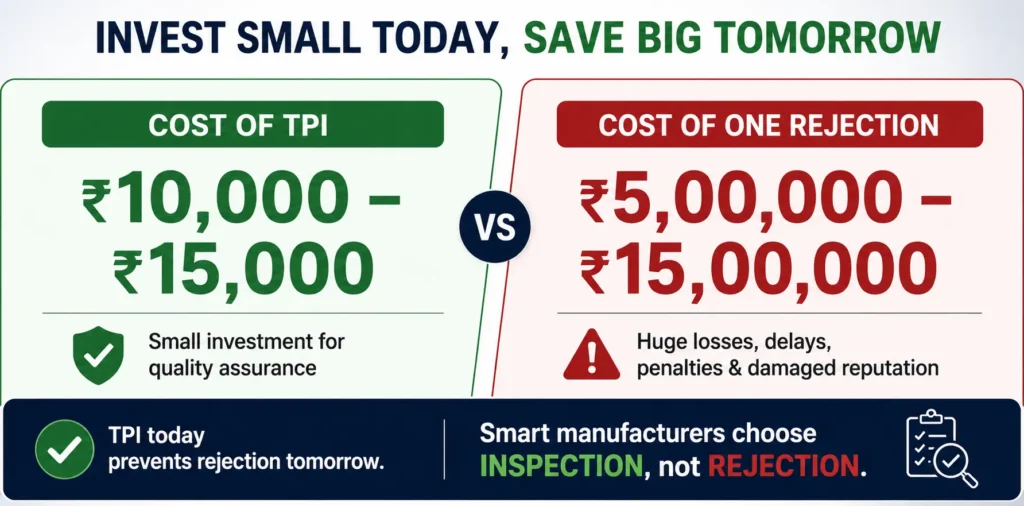
The 3rd party inspection cost for this shipment: ₹10,000–₹15,000.
The cost of the rejection: ₹5,00,000–₹15,00,000.
ROI of inspection = 33x to 100x return on a single prevented rejection.
The Five Ways Third Party Inspection Creates Return
ROI from third party inspection is not just about preventing rejections. There are five distinct ways it creates measurable financial return for Indian manufacturers:
Return 1: Prevented Rejections and Returns
This is the most direct return. As calculated above, one prevented rejection at the cost of a ₹10,000–₹15,000 inspection delivers a 33x–100x return. Even if inspection prevents one rejection every ten shipments, the annual ROI is strongly positive.
For an exporter doing 24 shipments per year at ₹12,000 per inspection:
- Annual inspection cost: ₹2,88,000
- One prevented rejection saves: ₹5,00,000–₹15,00,000
- Net return from single prevention: ₹2,12,000–₹12,12,000
Return 2: LC Payment Released Faster
Many Indian exporters operate under Letters of Credit where payment release is contingent on submitting an inspection certificate from an accredited body. Without that certificate, payment is held.
If your average order value is ₹20 lakhs and payment is delayed by 60 days due to missing inspection documentation, the working capital cost at typical MSME borrowing rates of 12–14% is: ₹20,00,000 × 12% × (60/365) = ₹39,452 per delayed payment
A ₹10,000 inspection fee that prevents a 60-day payment delay pays for itself nearly four times over on working capital cost alone.
Return 3: Supplier Quality Improvement
Suppliers who know their shipments will be independently inspected produce to a higher standard than suppliers who know inspection is unlikely. This is documented consistently across quality management research.
The benefit to Indian manufacturers: fewer defects reaching you, lower internal rework costs, and lower incoming quality inspection time. For manufacturers receiving components or raw materials, this reduction in incoming defect rates has direct cost savings in production efficiency.
Return 4: Government Tender Qualification
For Indian manufacturers targeting government procurement under CPWD, NHAI, Jal Jeevan Mission, RDSO, or state PWD contracts third party inspection certificates are frequently mandatory. Without an accredited inspection certificate, you cannot submit a compliant bid.
The return here is not measured in prevented costs but in revenue enabled. A government contract worth ₹50 lakhs–₹5 crores that requires a ₹12,000–₹30,000 audit or inspection certificate to qualify has an effectively incalculable ROI on the inspection investment.
Return 5: Buyer Retention and Repeat Orders
Quality failures damage buyer relationships. A single shipment rejection can end a supply relationship that took years to build. The lifetime value of an ongoing buyer relationship measured in repeat orders over three to five years dwarfs the cost of consistent inspection.
If your average buyer places ₹50 lakh in annual orders and you retain them for five years by consistently delivering verified quality, the lifetime value is ₹2.5 crores. The annual inspection cost for their orders: ₹1,00,000–₹2,00,000.
Inspection investment as percentage of buyer lifetime value: less than 1%.
When Third Party Inspection Is Most Worth The Cost
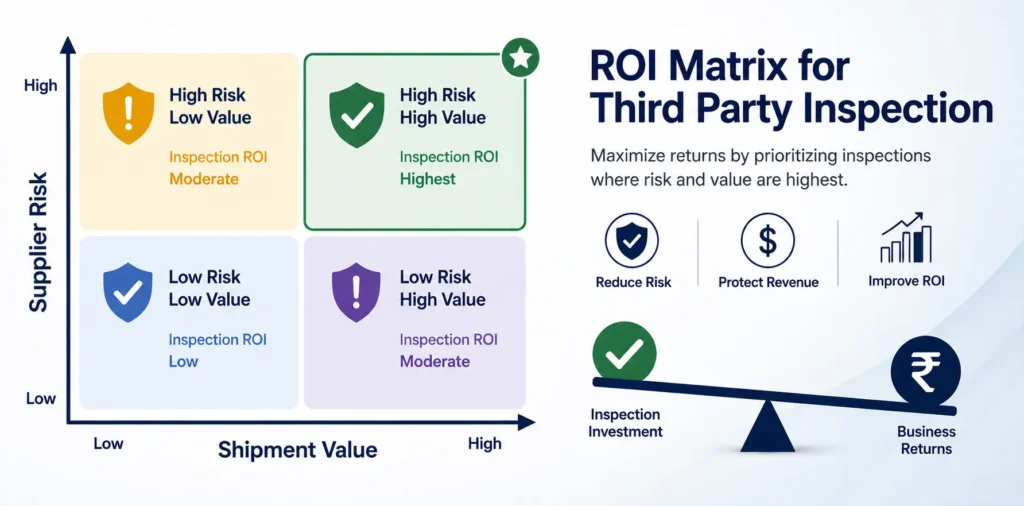
The ROI of third party inspection charges is highest in these specific situations:
- High-value shipments The higher the order value, the greater the financial exposure of a rejection. Inspection on a ₹50 lakh shipment is far more financially justified than on a ₹2 lakh shipment.
- New suppliers First orders with unproven suppliers carry the highest defect risk. Inspection on new supplier shipments delivers the clearest risk-reduction return.
- International shipments Distance from the buyer means problems are discovered late after shipping costs are sunk. Inspection before shipment is the only point at which problems can be corrected at low cost.
- Regulated markets Shipments to the EU, USA, Middle East, and other markets with strict quality or compliance requirements have significant financial and legal consequences for non-compliance. Inspection protects against both.
- Government contracts Where tender qualification requires inspection certificates, the ROI is essentially the value of the contract itself.
Why Third Party Inspection is Required Beyond ROI
ROI is a financial argument. But third party inspection is also required not just recommended in specific Indian contexts:
- Regulatory requirements: PNGRB for oil and gas pipelines, FSSAI for food exports, RDSO for railway component suppliers, and Jal Jeevan Mission project contracts all specify mandatory third party inspection.
- Buyer requirements: International purchase orders and LC conditions specify independent inspection certificates as conditions of payment. These are commercial requirements, not suggestions.
- Government tender compliance: GFR 2017 procurement rules and project-specific tender conditions mandate third party inspection for goods above specified thresholds. Without it, bids are non-compliant.
- Insurance requirements: Some trade finance and cargo insurance policies require documented independent inspection as a condition of claim eligibility.
In these contexts, the question of “is it worth the cost” does not arise it is a compliance requirement. The question becomes only “which accredited body should I use.”
The Real Calculation: Annual Inspection Budget vs. Annual Risk Exposure
Here is the calculation Indian manufacturers should run before deciding whether third party inspection is worth the cost:
- Step 1: Estimate annual shipment value (or annual government tender value)
- Step 2: Estimate your realistic defect/rejection rate (industry average: 3–8% of shipments without inspection)
- Step 3: Calculate potential annual rejection cost (rejection rate × average rejection cost ₹5–15 lakhs)
- Step 4: Calculate annual inspection cost (number of shipments × ₹10,000–₹15,000 per inspection)
- Step 5: Compare
Example Indian textile exporter, 24 shipments/year, average value ₹20 lakhs:
Annual rejection exposure (5% rate × ₹7 lakh average rejection cost × 24 shipments) = ₹8,40,000 Annual inspection investment (24 × ₹12,000) = ₹2,88,000 Net annual benefit of inspection: ₹5,52,000 ROI: 192%
This does not include working capital, buyer retention, or government tender benefits all of which add further return.
TNV Inspection Division The Investment That Pays
Third party inspection charges with TNV Inspection Division are:
- ₹8,000–₹15,000 per pre-shipment inspection (most orders, one man-day)
- Written quote based on your specific factory location and order scope
- Includes full AQL inspection, photographic report, and verifiable certificate
Every TNV inspection certificate is verifiable at certificate.tnvib.com accepted by international buyers, banks, and regulatory authorities in 95+ countries.
UAF Accreditation No. 5241222IB04 | Type A | Valid: December 2028 | Since 2011
📞 +91-9838070227 / +91-9838077603 | 🌐 tnvib.com 🔍 Verify: uafaccreditation.org
Conclusion
The question “is third party inspection worth the cost?” has a numerical answer for Indian manufacturers:
One prevented rejection = 33x–100x return on the inspection investment. One enabled LC payment = 4x return on working capital cost alone. One government contract enabled = effectively unlimited ROI on the qualification inspection.
The cost of third party inspection charges is real, visible, and manageable. The cost of not inspecting is invisible until it is not. And by the time it becomes visible, it is too late to recover the money cheaply.
Indian manufacturers who treat TPI charges as overhead are making a calculation based on incomplete information. The complete calculation almost always points the same way: inspection is worth the cost.
Get a written quote from TNV Inspection Division and start making inspection an investment, not an afterthought.
📞 +91-9838070227 / +91-9838077603 ✉ tnvindia@gmail.com | 🌐 tnvib.com 🔍 Verify accreditation: uafaccreditation.org 📄 Verify certificate: certificate.tnvib.com
Frequently Asked Questions(FAQ)
Is third party inspection worth the cost for small Indian exporters?
Yes and often more so for small exporters than large ones. A small MSME exporter typically has less financial buffer to absorb a shipment rejection. One rejection can represent months of production value. The cost of inspection (₹8,000–₹15,000 per shipment) is a predictable, manageable expense. The cost of one rejection (₹5,00,000–₹15,00,000) is not. For small exporters where a single rejection could seriously damage cash flow, the ROI of consistent third party inspection is highest.
How do I calculate the ROI of third party inspection for my business?
Estimate your annual rejection risk: multiply your shipment count by your realistic defect rate (typically 3–8% without inspection) and by the average cost of one rejection in your business. Then divide by your annual inspection investment (shipment count × your PSI day rate). The ratio shows your ROI. Most Indian manufacturers who run this calculation for the first time find that one prevented rejection pays for 6–12 months of inspection investment
Are third party inspection charges a tax-deductible business expense in India?
Third party inspection charges incurred for business purposes quality verification, regulatory compliance, export documentation are generally deductible as business expenses under the Income Tax Act. Consult your CA for guidance specific to your business structure and GST treatment. Many manufacturers also recover inspection costs by including them in the cost-of-goods calculation submitted to buyers.
What is the typical third party inspection charge per shipment in India?
The typical 3rd party inspection cost for a standard pre-shipment inspection by an accredited body in India is ₹8,000–₹15,000 per man-day, with most standard orders requiring one man-day. Factory audits run ₹12,000–₹30,000/day. The cost varies based on factory location, product complexity, order size, and whether the inspection body holds ISO/IEC 17020:2012 accreditation. Non-accredited providers charge less but risk certificate rejection which eliminates any cost saving.
Why is third party inspection required in India is it mandatory?
Third party inspection is legally mandatory in specific regulated sectors in India including PNGRB-regulated oil and gas projects, FSSAI-compliant food exports, RDSO-approved railway supply, and government procurement above certain thresholds under GFR 2017. It is commercially mandatory when buyers specify independent inspection certificates as purchase order or LC conditions. Beyond legal and commercial requirements, it is financially prudent the ROI of consistent inspection is strongly positive when measured against the real cost of quality failures.