
How to Get Your Suppliers Audited in India Without Visiting Every Factory
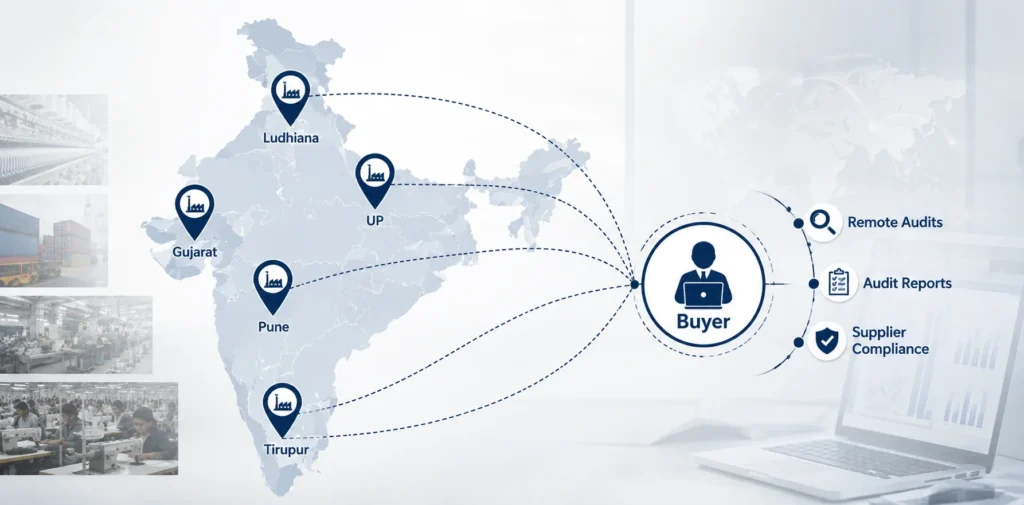
You have twelve suppliers across India. One in Tirupur, three in Gujarat, two in Pune, one in Ludhiana, and five in UP. You cannot fly to each location every quarter. And yet, your buyers expect verified supplier quality, your procurement policy requires vendor qualification, and your regulatory obligations demand documented compliance evidence.
This is the reality for most procurement teams and international buyers managing Indian supply chains. Physical visits are expensive, time-consuming, and simply not scalable when you are dealing with multiple suppliers across multiple states.
The answer is not to skip supplier audits. It is to do them properly using third-party supplier audit services in India from an accredited, independent inspection body whose inspectors are already located near your suppliers.
This guide explains exactly how to make that work.
Why You Cannot Skip Supplier Audits Even Remotely
Before explaining how, a brief word on why this matters.
Supplier quality problems in India do not announce themselves. A factory that looked capable during an initial visit may have changed production teams, substituted materials, or subcontracted work to an unapproved facility. A supplier who delivered well for two years may be struggling with capacity, compliance, or workforce issues that are invisible until a shipment fails.
The cost of discovering this at the wrong moment:
- A rejected shipment at a European port because subcontracted production did not meet the original quality standard
- A government tender disqualified because a supplier’s compliance certificate had lapsed
- A buyer relationship ended because goods were not as specified
Supplier audits conducted by independent third parties catch these issues before they cost you. And they do not require you to be physically present.
Step 1: Decide What Type of Supplier Audit You Need
Not all supplier audits serve the same purpose. Choosing the right type for your situation determines what information you get and how useful it is for your decisions.
Supplier Capability Audit (Pre-Order Qualification)
Use this before placing a first order with a new Indian supplier. The auditor visits the factory and assesses:
- Production capacity and equipment condition
- Quality management systems and procedures
- Technical capability for your specific product
- Workforce numbers, skills, experience levels
- Storage, material handling, and logistics readiness
This tells you: Can this supplier actually produce what they are promising?
Quality System Audit (Ongoing Supplier Monitoring)
Use this for existing suppliers annually or before major order renewals. The auditor checks whether the quality systems that were in place during qualification are still operating effectively. Particularly important if a supplier has grown rapidly, changed management, or taken on new product lines.
Social Compliance Audit (Ethical Supply Chain)
Use this when your buyers, sustainability policies, or market regulations require verified labor standards. The auditor assesses working conditions, wage compliance, working hours, child labor controls, worker welfare, and freedom of association against frameworks like SEDEX/SMETA or your own code of conduct.
Environmental Compliance Audit
Use this when your sustainability commitments or buyer requirements include environmental verification. Covers pollution control board compliance, effluent management, chemical storage, waste disposal, and carbon footprint documentation.
GMP / Regulatory Audit
Use this for food, pharmaceutical, or other regulated sectors where FSSAI, Drugs Act, or sector-specific compliance must be verified at the supplier level.
Step 2: Brief the Audit Company Not Your Supplier
This is where remote supplier audit management requires discipline.
When you commission a factory audit in India through a third-party audit company, you brief them not the supplier directly. You provide:
- The supplier’s name, address, and contact for scheduling access
- The audit type and scope you require
- Your quality standards, code of conduct, or specification documents
- Any previous audit reports for reference
- The specific areas of focus product lines, processes, compliance requirements
The audit company then contacts the factory to schedule access. They conduct the audit independently observing, documenting, interviewing, and photographing without your presence.
This independence is critical. An auditor briefed directly by the supplier, or one who conducts a “friendly visit,” does not give you objective findings. Choose a Type A accredited inspection body one with no commercial ties to your suppliers.
Step 3: Understand What the Auditor Will Do On-Site
You are not there. So understanding exactly what happens helps you interpret the report correctly.
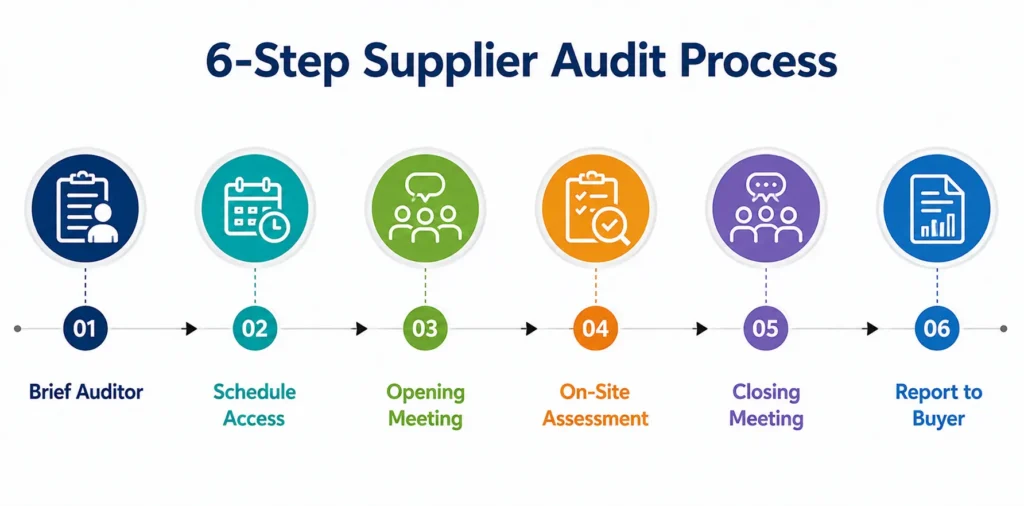
A professional supplier audit in India conducted by an accredited body follows a structured process:
Opening meeting auditor introduces scope, confirms agenda with factory management
Document review quality manuals, licenses, compliance certificates, training records, maintenance logs, previous audit corrective actions
Facility walkthrough production floor, storage areas, welfare facilities, safety systems, environmental controls
Worker interviews for social compliance audits, random and confidential interviews without management present
Process observation watching actual production, checking in-process controls, observing equipment operation
Closing meeting preliminary findings shared with factory management, opportunity to clarify factual points
Audit report delivered to you within 48–72 hours, with photographs, findings, non-conformity classifications, and recommended corrective actions
Everything the auditor observes is documented and photographed. You receive the complete picture without being there.
Step 4: Build a Supplier Audit Programme Not Just One-Off Checks
The real value of third-party supplier audit services in India comes from systematic, ongoing monitoring not single audits before placing a first order and then nothing for three years.
A practical supplier audit programme for Indian supply chains:
- New suppliers Full capability audit before first order. Pass/fail gate. No order placement without a satisfactory audit report.
- Existing suppliers (annual) Quality system audit every 12 months. Combined with a review of the previous year’s inspection reports and any quality issues raised.
- High-risk suppliers Suppliers with previous non-conformities, rapid growth, recent management changes, or products going to regulated markets audit every 6 months.
- Triggered audits Commission an immediate audit if a supplier fails a pre-shipment inspection, a buyer complaint is received, or you hear about a significant operational change at the factory.
- Social compliance audits Separate audit cycle, typically annual or aligned to your buyer’s requirements.
Maintaining audit records over time gives you a supplier performance history visible evidence of whether a supplier is improving, declining, or consistently compliant.
Step 5: Act on Audit Findings From Wherever You Are
An audit report is only useful if you act on it. Remote management of Indian suppliers requires a clear process for handling findings without defaulting to “I’ll visit and sort it out.”
For minor non-conformities:
- Request a corrective action plan from the supplier within 7–14 days
- Review the plan and confirm it is specific what will be fixed, how, by when
- Set a follow-up date for documentary evidence of completion
- Record the outcome in your supplier file
For major non-conformities:
- Do not place new orders until a corrective action plan is submitted and confirmed
- Commission a follow-up audit or inspection to verify corrections before resuming orders
- If the supplier cannot resolve major findings, begin sourcing alternatives
For critical findings safety violations, falsified records, significant non-compliance:
- Suspend new orders immediately
- Formally notify the supplier of suspension and required corrective actions
- Commission a re-audit before any order reinstatement
All of this can be managed remotely. The audit report, the corrective action correspondence, the re-audit commissioning none of it requires a physical visit when you have an accredited third-party audit company doing the on-site work.
TNV Inspection Division Supplier Audit Services Across India
TNV Inspection Division provides independent supplier audit and factory audit services across all major Indian manufacturing states from Lucknow headquarters with pan-India inspector coverage.
As India’s first UAF-accredited Type A inspection body under ISO/IEC 17020:2012, TNV conducts:
- Supplier capability audits before first order placement
- Quality system audits for ongoing supplier monitoring
- Social compliance audits against buyer codes of conduct
- Environmental compliance audits
- GMP audits for food and pharmaceutical suppliers
- Combined product inspection and supplier audit programmes
Why buyers choose TNV for remote supplier audit management:
- Type A independence no ties to any Indian manufacturer or supplier
- Pan-India coverage inspectors across all major manufacturing clusters
- Structured audit reports with photographs delivered within 48–72 hours
- UAF Accreditation No. 5241222IB04 valid December 2028
- Online certificate verification at certificate.tnvib.com
- Trusted by IRCTC, Adani Wilmar, Patanjali Ayurved, ICAR since 2011
Conclusion
Managing Indian suppliers without visiting every factory is not a compromise when you have the right system in place, it is more efficient and often more objective than relying on periodic personal visits.
The system is straightforward: choose the right audit type for each supplier situation, commission an accredited third-party audit company, receive detailed findings, and act on them through a structured corrective action process.
Done consistently, this gives you better supplier visibility than occasional factory trips and a documented supplier performance record that protects you when problems arise.
Ready to build a remote supplier audit programme for your Indian supply chain? Contact TNV Inspection Division.
📞 +91-9838070227 / +91-9838077603 ✉ tnvindia@gmail.com 🌐 tnvib.com 🔍 Verify accreditation: uafaccreditation.org 📄 Verify certificate: certificate.tnvib.com
Frequently Asked Questions (FAQ)
Can I manage Indian supplier audits without visiting the factory myself?
Yes and this is exactly what third-party supplier audit services in India are designed for. An accredited independent audit company visits your supplier's factory on your behalf, conducts a structured assessment, and delivers a detailed photographic report. You receive the same objective findings you would get from a personal visit without the travel cost and time. The independence of a third-party auditor often results in more honest findings than a buyer visit, where suppliers may present only their best performance.
How often should I audit my Indian suppliers?
For new suppliers, conduct a capability audit before placing the first order. For existing suppliers, an annual quality system audit is standard practice. High-risk suppliers those with previous non-conformities, products for regulated markets, or recent operational changes should be audited every six months. Social compliance audits typically run annually or as required by your buyers. Triggered audits should follow any significant quality failure or operational change at a supplier.
What is the difference between a supplier audit and a product inspection in India?
A supplier audit evaluates the factory its systems, capabilities, compliance, and working conditions to assess whether it can reliably produce to your requirements. A product inspection examines specific finished goods against specifications. Both serve different purposes: audits are used for supplier qualification and ongoing monitoring; product inspections verify specific shipments. Many procurement teams use both auditing suppliers periodically and inspecting shipments before dispatch.
What should I look for in a third-party supplier audit company in India?
The non-negotiables are: ISO/IEC 17020:2012 accreditation verified independently through the accreditation body's website, Type A classification (fully independent from manufacturers and suppliers), industry-specific experience in your product sector, real geographic coverage in your supplier locations, and structured photographic reports delivered within 48–72 hours. For UAF-accredited bodies like TNV, verify accreditation at uafaccreditation.org and certificates at certificate.tnvib.com.
How much does a supplier audit in India cost?
Vendor audit services in India typically range from ₹12,000 to ₹35,000 per man-day depending on audit type, supplier location, factory size, and scope. Standard capability audits take one day. Social compliance or GMP audits at larger facilities may take one to two days. The cost of a single audit is insignificant compared to the cost of a failed shipment, a compliance violation, or losing a buyer relationship due to undiscovered supplier issues. Contact TNV at tnvib.com for a specific quote based on your requirements.