
How Much Does Third Party Inspection Cost in India? (2026 Complete Guide)
The most common question Indian exporters and buyers ask before booking inspection is simple: how much does it cost?
It is also the question most inspection companies avoid answering directly.
This guide gives you the honest answer typical third party inspection costs in India in 2026, broken down by inspection type, the factors that affect what you pay, what a professional fee includes, and what warning signs suggest a provider is too cheap to be credible.
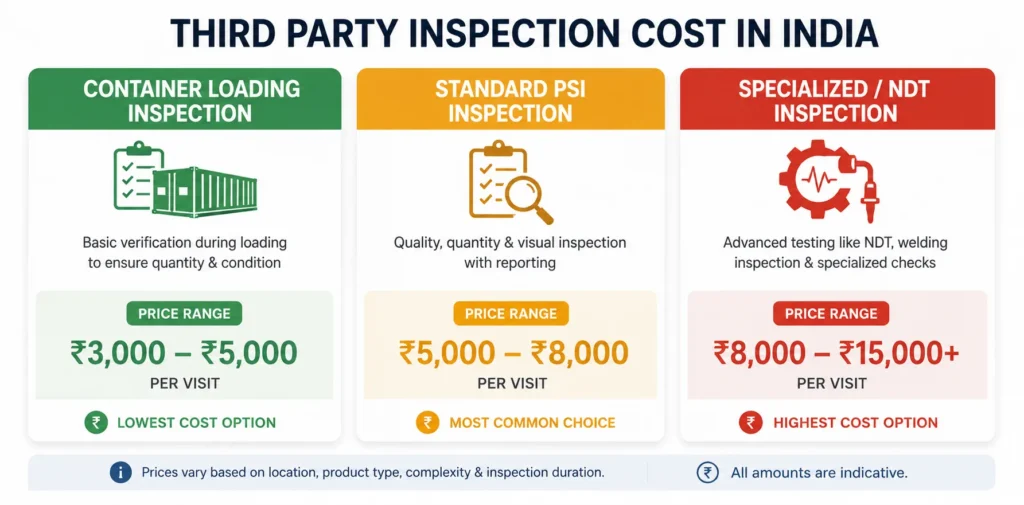
What Third Party Inspection Costs in India
Before breaking it down, here is the headline pricing for context:
Inspection Type | Typical Cost (India, 2026) |
Pre-Shipment / Final Inspection | ₹8,000 – ₹15,000 per man-day |
During Production Inspection | ₹8,000 – ₹15,000 per man-day |
Pre-Production Inspection | ₹8,000 – ₹12,000 per man-day |
Container Loading Supervision | ₹6,000 – ₹10,000 per man-day |
Factory / Supplier Audit | ₹12,000 – ₹30,000 per man-day |
Social Compliance Audit | ₹15,000 – ₹35,000 per man-day |
NDT Inspection (specialized) | ₹15,000 – ₹50,000+ per man-day |
GMP / Pharmaceutical Audit | ₹20,000 – ₹45,000 per man-day |
Most standard pre-shipment inspections take one man-day. Factory audits and specialized inspections may take one to two days.
These are the rates for professionally operated, accredited inspection bodies. Non-accredited providers may quote ₹2,000–₹5,000 per man-day a price that should be treated as a red flag, not a bargain.
What Factors Affect Third Party Inspection Cost in India?
No two inspections cost exactly the same. Here are the factors that move the price up or down:
1. Inspection Type and Complexity
A pre-shipment inspection of standard consumer goods counting cartons, AQL sampling, checking labels takes one day and costs at the lower end of the range. An NDT inspection of pressure vessels requiring specialized equipment and Level II certified technicians costs significantly more. The more technical the inspection, the higher the fee.
2. Factory Location
Inspection fees in India include the inspector’s travel time and logistics. A factory in Tirupur, Surat, or Pune near major inspection hubs costs less than a remote location in a less-served industrial zone. Some inspection companies charge travel expenses separately; others include them in a flat day rate. Always clarify what is included.
3. Order Quantity and Lot Size
Larger lots require larger AQL samples. An order of 500 units may take three hours to inspect. An order of 50,000 units of the same product may take a full day or more. Inspection companies typically quote per man-day so larger orders that require more days cost proportionally more.
4. Product Type and Technical Requirements
Standard garment inspection requires a trained inspector with measurement tools and AQL knowledge. Electronics inspection requires functional testing capability. Pressure equipment inspection requires certified NDT technicians. Products with higher technical requirements attract higher fees because the inspector qualifications and equipment required are more specialized.
5. Accreditation and Quality Tier
An ISO/IEC 17020:2012 accredited inspection body operating as a Type A organization maintains qualified staff, calibrated equipment, documented procedures, and ongoing accreditation surveillance all of which carry a cost that is reflected in their rates.
A company charging ₹2,000–₹3,000 per man-day is not maintaining these standards. Their low price is a direct signal of low capability and the risk of a certificate that gets rejected by your buyer or regulatory authority.
6. Urgency and Lead Time
Standard bookings made 3–5 days in advance are priced at base rates. Urgent inspections scheduled within 24 hours typically attract a premium of 20–30% on the base fee. If your supply chain leaves inspection to the last moment routinely, budget for this.
7. Report Requirements
Standard inspection reports photographic, AQL-based, delivered within 24 hours are included in base pricing. Special report formats, additional certification requirements, or bilingual reports (for export to markets requiring French, Arabic, or German documentation) may carry additional charges.
What Is Included in a Professional Inspection Fee?
- Inspector travel to your factory location
- On-site inspection time AQL sampling, visual examination, measurements, functional tests
- Photographic documentation timestamped, detailed
- Written inspection report defect classification, AQL data, findings
- Inspection certificate with unique number verifiable online
- Report delivery within 24–48 hours
- Follow-up availability for questions on findings
What is typically NOT included:
- Re-inspection fees if goods fail and corrections are made (a separate booking)
- Laboratory testing costs (if specialist lab tests are required alongside inspection)
- Expedite premium for less than 24-hour notice bookings
Always confirm scope inclusions when you receive a quote.
The Real Cost of Cheap Inspection
This is the calculation most buyers do not make.
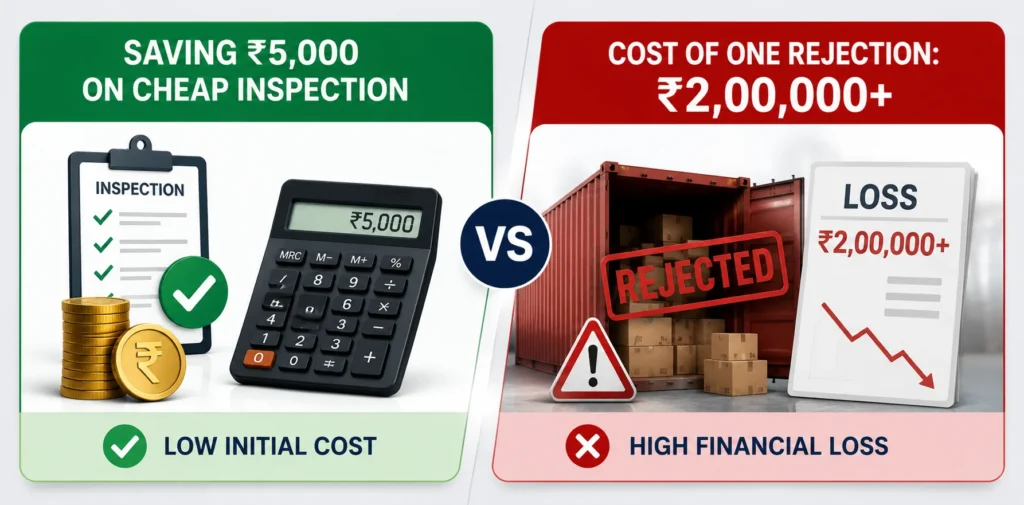
Suppose you save ₹5,000 by choosing a ₹3,000/day non-accredited provider instead of a ₹8,000/day accredited one.
Now suppose that certificate is rejected by:
- Your buyer’s bank LC payment withheld
- A government quality engineer supply rejected at depot
- A regulatory authority product held at port
The cost of one rejected shipment:
- Return freight (sea freight India–Europe, for example): ₹1,50,000–₹5,00,000+
- Port storage charges: ₹15,000–₹50,000+
- Re-inspection by an accredited body: ₹8,000–₹15,000
- Potential penalty for late delivery: contractual
- Buyer relationship damage: unquantifiable
The ₹5,000 you saved on inspection cost you several lakhs.
The right question is not “which inspection is cheapest?” It is “which inspection will be accepted and what does rejection cost me?”
How to Get Accurate Inspection Quotes in India
Getting a meaningful quote requires giving the inspection company the right information. When requesting a quote, provide:
For pre-shipment inspection:
- Product type and description
- Order quantity and number of SKUs
- Factory location (city and state)
- Preferred inspection date
- AQL level specified by your buyer (if provided)
- Any special testing requirements
For factory audits:
- Type of audit needed (capability, social compliance, GMP, etc.)
- Factory size (number of workers, production area)
- Factory location
- Specific standards or buyer code of conduct to audit against
Always request a written quote not a verbal estimate. The quote should specify what is included, the day rate, any travel costs, and the expected report delivery timeframe.
Get quotes from two or three accredited bodies. Compare scope and deliverables not just the day rate.
TNV Inspection Division Transparent Pricing, Accredited Service
TNV Inspection Division provides written quotes based on your specific inspection scope no hidden charges, no surprise additions.
Every inspection fee includes:
- Qualified inspector travel to your location
- Full on-site AQL inspection
- Timestamped photographic report
- Inspection certificate with online verification at certificate.tnvib.com
- Report delivery within 24 hours
Why the fee is justified:
- UAF Accreditation No. 5241222IB04 valid December 2028
- Type A independence reports accepted by buyers, banks, and regulators in 95+ countries
- ISO/IEC 17020:2012 compliant procedures
- Qualified inspectors with industry-specific experience
- Pan-India coverage with no subcontracting surprises
Contact TNV at tnvib.com or +91-9838070227 for a written quote based on your specific inspection requirement.
Conclusion
Third party inspection cost in India in 2026 ranges from ₹6,000 to ₹50,000+ per man-day depending on the inspection type, location, product complexity, and the quality tier of the provider.
For the most common need pre-shipment inspection of standard goods budget ₹8,000–₹15,000 per man-day with a professional, accredited inspection body. That is typically one day for a standard order.
The cost of getting this wrong choosing a cheap, non-accredited provider is not ₹5,000 saved. It is the cost of one rejected shipment, one refused LC payment, or one disqualified tender. Those consequences cost lakhs, not thousands.
Get a written quote from TNV Inspection Division transparent pricing, accredited service, results your buyers and banks will accept.
📞 +91-9838070227 / +91-9838077603 ✉ tnvindia@gmail.com 🌐 tnvib.com 🔍 Verify accreditation: uafaccreditation.org 📄 Verify certificate: certificate.tnvib.com
Frequently Asked Questions (FAQ)
What is the typical cost of pre-shipment inspection in India in 2026?
A standard pre-shipment inspection by an accredited third party inspection company in India costs between ₹8,000 and ₹15,000 per man-day in 2026. Most standard orders for consumer goods, garments, or engineering components take one man-day. The rate varies based on factory location, product complexity, and the accreditation status of the inspection body. Always request a written quote that specifies what is included.
Why are some inspection companies in India much cheaper than others?
Inspection companies charging ₹2,000–₹5,000 per man-day are typically non-accredited they do not hold ISO/IEC 17020:2012 accreditation and do not maintain qualified inspectors, calibrated equipment, or documented quality procedures. Their certificates are frequently rejected by international buyers, banks, and regulatory authorities. The apparent saving is quickly erased by the cost of a single rejected shipment or held LC payment.
What does a factory audit cost in India compared to a pre-shipment inspection?
Factory audits cost more than pre-shipment inspections because they take longer and require auditors with broader competency covering quality systems, compliance, safety, environmental practices, and sometimes worker welfare. Typical factory audit rates in India range from ₹12,000 to ₹30,000 per man-day, with most standard supplier capability audits taking one full day. Social compliance and GMP audits, which involve worker interviews and specialized regulatory knowledge, tend to be at the higher end of this range.
Are travel costs included in the inspection fee in India?
It depends on the inspection company. Some accredited inspection bodies include travel costs in their flat day rate particularly for factories in major manufacturing clusters. Others charge travel separately for remote locations. Always clarify when requesting a quote: ask whether the rate is all-inclusive or whether travel, accommodation, or logistics are billed separately.
How do I know if I am getting value from my inspection fee in India?
Value is not just about the day rate it is about what the fee delivers. A professional inspection fee should include: a qualified, industry-experienced inspector; full AQL sampling with documented methodology; timestamped photographic evidence; clear defect classification; a report delivered within 24 hours; and an inspection certificate verifiable online. If the provider cannot demonstrate ISO/IEC 17020 accreditation, cannot verify their certificate online, or charges less than ₹6,000 per day, the risk of an unusable certificate outweighs the cost saving.