
How to Use Third Party Inspection to Win Government Tenders in India
Quick Answer : Yes. Third party inspection can help suppliers meet quality and inspection requirements in Indian government tenders when independent inspection is specified in the tender conditions. Suppliers should use an appropriate accredited inspection body, complete the required inspection at the specified stage, and submit the correct inspection certificate with the supply.
You have found a government tender that matches exactly what your company offers. You even meet most of the eligibility criteria. However, as you go through the requirements, you come across a line stating that the goods have to be inspected by a third party inspection agency before dispatch, under the quality requirements/pre-dispatch conditions. If you do not have a plan on how to tackle this third-party inspection, you are already on a losing footing.
Every year, many businesses including MSMEs, manufacturers, and new tender openters lose out on government tenders not due to the inferior quality of their goods/services but due to the lack of experience and knowledge about third-party inspection requirements.
This is a comprehensive guide that will walk you through everything you need to know about third party inspections in india required by government tenders in India. From the list of agencies that government of India requires you to use for getting your goods inspected to the do’s and dont’s of using such agencies to help you win government tenders.
Why Government Tenders in India Require Third Party Inspection
What GFR 2017 Says About Inspection
The General Financial Rules 2017 (GFR 2017) issued by the Ministry of Finance is the overarching policy for all central government procurement in India. As per GFR 2017, the procuring departments must ensure that the goods procured conform to the specified quality standards through independent inspection and documentation.
While the GFR 2017 mandates such inspections, the specific requirements are usually stated in the tender documents. Most government tenders above a threshold value (for items like industrial goods, construction material, electrical equipment, engineering components etc.) have a mandatory requirement for inspection by an approved third party inspection agency prior to dispatch or shipment of the consignment.
The rationale for this requirement is simple – the government cannot rely on certifications done by the supplier itself in case of public funded procurements. A certificate of inspection from an independent and accredited inspection agency provides assured evidence (that can be checked/verified by the authorities) that what is being delivered is what has been ordered.
Which Government Bodies Mandate Third Party Inspection
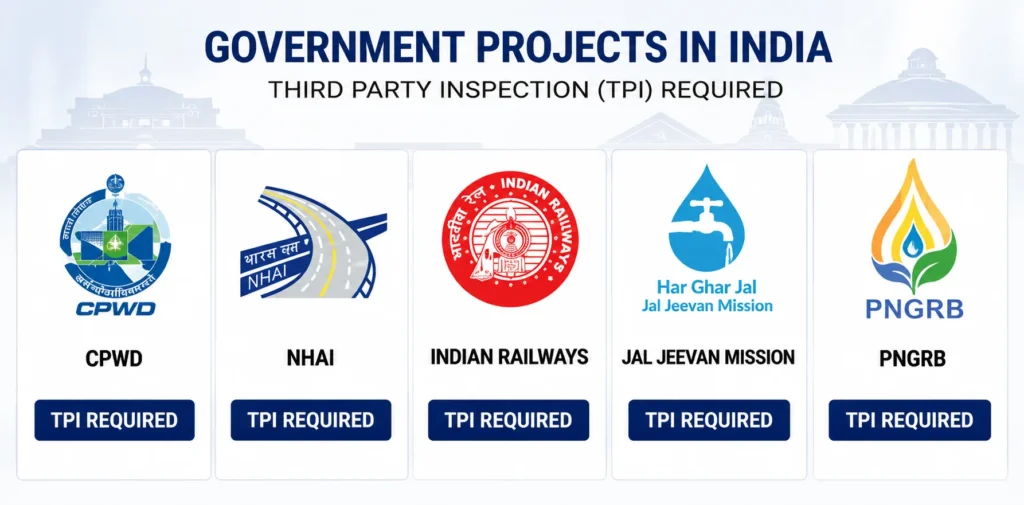
Third party inspection requirements are now mandatory in the procurement processes of various government agencies. Some of them are as listed below:
- CPWD (Central Public Works Department) : Third party inspection of construction material, electrical material and finishing material is mandated for CPWD, which executes projects for construction of government buildings and infrastructure.
- NHAI (National Highway Authority of India): Third party quality control inspection is mandated for approval of road construction material like steel, bitumen, aggregates and construction machinery. Inspection reports at various stages are required for NHAI projects.
- Jal Jeevan Mission : This is the Government of India’s flagship scheme for providing tap water to all in rural areas. The scheme’s procurement process mandates third party inspection of pipes, fittings, pumps and other equipment.
- RDSO (Research Designs and Standards Organisation): Indian Railways, which has vast network of railways in the country, mandates inspection of railway components at various stages and final inspection by approved third parties. RDSO approved manufacturers have to mandatorily submit inspection reports by third party agencies.
- PNGRB (Petroleum and Natural Gas Regulatory Board): This regulatory board mandates inspection of pipeline, pressure vessels and city gas distribution by approved third party inspection agencies.
- PSUs and Defence Procurement: Various public sector companies like BHEL, ONGC, SAIL, HAL, DRDO, Ordnance Factories etc. have mandatory third party inspection requirements as part of their procurement process.
- State Government Tenders: Most state government tenders for PWD works, medical equipment, smart city projects and municipal tenders now have third party inspection as mandatory requirement for dispatch of goods.
What Inspection Documents Government Tenders Ask For
Before being able to leverage third party inspection to win a government tender, it is important to understand precisely which documentation will be required.
Inspection certificate vs inspection report. What is the difference?
- Inspection certificate – Is a single page official document issued by an inspection body certifying that a particular batch of goods has passed inspection and conforms to the relevant requirements. This is the standard document that government tenders require to be submitted together with the inspected supply.
- Inspection report – Is a multi-page document detailing the inspection findings including photographs, measurements, AQL results, defect descriptions and more. This report is sometimes requested by government quality engineers when executing the contract.
Therefore, most tender documents require the winning bidder to provide the inspection certificate upon delivery of the goods while the inspection report should be kept on file as it may be requested at any time during the audit process.
Most importantly, note that the certificate must be issued by an inspection body that is
accredited according to ISO/IEC 17020:2012
recognized by an accreditation body (UAF, IAS, UKAS etc.)
and a type A inspection organization (independent from the suppliers)
Any certificate issued by a company that is not accredited by an official accreditation body or whose accreditation is unrecognized by the relevant authorities will not be accepted by government quality engineers.
Step-by-Step: How to Use Third Party Inspection to Win Government Tenders in India
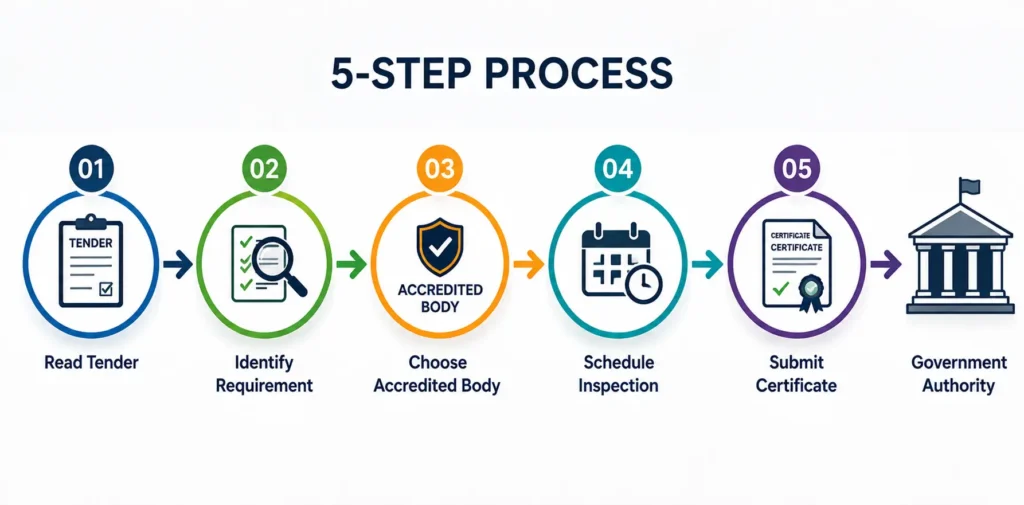
Step 1 Read the Tender Document Carefully
Before anything else, find the inspection clause. Look in:
- Section on “Quality Requirements”
- “Pre-Dispatch / Pre-Shipment Conditions”
- “Inspection and Testing” schedule
- General Conditions of Contract (GCC)
Note exactly what is asked: which inspection body is specified (some tenders name specific bodies or types), at what stage inspection must be done, what certificate format is required, and to whom the certificate must be submitted.
Some tenders specify “government inspection” meaning a government quality controller conducts the inspection. Most now specify “third party inspection by an accredited body.” Know which applies before booking.
Step 2 Identify the Exact Inspection Requirement
Tender inspection requirements fall into three categories:
- Pre-dispatch inspection goods are inspected at your factory or warehouse before they are dispatched to the government department. The inspection certificate accompanies the supply.
- Stage-wise inspection for works contracts and large infrastructure projects, inspection is required at multiple production or installation stages. Common in CPWD construction, NHAI projects, and RDSO supply chains.
- Factory acceptance test (FAT) for specialized equipment or machinery, the buying department or their inspector witnesses functional testing at your facility before dispatch clearance.
Identify which type applies to your specific tender then plan your inspection timeline accordingly.
Step 3 Choose an Accredited Inspection Body
This is the step most first-time tender bidders get wrong. They choose an inspection company based on price and discover at supply stage that the certificate is not accepted.
What government quality engineers check:
- Is the body accredited under ISO/IEC 17020:2012?
- Is the accreditation from a recognized body UAF, IAS, UKAS?
- Is the body’s accreditation scope relevant to the goods being inspected?
- Is the accreditation current not expired or suspended?
- Is the body Type A fully independent?
Verify independently at uafaccreditation.org before booking. Do not rely on the inspection company’s own certificate document.
Step 4 Schedule Inspection at the Right Stage
For pre-dispatch inspection of goods: Schedule when production is 100% complete and goods are packed and ready for dispatch. Do not schedule while goods are still being produced the inspector needs to examine finished, ready-to-ship goods.
For stage-wise inspection: Plan the inspection schedule into your project execution timeline. Late inspection causes project delays and penalties.
For goods with a tight delivery deadline: Book inspection at least 5–7 working days before your required dispatch date. This allows time for inspection, report delivery (24–48 hours), and any minor corrective actions if needed.
Step 5 Submit the Right Certificate With Your Supply
When dispatching goods to the government department:
- Attach the original or certified copy of the inspection certificate
- Ensure the certificate references the exact purchase order number and description
- Confirm the certificate is from an accredited body whose credentials are verifiable
- Keep the full inspection report filed for audit purposes
For projects requiring stage-wise inspection, submit each stage inspection certificate with the corresponding progress bill or milestone claim.
Government Sectors Where Third Party Inspection Is Most Commonly Required
Sector | Key Body | What Gets Inspected |
Construction | CPWD, State PWDs | Steel, cement, pipes, electrical, finishing |
Highways | NHAI | Bitumen, aggregates, steel, machinery |
Water Supply | Jal Jeevan Mission | Pipes, pumps, fittings, storage tanks |
Railways | RDSO | Wagons, components, track materials |
Oil & Gas | PNGRB | Pipelines, pressure vessels, CGD equipment |
Defence | DRDO, Ordnance | Components, assemblies, specialist equipment |
Power | BHEL, PGCIL | Transformers, cables, switchgear |
Medical Equipment | State Health Depts | Devices, consumables, equipment |
Common Mistakes That Disqualify Tender Bidders
- Mistake 1: Using a non-accredited inspection body The most common cause of certificate rejection. Always verify ISO/IEC 17020 accreditation independently before booking. A non-accredited certificate cannot be substituted after submission.
- Mistake 2: Wrong inspection scope The body is accredited but not for the specific goods in your tender. Accreditation scope must explicitly cover your product category. Verify the scope document, not just the main certificate.
- Mistake 3: Inspection done too late Pre-dispatch inspection must be completed before goods leave your factory. Inspection done after dispatch even if the goods are fine is not accepted as pre-dispatch inspection.
- Mistake 4: Certificate with wrong order reference The inspection certificate must reference your specific purchase order number and supply description. Generic certificates not tied to the specific supply are not accepted.
- Mistake 5: Submitting Type B or C body certificates Some government departments now specifically require Type A inspection bodies. Always check and default to Type A regardless, since it carries the highest credibility.
The MSME Advantage Why Small Businesses Should Use TPI Proactively
Most MSMEs assume third party inspection is only for large companies. This is wrong and missing this point costs small businesses government contracts.
Under GFR 2017, MSMEs are protected from EMD requirements and given price preference in many tenders. But quality compliance requirements apply equally. An MSME that submits a clean, accredited inspection certificate alongside their supply while competitors submit self-declarations demonstrates a level of quality seriousness that builds buyer trust and repeat orders.
For MSMEs supplying to government on GeM (Government e-Marketplace), third party inspection of supplies before dispatch is increasingly a differentiator. GeM’s rating system rewards suppliers whose deliveries match purchase orders something an inspection certificate helps demonstrate and document.
TNV Inspection Division Supporting Government Tender Suppliers Across India
TNV Inspection Division is India’s first UAF-accredited Type A inspection body under ISO/IEC 17020:2012 providing inspection services for government tender compliance since 2011.
Our government tender inspection services cover:
- Pre-dispatch inspection for CPWD, NHAI, Jal Jeevan Mission, RDSO, and PSU tenders
- Stage-wise inspection for infrastructure and works contracts
- Factory acceptance testing for specialized equipment
- Detailed inspection certificates accepted by government quality engineers
Why government suppliers choose TNV:
- UAF Accreditation No. 5241222IB04 valid December 2028
- Type A fully independent, no supplier ties
- Pan-India coverage across all manufacturing and supply locations
- Reports and certificates within 24–48 hours
- Online certificate verification at certificate.tnvib.com
- Trusted by IRCTC direct experience in government supply chain inspection
Verify our accreditation: uafaccreditation.org
Conclusion
Winning government tenders in India is not just about the lowest bid. Quality compliance documented through independent, accredited third party inspection is increasingly the factor that separates qualified suppliers from disqualified ones.
The process is straightforward when you understand it: read the tender’s inspection requirement, choose an ISO/IEC 17020 accredited Type A body, schedule inspection before dispatch, and submit the right certificate with your supply.
For MSMEs and small businesses entering government procurement for the first time, third party inspection is not an obstacle. It is the credential that proves you are serious and in a competitive tender, that matters.
TNV Inspection Division supports government tender suppliers across India with fast, accredited inspection services. Contact us today.
📞 +91-9838070227 / +91-9838077603 ✉ tnvindia@gmail.com 🌐 tnvib.com 🔍 Verify accreditation: uafaccreditation.org 📄 Verify certificate: certificate.tnvib.com
Frequently Asked Questions (FAQ)
Is third party inspection mandatory for all government tenders in India?
Not for all but for a large and growing number. Government tenders above specified values, particularly for industrial goods, construction materials, electrical equipment, engineering components, and infrastructure projects, routinely include mandatory TPI clauses. Under GFR 2017, quality verification is a procurement requirement, and independent inspection certificates are the standard method of demonstrating it. Always read the full tender document to identify whether TPI is required, at what stage, and what type of inspection body is specified.
What inspection certificate is accepted in government tenders in India?
Government tenders accept inspection certificates from bodies accredited under ISO/IEC 17020:2012 by recognized accreditation authorities UAF, IAS, UKAS, or other IAF member bodies. The certificate must reference the specific purchase order, describe the goods inspected, confirm the inspection findings, and be issued by a Type A body where independence is required. Certificates from non-accredited bodies regardless of how official they look are routinely rejected by government quality engineers.
Which inspection body is recognized for government tenders in India?
Any inspection body holding current ISO/IEC 17020:2012 accreditation from a recognized authority is eligible. TNV Inspection Division is India's first UAF-accredited Type A inspection body UAF No. 5241222IB04, valid December 2028 and has direct experience supporting suppliers in CPWD, NHAI, Jal Jeevan Mission, RDSO, and PSU supply chains. Verify any inspection body's accreditation independently at uafaccreditation.org before booking.
Can an MSME use third party inspection to qualify for government tenders?
Yes and it is a competitive advantage. MSMEs already benefit from EMD exemptions and price preference under GFR 2017 and the MSME procurement policy. Adding a clean third party inspection certificate to each supply demonstrates quality compliance that differentiates MSME suppliers from competitors, builds credibility with government buying departments, and supports better ratings on GeM. The cost of inspection is a fraction of the contract value.
What happens if I submit an inspection certificate from a non-accredited body in a government tender?
The certificate is likely to be rejected by the government's quality engineer or inspection authority. This can result in the supply being held at the depot or rejected entirely, delay in payment (since payment is often linked to inspection clearance), potential financial penalties for delayed or rejected supply, and removal from the approved vendor list for future tenders. Always verify accreditation before booking the five minutes spent at uafaccreditation.org protects you from these consequences.