
What is Third Party Inspection? A Complete Guide for Indian Businesses
India exported goods worth over $437 billion in 2023–24, making quality verification more critical than ever. Whether you manufacture garments in Tirupur, export engineering goods from Pune, or source products from Chinese suppliers for the Indian market, one question remains constant — how do you prove that what you are selling or buying actually meets the agreed quality standards?
This is exactly where third party inspection services in India becomes essential. It protects your money, your reputation, and your business relationships — before problems reach customers, ports, or regulatory authorities.
This guide explains everything Indian businesses need to know about third party inspection — what it is, how it works, which industries need it, and how to choose the right accredited inspection body in India.
What is Third Party Inspection?
Third party inspection is an independent quality verification service where a neutral organization with no connection to either the buyer or the seller examines products, materials, processes, or installations to confirm they meet defined standards, specifications, or regulatory requirements.
In simple terms: a qualified expert who has nothing to gain from the result checks your products and gives you an honest written report.
Who is the “Third Party”?
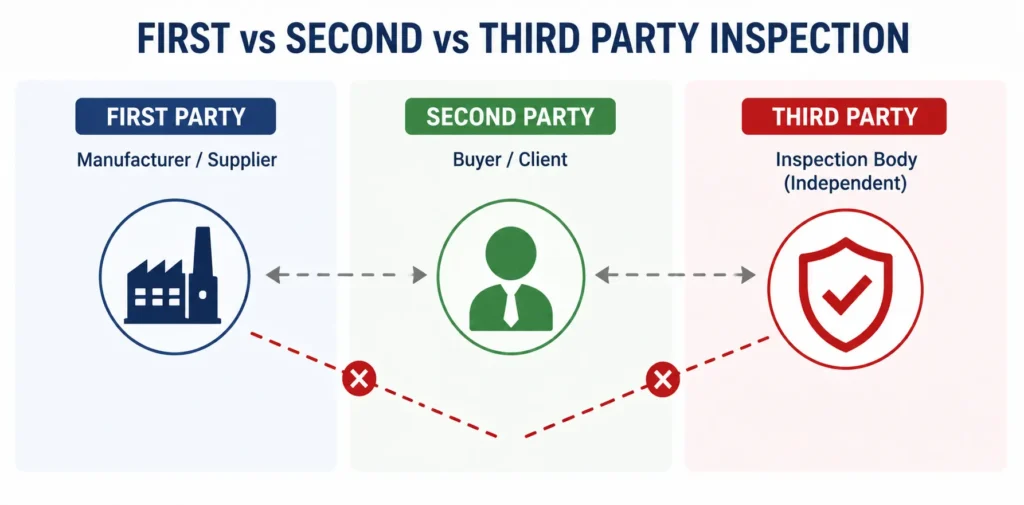
In any business transaction, there are always two main parties:
- First Party : The manufacturer or supplier who makes the product
- Second Party : The buyer or client who purchases the product
- Third Party : An independent inspection body with no commercial relationship to either side
The third party has only one job: inspect accurately and report honestly.
First Party vs Second Party vs Third Party — Quick Comparison
|
Type |
Who Conducts It |
Independence |
Credibility |
|
First Party |
Manufacturer checks own product |
None |
Low |
|
Second Party |
Buyer inspects supplier’s goods |
Partial |
Medium |
|
Third Party |
Independent inspection body |
Complete |
High |
What Makes It Truly “Independent”?
A genuine third party inspection company must be a Type A Inspection Body under ISO/IEC 17020:2012. This means they have no ownership, financial, or operational ties to any manufacturer, supplier, or buyer. Their reputation depends entirely on accurate, unbiased reporting which is why their reports are trusted by banks, customs authorities, and international buyers worldwide.
Why Do Indian Businesses Need Third Party Inspection?
Third party inspection in India serves three distinct groups of businesses each with specific needs and challenges.
For Indian Exporters
Indian exporters face constant pressure to prove product quality to international buyers who cannot visit factories personally. Third party inspection helps by:
- Satisfying Letter of Credit (LC) conditions that require an independent inspection certificate before payment is released
- Reducing shipment rejection risk at destination ports by catching quality issues before goods leave India
- Meeting buyer-mandated inspection requirements from major retailers in Europe, the USA, the Middle East, and Southeast Asia
- Providing documented evidence of quality that protects exporters in commercial disputes
Without a credible inspection certificate from an accredited body, many international buyers simply will not release payment or accept shipment.
For Indian Importers
When you source products from overseas suppliers whether from China, Bangladesh, Vietnam, or Turkey you are trusting someone you may never have met to deliver exactly what they promised. Third party inspection protects importers by:
- Verifying product quality, quantity, and packaging before goods leave the supplier’s factory
- Identifying problems while correction is still possible not after the container has sailed
- Providing photographic documentation of product condition that can support claims or negotiations if issues arise after arrival
For Indian Manufacturers
Domestic manufacturers increasingly need third party inspection to:
- Qualify for government tenders where third party quality verification is mandatory under GFR (General Financial Rules) guidelines
- Comply with infrastructure project requirements under CPWD, NHAI, Jal Jeevan Mission, and other government schemes
- Demonstrate product quality to large corporate buyers and retail chains who require independent verification
- Meet regulatory compliance requirements from authorities like FSSAI, PNGRB, RDSO, and BIS
Types of Third Party Inspection Services in India
Professional third party inspection services in India cover every stage of the supply chain from raw materials to final shipment.
- Pre-Production Inspection (PPI): Conducted before manufacturing begins. Verifies that raw materials, components, and production setup meet requirements. Prevents problems from being built into the product from day one. Best for critical orders where material quality is non-negotiable.
- During Production / In-Process Inspection (DPI/IPI): Performed when production is approximately 20–30% complete. Identifies quality deviations while there is still time and flexibility to make corrections. Significantly reduces the cost of rework compared to catching defects at the end.
- Pre-Shipment / Final Inspection (PSI/FI): The most commonly requested inspection type. Conducted when 80–100% of goods are finished and packed. Checks quantity, quality, workmanship, measurements, packaging, and labelling against buyer specifications. Provides clear pass or fail result before shipment.
- Container Loading Supervision (CLS): An inspector is present when goods are loaded into shipping containers. Verifies quantities being loaded, checks for visible damage, confirms proper loading procedures, and ensures container condition is acceptable. Critical for preventing quantity disputes and transit damage claims.
- Factory Audit / Vendor Assessment: A comprehensive evaluation of a manufacturing facility production capability, quality management systems, workforce, equipment, safety practices, and regulatory compliance. Used before placing large orders with new suppliers or when qualifying vendors for ongoing supply relationships.
- Specialized Inspections: Industry-specific technical inspections including Non-Destructive Testing (NDT) for pipelines and pressure vessels, fire safety audits, environmental compliance assessments, and in-service inspections for operational equipment. Commonly required in oil and gas, construction, power, and heavy engineering sectors.
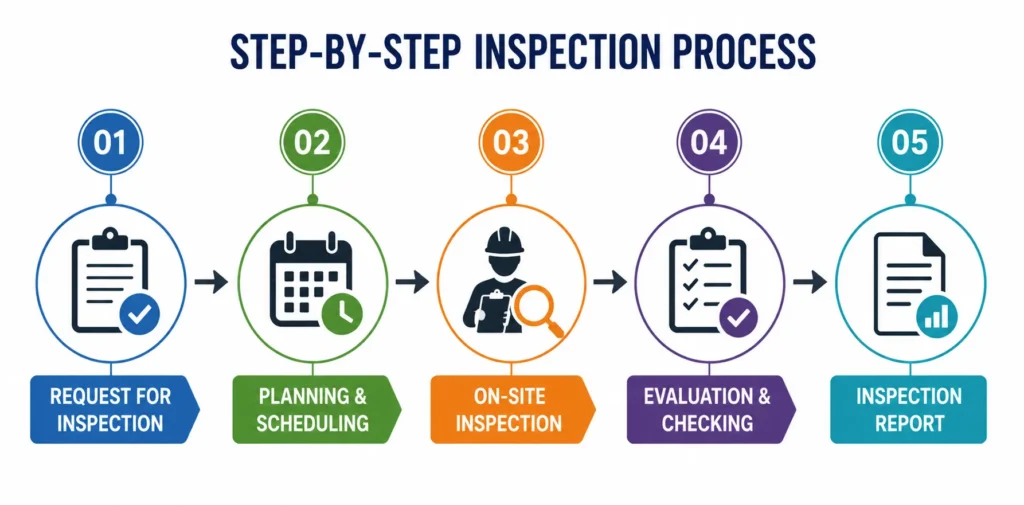
How Does Third Party Inspection Work in India? (Step-by-Step)
Understanding the inspection process helps businesses prepare effectively and get maximum value from their investment.
- Step 1 : Submit Inspection Request: Contact the inspection body with details about what needs inspecting, where the factory or warehouse is located, what specifications or standards apply, and when goods will be ready. The inspection body reviews requirements and provides a clear quote.
- Step 2 : Inspection Planning and Inspector Assignment: Once confirmed, a qualified inspector with relevant industry experience is assigned. The inspector reviews your specifications, approved samples, and quality standards before visiting ensuring the inspection is focused on what matters most to your business.
- Step 3 : On-Site Inspection Execution: The inspector visits the factory, warehouse, or project site on the scheduled date. They select random samples using AQL (Acceptable Quality Level) standards, conduct visual examinations, take measurements, perform functional tests, check packaging and labelling, and photograph all findings including both conforming and non-conforming items.
- Step 4 : Report Delivery (24–48 Hours): Within 24 to 48 hours of completing the inspection, you receive a detailed written report. The report includes a clear pass or fail result, photographs of products and any defects found, measurement data, defect classification (critical, major, minor), and specific recommendations. Every certificate issued is verifiable online at certificate.tnvib.com.
- Step 5 : Follow-Up and Corrective Action: If the inspection identifies significant issues, you decide whether to require supplier corrections, negotiate a price adjustment, or reject the shipment. For corrected goods, a re-inspection confirms that problems have been resolved before shipment proceeds.
Industries That Use Third Party Inspection in India
Third party inspection is not limited to any single sector. Across India, businesses in diverse industries rely on independent inspection to maintain quality, meet regulatory requirements, and build buyer confidence.
- Textiles and Garments : India’s largest export sector. Factories in Tirupur, Surat, Ludhiana, and Kolkata routinely require pre-shipment inspection to satisfy international buyer requirements before releasing payment for garment and fabric orders.
- Engineering and Metal Products : Manufacturing clusters in Pune, Rajkot, Faridabad, and Coimbatore produce castings, forgings, machined parts, and fabricated components that require dimensional inspection and material verification before dispatch.
- Food and Agriculture : Exporters seeking APEDA registration and compliance with FSSAI regulations require independent inspection of food products, packaging, and documentation to meet both domestic regulations and international food safety standards.
- Oil and Gas : PNGRB regulations mandate third party inspection for pipeline construction, CGD network expansion, and pressure equipment in India’s rapidly growing energy infrastructure.
- Construction and Infrastructure : Government projects under CPWD, NHAI, Jal Jeevan Mission, and Smart Cities Mission increasingly require independent quality verification of construction materials, structural work, and project execution.
- Pharmaceuticals : GMP (Good Manufacturing Practice) compliance, equipment qualification, and regulatory inspection support are essential for Indian pharma manufacturers exporting to regulated markets worldwide.
- Consumer Goods and Electronics : Importers and brands sourcing products for the Indian market use third party inspection to verify quality before accepting goods from Asian suppliers.
What is ISO/IEC 17020:2012 and Why It Matters for Indian Buyers
ISO/IEC 17020:2012 is the international standard that defines the requirements for the competence, impartiality, and consistent operation of inspection bodies. It is published by the International Organization for Standardization (ISO) and is recognized globally as the benchmark for professional inspection services.
When an inspection body is accredited against ISO/IEC 17020:2012, it means an independent accreditation authority has verified that the organization employs qualified inspectors, uses proper equipment and documented procedures, operates without conflicts of interest, and delivers consistent, reliable results.
What is a Type A Inspection Body?
ISO/IEC 17020 classifies inspection bodies into three types based on independence:
- Type A — Fully independent. No commercial ties to manufacturers, suppliers, or buyers. The most credible type for third party inspection.
- Type B — Part of a larger organization, with some independence within that structure.
- Type C — May be involved in design, manufacture, or supply of items they inspect. Least independent.
For genuine third party inspection, always choose a Type A accredited body.
Why UAF Accreditation is Important
UAF — the United Accreditation Foundation, USA — is an internationally recognized accreditation body that evaluates inspection bodies against ISO/IEC 17020:2012 standards. UAF is a signatory to the IAF Multilateral Recognition Arrangement (MLA), meaning inspection reports from UAF-accredited bodies are recognized by buyers, banks, customs authorities, and regulators in 95+ countries.
When you work with a UAF-accredited inspection body in India, you get reports that carry genuine international credibility — not just claims.
How to Verify an Inspection Body’s Accreditation in India
Before engaging any inspection company in India, verify their accreditation:
- Ask for their ISO/IEC 17020 accreditation certificate
- Check the certificate number, scope, and validity date
- Verify independently at uafaccreditation.org (for UAF-accredited bodies)
- Verify specific certificates issued at certificate.tnvib.com
Never rely solely on the company’s own claims. Independent verification takes two minutes and protects you completely.
Is Third Party Inspection Mandatory in India?
The short answer is: it depends on your sector and the nature of your business. In many cases, third party inspection in India is legally required. In others, buyers make it a commercial condition. In all cases, it represents best practice.
When It Is Legally Required in India
- Government Tenders (GFR Rules) : General Financial Rules require independent quality inspection for goods procured under government contracts above specified thresholds. CPWD, NHAI, Railways, and defence procurement all mandate third party inspection.
- FSSAI (Food Safety) : Food businesses exporting under APEDA registration and those seeking FSSAI compliance often require third party inspection of facilities, products, and processes.
- PNGRB (Petroleum and Natural Gas) : The Petroleum and Natural Gas Regulatory Board requires third party inspection for pipeline projects, CGD infrastructure, and pressure equipment installations under its regulatory framework.
- RDSO (Railways) : Suppliers to Indian Railways must meet Research Designs and Standards Organisation requirements, which include mandatory vendor inspection for railway wagons, components, and track materials.
- Jal Jeevan Mission : The Government of India’s flagship rural water supply programme mandates third party quality monitoring for construction and materials used in water infrastructure projects.
When Buyers Make It Mandatory
International buyers particularly large retail chains, European importers, and Middle East buyers routinely include third party inspection as a condition of their purchase orders and Letters of Credit. Without a valid inspection certificate from an accredited body, payment release is withheld.
How to Choose the Right Third Party Inspection Company in India
With many inspection companies operating in India, selecting the right one requires careful evaluation. Use this checklist:
- ISO/IEC 17020:2012 Accreditation : Non-negotiable. Verify it independently.
- Recognized Accreditation Body : UAF, IAS, UKAS, or other IAF member. Not self-declared or unknown bodies.
- Type A Classification : Confirms complete independence from suppliers and buyers.
- Industry-Specific Experience : Does the company have proven expertise in your product category?
- Pan-India Coverage : Can they serve your factory locations across all states?
- Fast Report Delivery : 24 to 48 hours is the professional standard. Slower is unacceptable for trade timelines.
- Online Certificate Verification : The ability to verify issued certificates online demonstrates transparency and accountability.
- Clear Pricing : No hidden charges. Get a written quote before confirming.
- Responsive Communication : Fast responses to inquiries indicate professional service standards.
Why TNV Inspection Division is India's Trusted Choice
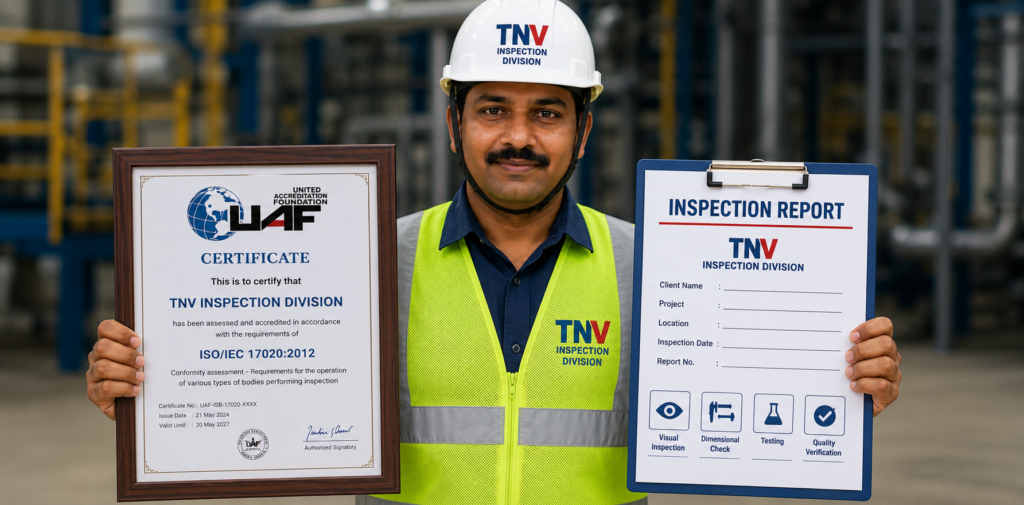
TNV Inspection Division is India’s first UAF-accredited Type A inspection body operating under ISO/IEC 17020:2012 — the international standard for inspection body competence. Headquartered in Lucknow, Uttar Pradesh, TNV has been delivering trusted third party inspection services across India and 95+ countries since 2011.
What makes TNV different:
- UAF Accreditation : Certificate No. 5241222IB04, valid until December 2028. Verifiable at uafaccreditation.org
- Type A Independence : No commercial ties to any manufacturer, supplier, or buyer
- 105+ Qualified Inspectors : Industry-specific expertise across all major sectors
- Pan-India Coverage : Serving all manufacturing hubs across India
- Trusted Clients : Adani Wilmar, Patanjali Ayurved, IRCTC, ICAR and more
- 24–48 Hour Reports : Detailed reports with photographic evidence delivered fast
- Online Verification : Every certificate verifiable at certificate.tnvib.com
Final Thought
Third party inspection in India has moved from being an optional quality measure to an essential business requirement. Whether you are an exporter satisfying international buyer requirements, a manufacturer qualifying for government tenders, or an importer protecting your investment, independent inspection from an accredited body provides the objective verification that modern business demands.
The key is choosing the right partner one with verified accreditation, proven industry expertise, and a commitment to accurate, impartial reporting. That combination is what protects your business, builds buyer confidence, and ensures that quality is not just promised but proven.
Ready to protect your quality? Contact TNV Inspection Division today.
📞 +91-9838070227 / +91-9838077603
✉ tnvindia@gmail.com
🌐 tnvib.com
🔍 Verify our accreditation: uafaccreditation.org
📄 Verify your certificate: certificate.tnvib.com
Frequently Asked Questions (FAQs)
What is third party inspection in simple words?
Third party inspection is when an independent company not the seller and not the buyer checks products or services to confirm they meet the required quality, safety, or regulatory standards. The inspector has no interest in the outcome, so their report is trusted by all parties.
Is third party inspection mandatory in India?
Yes, in several sectors. Government tenders under GFR rules, PNGRB pipeline projects, RDSO-approved railway suppliers, FSSAI food export requirements, and Jal Jeevan Mission projects all mandate third party inspection. For export trade, international buyers frequently make it a contractual condition.
How much does third party inspection cost in India?
Inspection costs in India typically range from ₹8,000 to ₹20,000 per man-day depending on product complexity, location, and inspection scope. This is a small fraction of the cost of one rejected shipment or failed government tender. Contact TNV at tnvib.com for a specific quote.
What is the difference between inspection and certification in India?
Inspection verifies a specific product, batch, or process at a point in time and issues an inspection report. Certification evaluates an organization's management system over time and issues a certificate (like ISO 9001). TNV is an inspection body we verify specific goods and processes, not management systems.
Which is the best third party inspection company in India?
TNV Inspection Division is India's first UAF-accredited Type A inspection body under ISO/IEC 17020:2012. With 12+ years of experience, 105+ inspectors, and presence in 95+ countries, TNV is among the most trusted inspection companies in India. Verify our accreditation at uafaccreditation.org.
How long does a third party inspection take in India?
A standard pre-shipment inspection for a typical order takes one working day at the factory. Larger orders, complex products, or specialized technical inspections may require two or more days. The inspection report is delivered within 24 to 48 hours after the on-site inspection is complete.
What documents are needed for third party inspection in India?
Typically required documents include the purchase order or contract, product specifications or technical drawings, approved sample details, packing list, and any applicable regulatory or buyer quality standards. The inspection body will advise on specific requirements based on your product and inspection scope.
What is UAF accreditation and why does it matter?
Far far away, behind the word mountains, far from the countries Vokalia and Consonantia, there live the blind texts. Separated they live in Bookmarksgrove right at the coast