
Third Party Inspection Services in India: Process, Benefits & Cost Factors
Third party inspection services in India help buyers, manufacturers, exporters, and procurement teams independently verify product quality, specifications, and compliance before delivery or acceptance.
Whether you need a pre-shipment inspection, supplier inspection, or quality verification for an industrial project, choosing the right inspection company can help reduce quality risks and support buyer requirements.
What Are Third Party Inspection Services And Why Does Independence Matter?
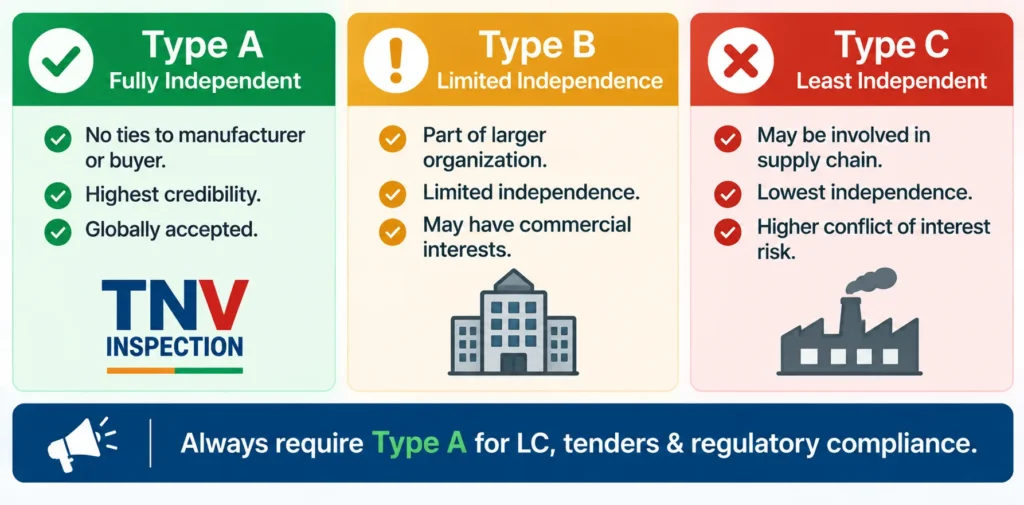
Third-party inspection is an independent quality verification service conducted by an organisation that has no commercial relationship with either the manufacturer or the buyer.
In every transaction, there are two commercial parties:
- First party the manufacturer or supplier who produces the goods
- Second party the buyer or client who purchases them
- Third party an independent inspection body with no stake in the outcome
The third party’s only job is to examine what is there and report it honestly. No production pressure. No buyer relationship to protect. Just a qualified inspector, a defined standard, and an accurate report.
This independence is what makes third-party inspection certificates credible to banks, buyers, regulatory authorities, and government agencies none of whom will accept a manufacturer’s self-certification for the same purpose.
The Type Classification Under ISO/IEC 17020:2012
International standard ISO/IEC 17020:2012 governs inspection bodies and classifies them by independence:
- Type A Fully independent. No ties to manufacturers, suppliers, or buyers. Reports accepted for LC payment, government tenders, and regulatory compliance. This is what TNV Inspection Division is.
- Type B Part of a larger organization that also manufactures or supplies. Limited independence.
- Type C May be involved in the supply chain of similar products. Lowest independence.
For any situation where an inspection certificate must be accepted by a third party bank, buyer, government, or regulator Type A is what you need.
Need Independent Third Party Inspection Services?
Get professional inspection support for your products, suppliers, factories, or projects in India.
Who Actually Needs Third-Party Inspection in India?
Third-party inspection is not just for large exporters. Here are the five situations where it is either required or clearly the right business decision:
- Scenario 1 Indian Exporter with LC Conditions Your buyer requires a pre-shipment inspection certificate from an accredited body before releasing payment under the Letter of Credit. Without it, the bank holds your money. This is the most common reason Indian exporters book inspection and the most direct financial motivation.
- Scenario 2 Importer Sourcing from Indian Suppliers You are sourcing products from Indian manufacturers you have not visited. You want to verify quality, quantity, and compliance before accepting the shipment. Booking a pre-shipment inspection at the supplier’s factory conducted by an independent Type A body gives you objective evidence before goods leave India.
- Scenario 3 Manufacturer Bidding for Government Tenders Government procurement under GFR 2017, CPWD contracts, NHAI projects, Jal Jeevan Mission, and Indian Railways (RDSO) routinely specify third-party inspection as a pre-dispatch condition. Without an accredited inspection certificate, your supply is non-compliant even if the goods are perfect.
- Scenario 4 Project Owner or Contractor in Regulated Sectors PNGRB mandates third-party inspection for oil and gas pipelines, city gas distribution networks, and LPG infrastructure. FSSAI requires third-party audits for certain food business operators. RERA creates accountability for construction quality that independent inspection supports.
- Scenario 5 MSME Entering International Supply Chains An MSME exporting for the first time, supplying to a new retail buyer, or qualifying for a corporate vendor list faces inspection requirements they may not have encountered before. Third-party inspection is the quality credential that opens these doors at a cost (₹8,000–₹15,000 per inspection) that represents 0.5%–2% of most MSME order values.
In-House Inspection vs Third-Party Inspection The Honest Comparison
Many manufacturers conduct their own quality checks. That is good practice. But it does not replace third-party inspection for most formal purposes.
Parameter | In-House Inspection | Third-Party Inspection |
Independence | First-party same organisation | Type A fully independent |
Accepted for LC payment | ❌ Banks do not accept | ✅ Banks require accredited TPI |
Accepted for government tender | ❌ Not accepted | ✅ Accepted when accredited |
Credibility with international buyers | Low conflict of interest | High no commercial interest |
Production pressure on inspector | High internal targets | None no stake in outcome |
Regulatory compliance evidence | Not accepted | Accepted by PNGRB, FSSAI, RDSO |
The conclusion is not that in-house inspection is useless it is the first line of quality control and essential for daily operations. Third-party inspection is the independent layer on top that external parties buyers, banks, governments will actually trust.
Both serve different purposes. Use both.
How Third Party Inspection Services Work in India Step by Step
Step 1: Send Your Enquiry
Contact the inspection company with your requirement:
- Product type and description
- Factory name and full address (city and state)
- Order quantity and number of SKUs
- Preferred inspection date
- AQL level specified by your buyer (if provided)
- Any special requirements or compliance standards
The inspection company responds within 24 hours with scope confirmation and a written cost estimate.
Step 2: Inspection Planning
An inspector with relevant industry experience is assigned. They review your purchase order, approved samples, technical specifications, and AQL levels before the inspection date. You receive confirmation of the inspector’s name and the agreed scope.
Step 3: On-Site Inspection
The inspector visits your factory or warehouse on the agreed date and conducts the inspection against the agreed scope. For pre-shipment inspection the most requested service this includes:
- Random AQL sampling from packed, finished goods
- Visual quality and workmanship assessment
- Measurement verification against specifications
- Functional testing where applicable
- Packaging and labelling compliance check
- Quantity verification against packing list
- Timestamped photographic documentation throughout
Step 4: Report Delivery Within 24 Hours
You receive a structured inspection report within 24 hours covering:
- Overall pass or fail result
- Findings for each inspection parameter
- Defect classification critical, major, minor
- Photographic evidence timestamped
- Measurement data and test results
- Quantity verification outcome
- Recommendations
Every certificate carries a unique reference number that can be independently verified online.
Step 5: Act on the Results
Pass: Share the certificate with your buyer or bank. Proceed with shipment or contract milestone.
Issues identified: The report shows exactly what failed, with photographs. Address corrections with the supplier. Arrange re-inspection if needed before shipment.
Types of Third Party Inspection Services Available in India
Different stages of the supply chain require different types of inspection:
- Pre-Production Inspection (PPI): Checks raw materials, components, and factory setup before manufacturing begins. Prevents problems being built into finished goods.
- During Production Inspection (DPI): Conducted when 20–30% of production is complete. Catches deviations early when corrections are cheapest.
- Pre-Shipment Inspection (PSI): The most commonly requested. Conducted when 80–100% of goods are finished and packed. Confirms the actual shipment meets specifications before it leaves the factory.
- Container Loading Supervision (CLS): Inspector present during loading verifies quantities, checks packaging condition, confirms correct goods are loaded.
- Factory / Supplier Audit: Evaluates the manufacturing facility capability, quality systems, compliance, worker welfare. Used before placing first orders with new suppliers.
- Industrial and NDT Inspection: Specialized on-site inspection for pipelines, structures, pressure vessels, and industrial equipment. Includes non-destructive testing (ultrasonic, radiographic, magnetic particle, dye penetrant).
- Stage-wise Inspection: For long-duration projects infrastructure, construction, energy inspection at defined milestones throughout the project lifecycle.
What Third Party Inspection Services Deliver for Indian Businesses
Benefit 1: LC Payment Released on Time
The most direct financial benefit. Banks releasing LC payment require an inspection certificate from an ISO/IEC 17020 accredited body. Without it or with one from a non-accredited body payment is held. Third party inspection services in India are, for most exporters, the direct enabler of on-time payment.
- Benefit 2: Shipment Rejections Prevented A rejected shipment at a European or American port involves return freight (₹1.5–3 lakhs), port storage, rework costs, and potential loss of the buyer relationship. Pre-shipment inspection in India costs ₹8,000–₹15,000. One prevented rejection pays for 50–100 inspections. The math is straightforward.
- Benefit 3: Government Tender Qualification Under GFR 2017, CPWD contracts, NHAI projects, Jal Jeevan Mission, and RDSO railway procurement third party inspection is specified as a mandatory pre-dispatch condition. An accredited inspection certificate is what makes your supply compliant, regardless of actual product quality.
- Benefit 4: Objective Supplier Evaluation Independent quality assurance services give you a factual view of what a supplier can actually deliver without visiting the factory yourself. Factory audit reports from a Type A body are accepted as credible evidence of supplier capability by buyers and procurement teams internationally.
- Benefit 5: Regulatory Compliance Evidence PNGRB-regulated oil and gas infrastructure, FSSAI food business compliance, and RERA construction accountability all require independent inspection documentation. Third party inspection services produce the reports that regulatory submissions require self-certification does not serve this purpose.
- Benefit 6: Dispute Protection When quality disagreements arise between buyers and suppliers, inspection reports from an accredited body provide objective, timestamped, photographic evidence that both parties can trust. Disputes resolved faster. Claims supported. Relationships protected.
What a Good Inspection Report Contains Key Insights
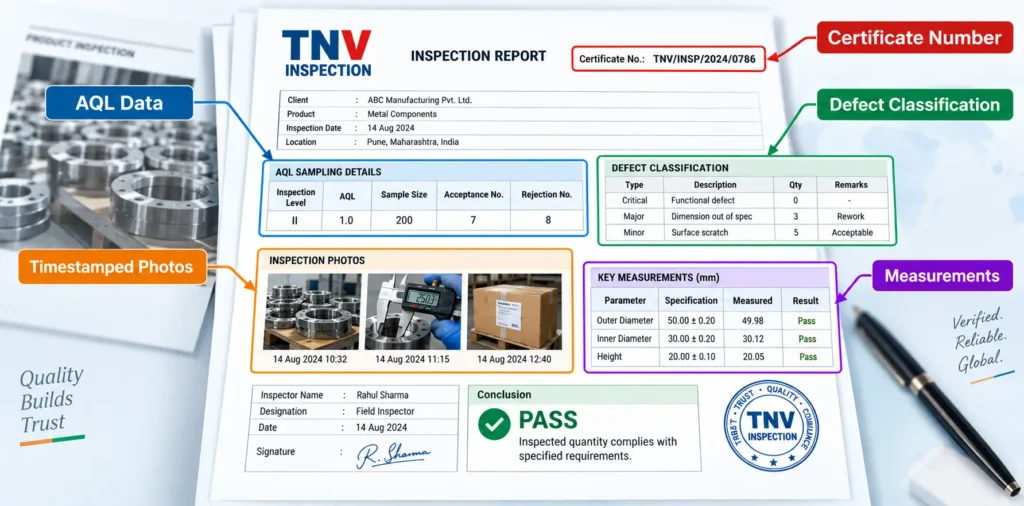
A professional inspection report from an accredited body contains:
- AQL Data with Context: Not just “pass” but defects found versus the accept/reject threshold. A pass at 19/21 defects is very different from 2/21. The first signals a supplier at the edge of acceptable quality.
- Defect Classification: Critical (safety/regulatory failure), major (customer rejection risk), minor (cosmetic). The split matters five minor defects is a different situation from one major defect.
- Timestamped Photographs: Of products, defects, packaging, measurements covering both conforming and non-conforming items.
- Measurement Data: Actual figures recorded against specification tolerances not just “meets spec” without supporting numbers.
- Packaging and Labelling Findings: Carton strength, barcode scan results, label accuracy, regulatory compliance marks where many shipments fail despite passing product inspection.
- Quantity Verification: Actual carton count and pieces per carton versus the packing list.
- Inspector Observations: Professional notes that do not trigger a fail but indicate risk valuable intelligence for your next order.
Red flags in a poor inspection report:
- No photographs, or only photographs of perfect goods
- No AQL data just a pass/fail stamp
- No defect descriptions or classifications
- No certificate reference number for independent verification
Common Mistakes Indian Businesses Make with Third Party Inspection
- Mistake 1: Choosing a non-accredited provider to save money A ₹3,000/day inspection certificate that gets rejected by your buyer or bank costs you the entire shipment value not just the ₹7,000 you saved versus an accredited provider. Always verify ISO/IEC 17020 accreditation independently before booking.
- Mistake 2: Booking inspection too late Pre-shipment inspection must happen before goods are loaded. Scheduling with less than 48 hours notice often incurs urgency premiums (20–30% above base rate) and risks unavailable inspectors. Build inspection into your production timeline not as an afterthought.
- Mistake 3: Not briefing the inspector properly Vague instructions produce vague results. Provide purchase order, approved samples, technical specifications, and AQL level before inspection day. The more specific your brief, the more useful the report.
- Mistake 4: Ignoring minor findings in passing reports Minor defects that do not trigger a fail today are early warnings of supplier quality trends. Accumulating minor defects across shipments signal an underlying process problem that will eventually produce a major failure.
- Mistake 5: Using the same inspection frequency for all suppliers regardless of risk New suppliers and suppliers with previous non-conformities need 100% inspection. Proven suppliers with clean track records can move to sampling inspection. Applying the same approach to all suppliers wastes budget where risk is low and under-inspects where risk is high.
What Determines Third Party Inspection Charges in India?
Third party inspection charges in India are not fixed. Five factors determine what you pay:
Cost Factor 1: Type of Inspection
Inspection Type | Cost Per Day (Accredited) |
Pre-Shipment Inspection | ₹8,000 – ₹15,000 |
During Production Inspection | ₹8,000 – ₹15,000 |
Container Loading Supervision | ₹6,000 – ₹10,000 |
Factory / Supplier Audit | ₹12,000 – ₹30,000 |
Industrial / NDT Inspection | ₹15,000 – ₹50,000+ |
Cost Factor 2: Factory Location
Major manufacturing clusters Tirupur, Surat, Pune, Lucknow, Delhi NCR, Ludhiana, Rajkot have resident inspectors. Minimal travel cost, usually included in the base rate. Remote or semi-urban locations may attract travel supplements of ₹3,000–₹10,000. Always ask: “Is travel included in your quote for this location?”
Cost Factor 3: Order Size and Man-Days Required
Larger orders require larger AQL samples which takes more time. Standard orders (500–10,000 units, standard products) typically take one man-day. Orders requiring two or more days cost proportionally more.
Cost Factor 4: Product Complexity
Consumer goods and garments: lower end. Precision engineering, electronics, pharmaceutical, or NDT-requiring products: higher end. Specialist equipment or certification requirements push costs further.
Cost Factor 5: Accreditation Tier
Non-accredited providers: ₹2,000–₹5,000/day. Certificates frequently rejected. ISO/IEC 17020:2012 accredited Type A providers: ₹8,000–₹15,000/day (PSI). Certificates accepted in 95+ countries.
The question is not which inspection is cheapest. It is which certificate will actually be accepted.
The cost of not inspecting: One rejected shipment costs ₹5,00,000–₹15,00,000 in return freight, rework, and held LC payment. One prevented rejection pays for 50–100 standard inspections.
Read More: https://tnvib.com/third-party-inspection-cost-india
Ready to Get a Written Quote?
Contact TNV Inspection Division with your factory location, product type, and inspection date. We respond within 24 hours — no obligation, no vague estimates.
How to Choose the Right Third Party Inspection Company in India
Five things to verify before you book:
- ISO/IEC 17020:2012 Accreditation Verify independently at the accreditation body’s official website not from the company’s own certificate. For UAF-accredited bodies, check uafaccreditation.org.
- Type A Classification Confirmed on the accreditation certificate. Essential for LC payment, government tenders, and regulatory compliance acceptance.
- Industry-Specific Experience An inspector who knows your product category catches what a generalist misses. Ask for references in your specific sector.
- Real Geographic Coverage Confirmed local inspector presence near your factory not claimed national coverage that relies on distant inspectors or subcontractors.
- Online Certificate Verification Every certificate should carry a unique number verifiable online. This protects you from fraudulent or altered documentation and gives your buyer instant confidence.
Arrange Third-Party Inspection With TNV
TNV Inspection Division is India’s first UAF-accredited Type A inspection body under ISO/IEC 17020:2012 providing third-party inspection services across India and 95+ countries since 2011.
What we provide: Pre-shipment inspection | Factory audits | Industrial & NDT inspection | Container loading supervision | Stage-wise project inspection | Vendor assessment
Why clients choose TNV:
- UAF Accreditation No. 5241222IB04 valid December 2028
- Type A zero commercial ties to any supplier or buyer
- 36+ industry sectors under one accreditation
- Pan-India inspector coverage
- Reports delivered within 24 hours
- Certificates verifiable at certificate.tnvib.com
- Trusted by IRCTC, Adani Wilmar, Patanjali Ayurved, ICAR since 2011
Conclusion
Third-party inspection is not a formality or a cost to minimize. It is the quality checkpoint that protects your payment, your buyer relationship, and your reputation at a cost that represents less than 1% of the order value it is protecting.
Understanding how it works, who needs it, what the report contains, and how to choose the right provider removes every barrier to making it a standard part of how you do business.
The next step is straightforward: tell us what you need inspected, where, and when. We will respond with a clear scope and written quote within 24 hours.
Contact TNV Inspection Division Today
Get your first inspection arranged with our inspection team.
Request an InspectionFrequently Asked Questions (FAQ)
What is the difference between first-party, second-party, and third-party inspection?
First-party inspection is conducted by the manufacturer on their own products no independence. Second-party inspection is conducted by the buyer or their representative partial independence, but the buyer has commercial interests. Third-party inspection is conducted by an independent organisation with no stake in the outcome complete independence. Only third-party inspection from an accredited Type A body is accepted for LC payment release, government tender compliance, and regulatory submissions in India and internationally.
Is third-party inspection mandatory in India?
It depends on your sector and contract terms. For oil and gas (PNGRB), food exports (FSSAI), railway supply (RDSO), and government procurement under GFR 2017, it is legally or contractually required. For international export trade, buyers routinely specify it as an LC or purchase order condition making it commercially mandatory. For all other businesses, it is strongly advisable because the cost of one quality failure far exceeds the cost of regular inspection.
How do I verify that an inspection company in India is genuinely accredited?
Ask for their ISO/IEC 17020:2012 accreditation certificate note the certificate number and accreditation body name. Then visit the accreditation body's official website and search their directory independently. For UAF-accredited bodies like TNV, verify at uafaccreditation.org. For specific inspection certificates issued by TNV, verify at certificate.tnvib.com. Never rely solely on the certificate the inspection company provides.
What happens if my goods fail a third-party inspection?
A failed inspection is not the end it is information arriving at the right time. You receive a detailed report showing exactly what failed, with photographs and defect classifications. You then work with your supplier to fix the identified issues. Once corrections are made, arrange a re-inspection to confirm resolution before shipment proceeds. Addressing defects at the factory is always cheaper, faster, and less damaging than dealing with rejections after goods have shipped.
How far in advance should I book third-party inspection in India?
For standard pre-shipment inspections in major manufacturing cities, 3–5 business days is sufficient. For remote locations or specialized industrial inspections, allow 5–10 days. Same-day or next-day bookings are possible in most major cities but typically attract an urgency premium of 20–30%. Build inspection into your production timeline from the start not as a last-minute addition to avoid urgency costs and inspector unavailability.